


Information
Stage twelve of the central Portuguese Way, from Caldas de Reis to Padrón, is a short and very pleasant day of just 18.6 kilometres, in which inland Galicia sends us off with cool forests, small hamlets and the constant sound of water. We leave Caldas de Reis following the valley of the river Bermaña, an easy start that lets the body settle into rhythm as the landscape begins to change.
During the first kilometres we cross a pleasant stretch of trails between oak, chestnut and eucalyptus trees, with a few gentle climbs that pose no real difficulty. The Way runs through rural parishes such as San Miguel de Valga, Pontecesures and Infesta, where hórreos, stone crosses and small pazos still speak of the agrarian tradition of southern Galicia. Crossing Pontecesures and going down to the bridge over the river Ulla is one of the most symbolic moments of the day: here we leave the province of Pontevedra behind and enter A Coruña, with Santiago now clearly on the horizon.
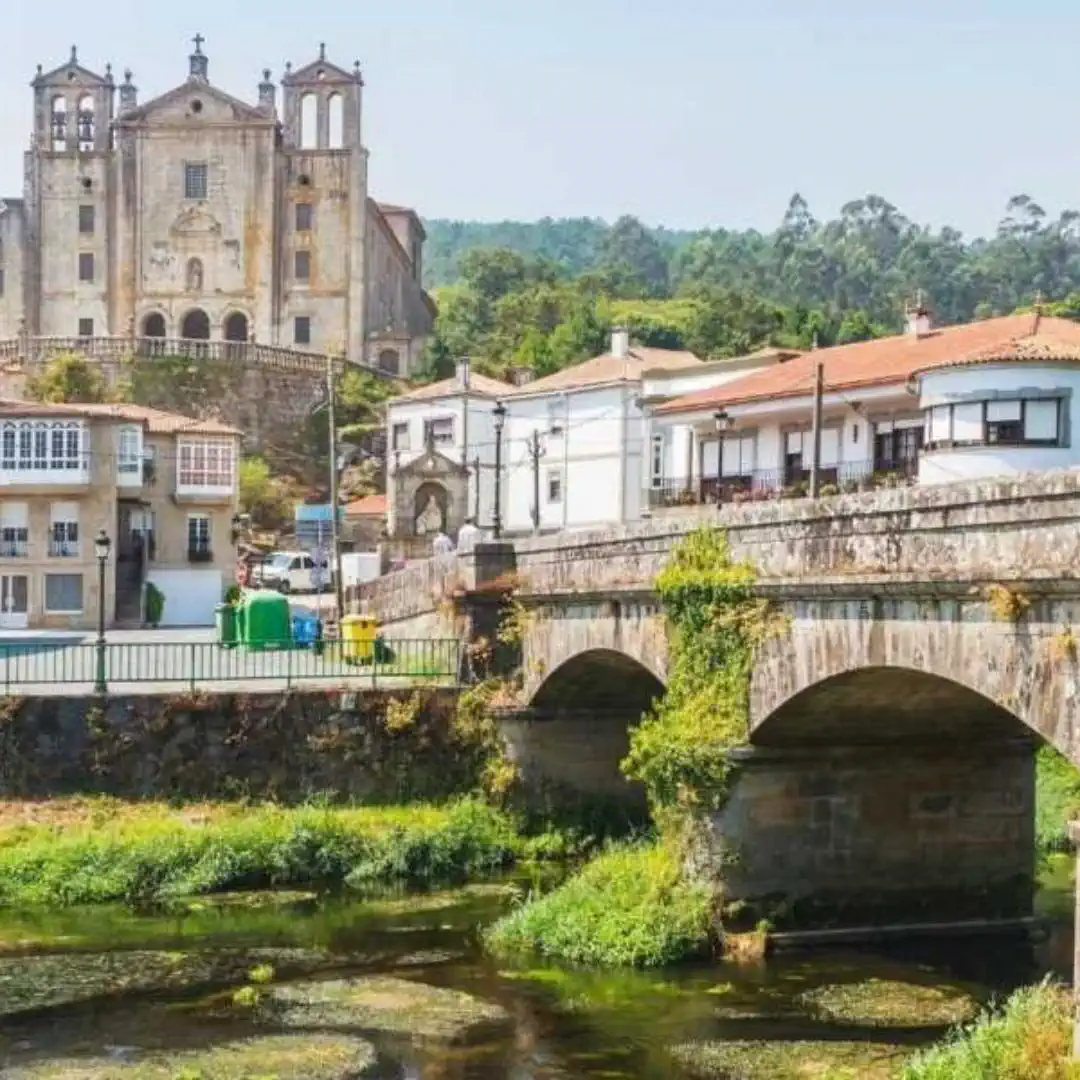
Arriving in Padrón brings the stage to a close. This is a village with a historical and literary weight that few Galician towns can match. Rosalía de Castro lived and wrote here, and her House-Museum at La Matanza, a short walk from the centre, is a must-visit for anyone who wants to understand modern Galician poetry. A few streets away, in the parish church of Santiago, lies the famous Pedrón: the stone which, according to pilgrim tradition, was used to moor the boat that brought the remains of the Apostle Santiago from Jerusalem. Touching it, or simply standing in front of it, is a gesture that carries centuries.
Before wrapping up the day, it is worth stopping by the Convento del Carmen and walking along the river Sar at sunset, when the golden light falls over Plaza Macías. For dinner, the famous Padrón peppers ("some are hot, some are not") are the perfect sidekick to a plate of octopus. A short stage in distance, then, but rich in content: easy kilometres to rest the legs and plenty of time to soak up Galicia's most literary corner before the final leg to the cathedral of Santiago.
We leave Caldas de Reis along the valley of the river Bermaña, surrounded by cool woodland and the small Galician hamlets that set the unhurried rhythm of the morning. After a few gentle climbs through eucalyptus, oak and chestnut trees, the Way takes us to Pontecesures, where the river Ulla marks the border with the province of A Coruña. Crossing the historic bridge, the stage ends in Padrón, one of the most literary and pilgrim-rich towns in Galicia. Here in Padrón, the memory of Rosalía de Castro — whose House-Museum is a must-stop for anyone who feels poetry — lives alongside the famous legend of the Pedrón: the stone kept beneath the main altar of the parish church of Santiago, where tradition says the boat carrying the body of the Apostle was moored. A short stage in distance but packed with history, ideal to walk slowly and to save some time at the end to enjoy the famous Padrón peppers.Photos
Hostels
-

Pilgrims' Hospital San Antonio de Herbón
Address Convento de Herbón, s/n 15915 Herbón
Website Not available
Email hospitalidad@amigosdelcamino.com
Website Not available
-

Pilgrims' hostel of Pontecesures
Address Estrada das Escolas – Rúa Pousa Antelo Infesta 36640 Pontecesures
Website (+34) 699 832 730
Email Not available
Website Not available
-

Pilgrims' hostel in Padrón
Address Costanilla do Carmen, s/n 15900 Padrón
Website +34 673 656 173
Email Not available
Website Not available
-

Pilgrims' Hospice of O Pino (Valga)
Address Lugar de O Pino, s/n 36646 O Pino (Valga)
Website +34 638 943 271
Email Not available
Website https://www.valga.gal/es/turismo/camino-de-santiago/albergue-de-peregrinos
Villages
-

Padrón
Region Padrón
Province A Coruña
Population 8
-

Caldas de Reis
Region Caldas de Reis
Province Pontevedra
Population 9
