


Canfranc - An architectural monument next to a medieval town
14 November, 2026
Canfranc, in the Huesca Pyrenees, is the first stop on the Aragonese Way after crossing Somport. We tell you what to see, from the International Station to the medieval old town, what to eat, where to sleep and how to get there.

Canfranc is the first stop on Spanish soil on the Aragonese Way, the route that enters the Iberian Peninsula through the Somport pass. Whether you arrive as a pilgrim or you are coming to spend a few days in the Pyrenees, a place full of history awaits you here, with a train station that looks like a palace and a beautiful valley for walking.
We have gathered what you need to know to make the most of your visit: what to see, what to eat, where to sleep and how to get there.
What to see and do in Canfranc?
Canfranc is a municipality in the province of Huesca, in Aragon, made up of two settlements: Canfranc Pueblo, at about 1,040 metres above sea level, and Canfranc Estación, a few kilometres further up at about 1,190 metres, next to the great international station. Its name is usually linked to the Latin Campus Franci, which could be translated as "the field of the Franks".
Because of its location, at the foot of the Somport pass and on the border with France, Canfranc was for centuries a place of passage. From the Middle Ages it had a customs post, where tolls were charged to merchants and travellers, and it became a key point in the trade between Aragon and French Bearn. Pilgrims crossing the Pyrenees on their way to Santiago also came down this way.
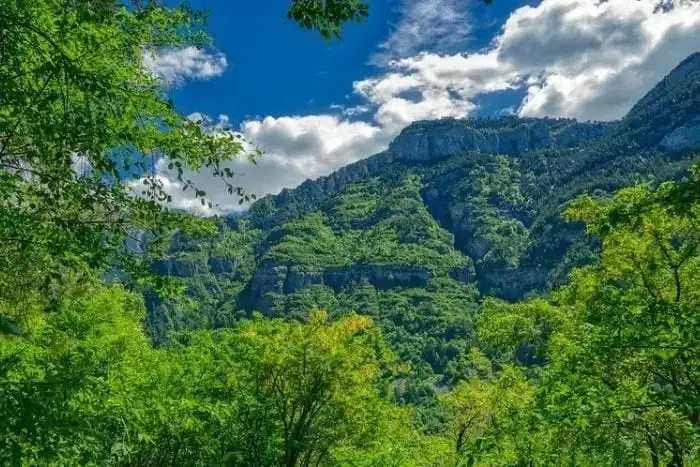
The forests of the Aragón valley, the landscape that accompanies pilgrims on their descent from Somport.
The Canfranc International Station
This is the great jewel of the valley. The Canfranc International Station opened in 1928 to link Spain and France by train across the Pyrenees. It is an enormous building, somewhere between Art Nouveau and Art Deco, with a long façade full of windows and a slate roof topped by a central dome.
After decades of neglect, the building was restored and since 2023 it has housed a luxury hotel, which keeps the façade and a good part of the original structure. You can see the inside on guided tours that tell its story of trains, smuggling and spies. We recommend checking opening times and bookings at the Canfranc tourist office before you go.
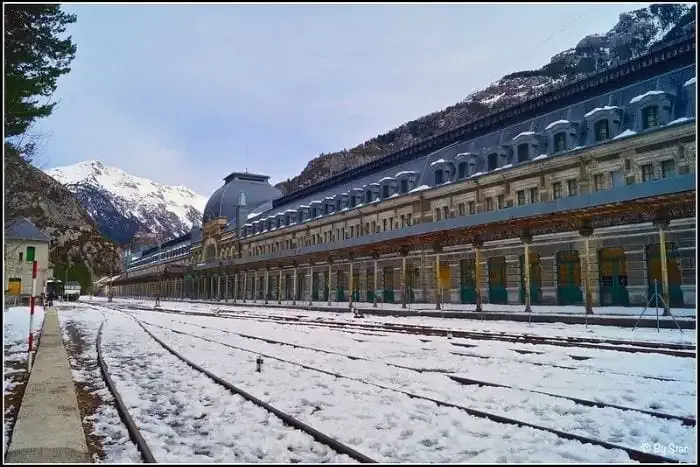
The Canfranc International Station, opened in 1928, in the depths of winter.
Canfranc Pueblo, the medieval heart
Canfranc Pueblo was born in the Middle Ages on the edge of the Camino de Santiago, and its main street still follows the line of the old road. The fires of the seventeenth and twentieth centuries destroyed a good part of its old buildings, but it still has some very charming corners.
Among the things you can see are the church of the Assumption, with its Baroque altarpieces; the medieval tower of Aznar Palacín; and, on the way out towards Jaca, the ruins of the Trinity church, part of a complex founded in the sixteenth century by the merchant Blasco de Les to look after the poor and pilgrims. Over the Aragón river you cross the Pilgrims' Bridge, which marks the end of the old town.
Fortifications and walks around the valley
The valley is dotted with old defences that recall its role as a border area, such as the Torreta de Fusileros, between the two settlements of Canfranc, or the Coll de Ladrones fort, above Canfranc Estación. The surroundings are also perfect for hiking in summer and for skiing and snowshoeing in winter, with the Astún and Candanchú resorts very close by.
On the way to Somport lie the remains of the Hospital of Santa Cristina, which welcomed pilgrims who had just crossed the pass. In the twelfth century, Aymeric Picaud mentioned it as one of the three great hospitals of Christendom, along with those of Jerusalem and the Great St Bernard.
Where to eat?
The cooking of the valley is mountain food, simple and hearty, with influences from both sides of the border. It is well worth trying the migas (fried breadcrumbs with chorizo and bacon), the ternasco de Aragón (roast young lamb), game stews, the cheeses of the Pyrenees and, in autumn, the mushrooms that fill the valley's forests.
You will find bars and restaurants in both Canfranc Estación and Canfranc Pueblo, as well as the restaurant of the station hotel, which is also open to the public. If you go in high season or at the weekend, it is best to book.
Where to sleep?
Canfranc has accommodation for every taste: hostels designed for pilgrims and mountaineers, guesthouses and mountain hotels in Canfranc Estación and, for a special occasion, the hotel in the international station itself. If you are walking the Aragonese Way, Canfranc is a good place to spend your first night after coming down from Somport.
How to get to Canfranc?
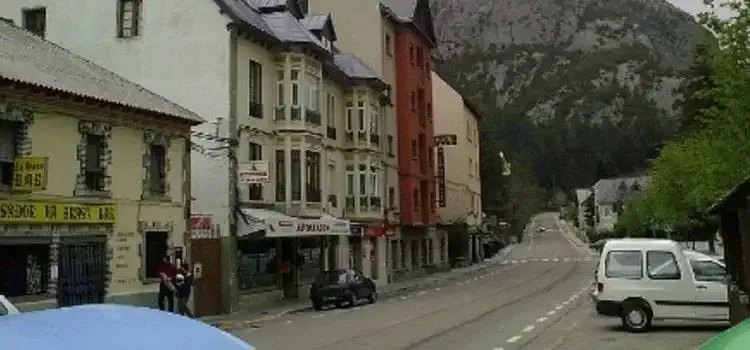
The main street of Canfranc Estación, surrounded by mountains.
From the Spanish side you can arrive by regional train on the line that climbs from Zaragoza, Huesca and Jaca, or by road from Jaca, passing through Castiello de Jaca and Villanúa. From France, the train currently only goes as far as Bedous, and from there a bus continues to Canfranc: the full reopening of the line on the French side is still pending.
If you arrive on foot as a pilgrim, the Camino descends from the Somport pass through Candanchú and follows the Aragón river valley, passing the Coll de Ladrones fort, to Canfranc Estación. It then continues towards Canfranc Pueblo and Jaca.
And if you then feel like walking the Camino all the way to Santiago, take a look at the Camino de Santiago routes we suggest. When you have made up your mind, you can calculate the price of your Camino here in a moment.
Comments (1)
CaminoSantiago
Leave a comment