


The Compostela: the Pilgrim's Certificate, and everything you need to know
18 June, 2026
The Compostela is the certificate that certifies the completion of the Camino de Santiago. It is obtained by meeting distance requirements and stamping the pilgrim passport. Originating in the medieval period, it symbolizes the pilgrimage, although the true value lies in the experience lived.

Every pilgrim who completes the Camino de Santiago receives a reward upon arriving at the Apostle's tomb, which is none other than the journey they have undertaken and everything it entails: effort and sacrifice, tears and joys, new friendships, and unique memories that will forever remain in their hearts. In addition to this, they also receive the Compostela, tangible proof that the pilgrim has completed the Camino de Santiago and experienced all the enriching aspects of this pilgrim adventure. But what exactly is the Compostela? What is its origin? How is it obtained? What types of Compostelas exist? And most importantly, what does the Compostela tell us? You will find answers to all of these questions in this post.
What is the Compostela?
To begin with, let's use the correct term: it's called the Compostela, not "compostelana", that refers to a woman from Santiago de Compostela. Many pilgrims, especially newcomers, mistakenly use this term to refer to the Compostela. Be aware: this error can bring you bad luck, like causing more blisters or making it rain on your journey (joke mode activated!). Now that we've clarified this, the Compostela is the document that certifies that the pilgrim has completed the Camino de Santiago and is obtained at the Pilgrim's Office in Santiago.
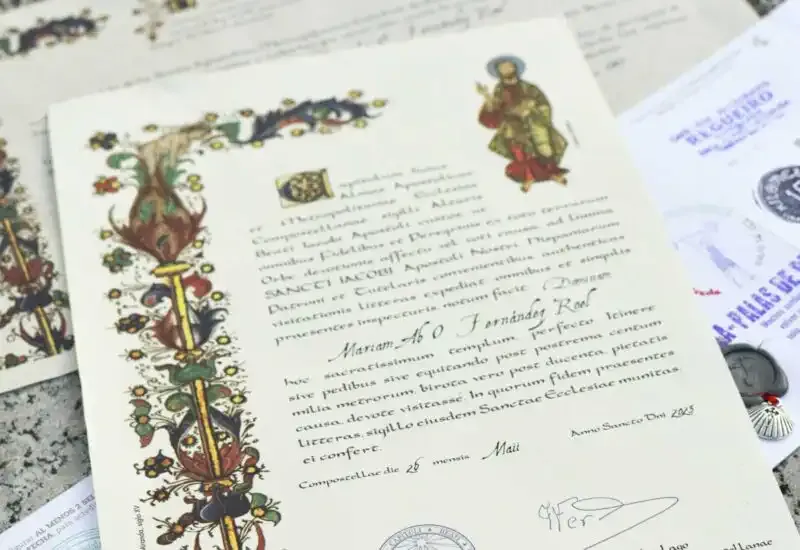
A Compostela, the pilgrim’s certificate
As you can see in the example image, the Compostela is an A4-sized parchment that acknowledges your pilgrimage. Of course, it will display your name and the date on which you obtained this cherished treasure.
Origin of the Compostela
If we travel back in time, the original Compostela would be the scallop shell (vieira), the primary symbol of the Camino de Santiago. In the Middle Ages, when the pilgrimage to Santiago de Compostela emerged in the 9th century, the Camino de Santiago was a round-trip journey. Pilgrims undertook this journey not for adventure or tourism but as penance for committing a serious crime or sin, or simply out of devotion to the Apostle. To prove that they had reached the tomb of Saint James and completed this penance, they returned to their homes (provided they didn't die during the journey) with tangible evidence of their pilgrimage, the pilgrim's shell.
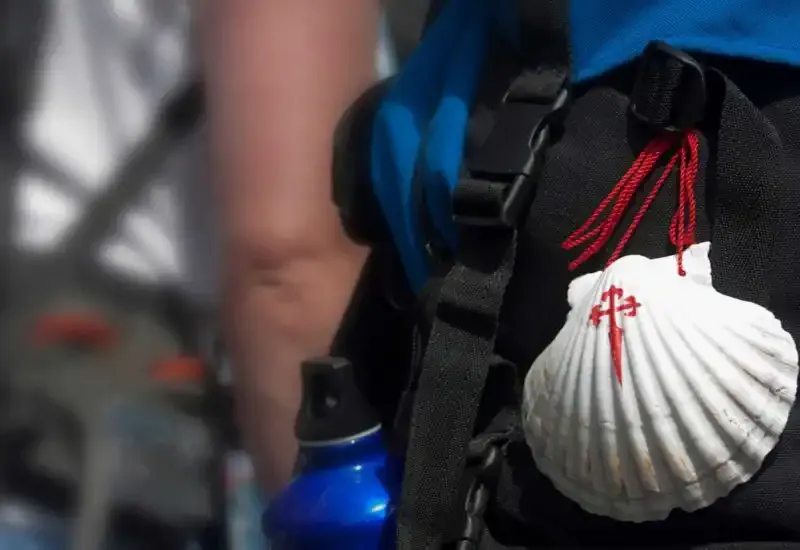
Ancient pilgrims identified themselves with the scallop shell
However, soon enough, opportunism emerged, and some enterprising Galicians with an eye for business began selling these shells to pilgrims and facilitating the falsification of pilgrimages. The Church in Compostela and even the Pope at the time, aware of this situation, started issuing, from the 13th century onwards, letters of proof, the direct precursor and origin of the current Compostela, which were difficult to counterfeit. From the 16th century, the Camino fell somewhat into obscurity, and it wouldn't be until the mid-20th century that it experienced a resurgence, along with the tradition of awarding Compostelas. It was from the Holy Year of 1993 onwards when the Camino saw a revival, and the Compostela began to be granted on a massive scale.
How to obtain the Compostela?
To obtain the Compostela, which is now provided free of charge at the Pilgrim's Office in Santiago de Compostela, the pilgrim must first acquire their credential. It's important to emphasize not to confuse the credential with the Compostela.
What is the Pilgrim's Credential?
The Pilgrim's Credential can be obtained at churches, tourist offices, pilgrim's offices, hostels, and other places. It serves as the pilgrim's passport, a thin cardboard booklet where they need to write their personal information, the starting point of the official Jacobean route they are going to follow, and the mode of travel (on foot, by bicycle, on horseback, by sail, in a wheelchair, etc.). They must also stamp it at least twice per stage, meaning at the beginning and end of each stage. Stamping can be done at any institution or location along the Camino, including churches, monasteries, hostels, tourist offices, town halls, hotels, bars, restaurants, and more. Two stamps are sufficient, although some pilgrims go stamp-crazy and collect them from every place they pass through.
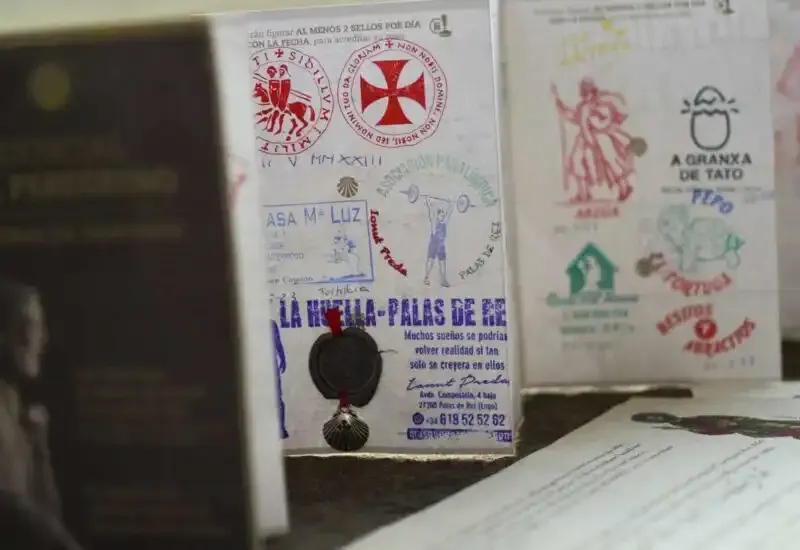
Pilgrim Credential
Requirements to Obtain the Compostela
Once the credential is obtained, you are ready to walk the Camino and receive the Compostela. What requirements must you meet? Keep in mind that the criteria vary depending on the mode of pilgrimage:
- On foot or on horseback, you must walk at least 100 continuous kilometers on one of the official routes, with the final stage being at least the one immediately before reaching the Cathedral of Santiago. If your pilgrimage starts outside Spain, you must complete at least 70 km within Spanish territory.
- By bicycle, you must cover 200 km, following the same conditions as for walking.
- By sailboat, you need to sail 100 nautical miles and then complete the Camino on foot from the port of disembarkation, collecting the necessary stamps in your credential.
Since 2025, a new rule has been introduced for obtaining the Compostela. Previously, it was mandatory to complete the last 100 km (or more) continuously until reaching Santiago de Compostela. Now, this is no longer the case. You can walk a 100 km section of an official route far from Galicia and Santiago de Compostela, but you must also complete the final stage immediately before Santiago, following your chosen route. In other words, the 100 km do not have to end in Santiago continuously, but you must still walk the final stage leading to the Apostle’s city. For example, you could walk from Lisbon to Golegã on the Portuguese Way (about 120 km) and then travel to Padrón to reach Santiago. Or, you could walk the Northern Way section between Bilbao and Santander (about 115 km), then travel to O Pedrouzo to complete the last stage. This applies across the different Jacobean routes. In these and similar cases, it is still necessary to stamp the credential twice per stage.
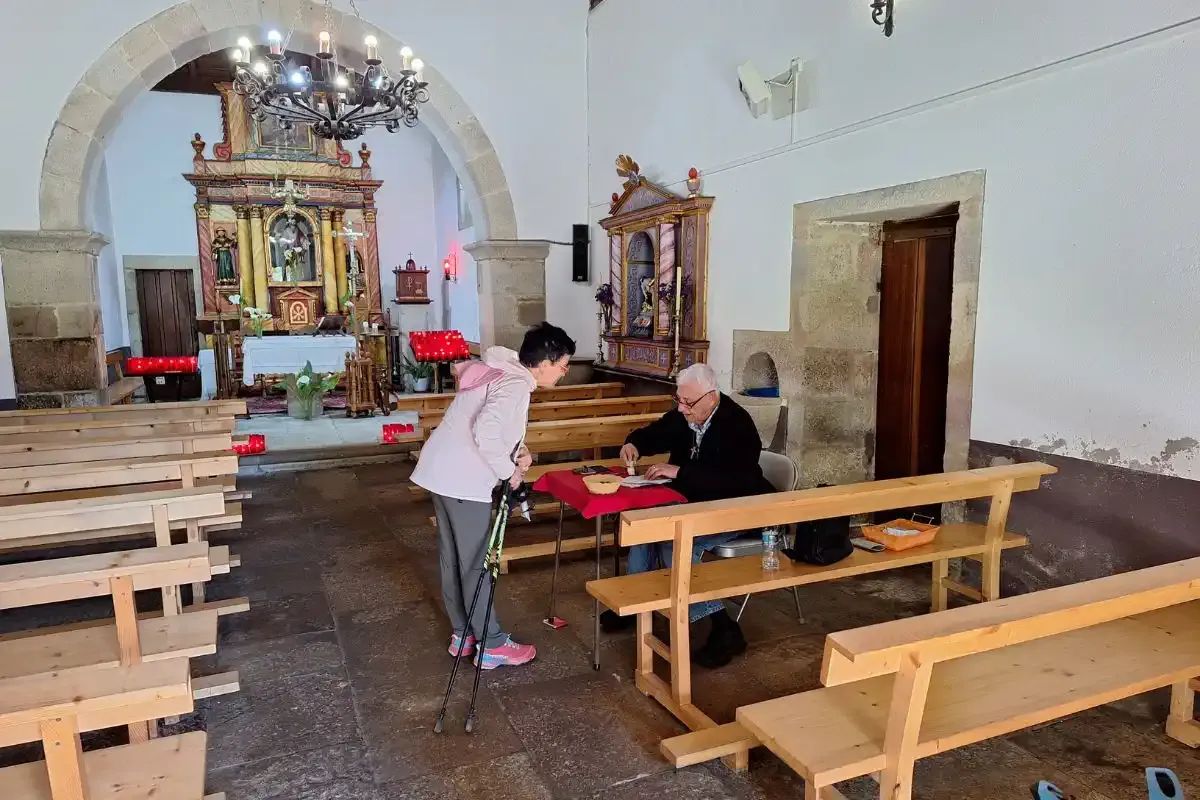
A pilgrim obtaining her stamps in a church
Requesting the Compostela
Once in Santiago, or even before arriving, there's a mandatory online registration process that involves filling out a form with personal details. After completing this step, you'll receive an alphanumeric code that you must show at the entrance of the Pilgrim's Office in Santiago. You should also provide the date when you completed this registration. With all of this done, you'll receive a ticket with your turn number and a QR code, which allows you to check the real-time waiting time. When your turn arrives, you can enter the office, where they will verify your stamps and hand over your coveted Compostela. Furthermore, the Compostela allows for a unique and emotional gesture: if you are walking the Camino in place of a loved one who cannot do it themselves or has passed away, you can request that your Compostela be dedicated to that person, known as dedicatoria vicarie pro. In addition to your name, the name of your loved one will also appear on the Compostela.
The two models of Compostela based on your motivation
One of the questions you will be asked during the mandatory online registration is the motivation behind your pilgrimage. If you are walking the Camino for religious or religious and other reasons, you will receive a specific model of the Compostela. This model contains text written in Latin and certifies that you have completed the Camino for religious and devotional purposes.
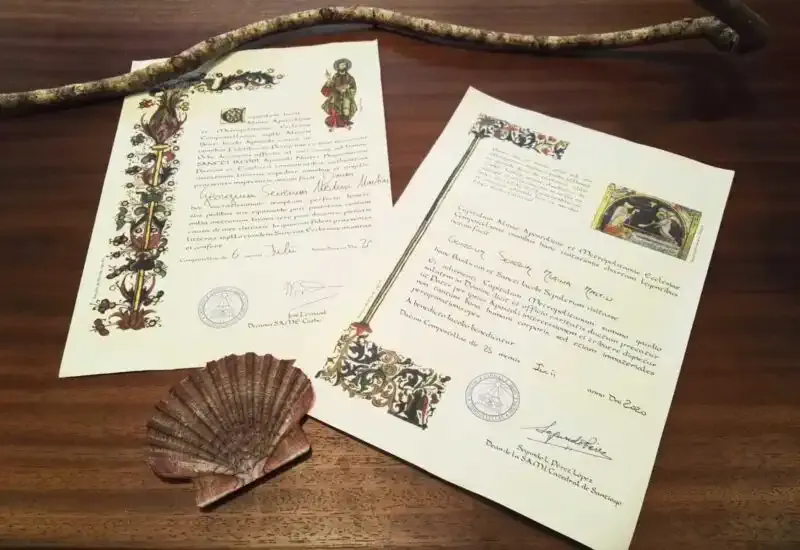
Two Compostelas depending on the reason
However, if your motivation is non-religious, you will receive a different certificate. The Compostela Church, realizing that many pilgrims undertake the Camino for sporting, tourist, or cultural interests, welcomes all pilgrims and also provides a certificate of pilgrimage. Your name will still appear on this document, but it has a different format, and the text is in Spanish, not Latin. In addition to the Compostela, there is also the option to request the Distance Certificate, a document that indicates where the pilgrim began their journey and how many kilometers they covered. While the previous models of the Compostela are free, this document costs 3€.
Other Pilgrim Certificates
There are also other pilgrim certificates, such as those for the Finisterre and Muxía Way. This is a very special official route, and it has its own credentials and certificates, known as the Finisterrana and the Muxiana. Additionally, when walking the Portuguese Way, you can obtain the Pedronía in Padrón. There are many more certificates for other routes, but we'll save those details for other posts.
In summary, dear future Pilgrim
To walk the Camino de Santiago and obtain the Compostela, you should follow these steps:
- Choose either the last 100 km of an official Camino with arrival in Santiago or a distant section—just remember that you must also walk the final stage leading to Santiago.
- Purchase your official credential.
- Walk and get your credential stamped at least twice per stage (at the beginning and end).
- Upon reaching Santiago (or even before), complete your online registration.
- Visit the Pilgrim's Office in Santiago, and you're all set!
Now that you have all the information, you know how to obtain your Compostela. If you've caught the pilgrim bug, the last 100 km of the French Way from Sarria or the Portuguese Way from Tui would be the best options to earn your first Compostela. A word of warning: the first Compostela you obtain won't be the last but the first of a great collection because the Camino is addictive. Just ask someone who already has a few. However, remember, as important or even more so than the Compostela, as we mentioned at the beginning of this post, the best certificate you will obtain is knowing what the Camino de Santiago is and the inner Compostela that will remain engraved in you for your entire life.
Comments (6)
GETULIA CHÁPERO LÓPEZ
Cristian Rodriquez
Pilar Garcia Palazón
Cristian Rodriquez
Sergio correa
CaminoSantiago
javier
CaminoSantiago
Danica
CaminoSantiago
Martha
CaminoSantiago
Leave a comment