


Artieda - Charming village crossed by the Pilgrims' Route to Santiago de Compostela
16 November, 2026
Artieda, on top of a hill above the Yesa reservoir, is one of the stops on the Aragonese Way. We tell you what to see, from the church of San Martín to its Roman past, what to eat, where to sleep and how to get there.

Artieda is a small Aragonese village perched on top of a hill, above the Aragón river valley and next to the Yesa reservoir. It belongs to the province of Zaragoza and to the Jacetania district, in the area known as the Canal de Berdún, and it is one of the stops on the Aragonese Way before it enters Navarre.
We tell you what to see, what to eat, where to sleep and how to get there so you can make the most of your time in Artieda, whether you arrive on foot or come for a short getaway.
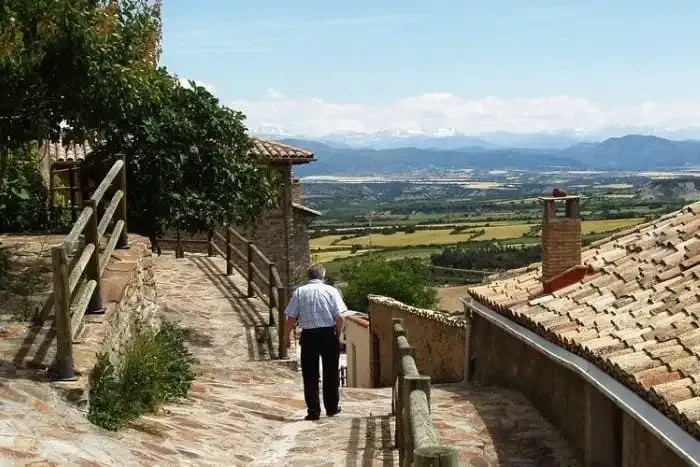
From the top of Artieda you look out over the valley, with the Pyrenees on the horizon.
What to see and do in Artieda?
The village has kept its medieval air, with cobbled streets and stone houses in the traditional mountain style. The best way to see it is to wander without hurry and stop at its viewpoints over the valley.
Church of San Martín and the Torre Museo
The church of San Martín is Romanesque in origin, from the twelfth century, and still keeps its semicircular apse. It has a single nave, to which side chapels were added in the sixteenth century, and a square tower of ashlar stone. Inside it holds altarpieces and pieces of goldwork from the sixteenth and seventeenth centuries.
Next to the church, an old tower has been turned into the Torre Museo, a tower museum and interpretation space devoted to the Camino de Santiago, where each floor represents a season of the year and a stage of life. You can also see there a replica of the Roman mosaic found at the site of El Forau de la Tuta. It opens mainly in the high season, so check the opening hours before you go.
Artieda's Roman past
At the foot of the village lies the site of El Forau de la Tuta, where excavations have uncovered the remains of a Roman city whose name is still unknown, with baths, necropolises and mosaics. In the area there are also stretches of the old Roman road that linked Jaca with Pamplona.
Hermitages and historic houses
Within the municipality there are several hermitages, among them those of San Pedro, Santa Lucía, Santa Cruz, San Babil and San Tornil. The hermitage of San Pedro, beside the Camino, was built partly with stones from the ancient Roman city, and a large reused Roman capital can still be seen in its wall.
In the old centre it is worth looking out for the Casa de los Diezmos (the tithe house) and the house of the former pilgrims' hospital, which recall the village's long tradition linked to the Camino and its pilgrims.
Where to eat in Artieda?
The local cooking is that of the Aragonese mountains: migas (a dish of fried breadcrumbs), ternasco de Aragón (young lamb), grilled meats, hearty stews, cured meats and Pyrenean cheeses. In the village there is a bar and restaurant serving home cooking, the only place to stop on this stage of the Camino, so it is wise to check the opening days beforehand, especially out of season.
Where to sleep in Artieda?
Artieda has a pilgrims' hostel and rural accommodation. Since it is a small village, there are few beds, so if you plan to sleep here, check the opening dates first and book in good time.
How to get to Artieda?
By car, you reach it from Pamplona or from Jaca along the Pyrenees motorway (A-21), which links the two cities, and from it a local road climbs up to the village. The nearest airport is Pamplona.
If you arrive as a pilgrim, Artieda lies on the stage from Arrés to Ruesta, after coming down from Canfranc and Jaca along the GR 65.3 path. The village sits high up, a little off the route, but it is worth the climb: it is the only place with services on the stage. From here you have about 10 km left to Ruesta, and after that the Camino continues through Undués de Lerda to Sangüesa.
And if you feel like walking the Camino all the way to Santiago, take a look at the Camino de Santiago routes we suggest. Once you have made up your mind, you can work out the price of your Camino here in a moment.