


A new Way promoted in the land of Korea: The "Jeju Olle"
08 February, 2026
The entry from Pilgrims around the world about Jeju Olle presents this network of long-distance trails on Jeju Island (South Korea), inspired by the Camino de Santiago and created by a Korean pilgrim after walking to Compostela, describing its origin, design in multiple coastal routes, connection with local culture, and the experience of international walkers seeking nature, adventure, and cultural connection.

Just as in Europe, and especially in Spain, we have the Camino de Santiago, the First European Cultural Route, and just as in Japan there is the Kumano Kodo, in South Korea they also have their own pilgrimage route, the "Jeju Olle" on Jeju Island. A Korean pilgrim to Santiago de Compostela in 2006 was so captivated by the Jacobean route that she decided to develop her own route in her country. Now, Koreans have their own hiking route, the "Jeju Olle Trail".
About Jeju Island
South Korea is a continental country also composed of many islands. One of them, the furthest from the Korean peninsula, is Jeju Island, located halfway between the Yellow Sea and the East China Sea. It is a volcanic island with unusual tropical beauty, which is a highly sought-after tourist destination among lovers, couples, and newlyweds.
This island has its own culture, distinct from peninsular South Korea, including its language, with notable differences from the languages and dialects of the peninsula. In fact, the name of the route contains a term from its language, "Olle," which means "narrow path". Let us learn a little more about the "Jeju Olle" route.
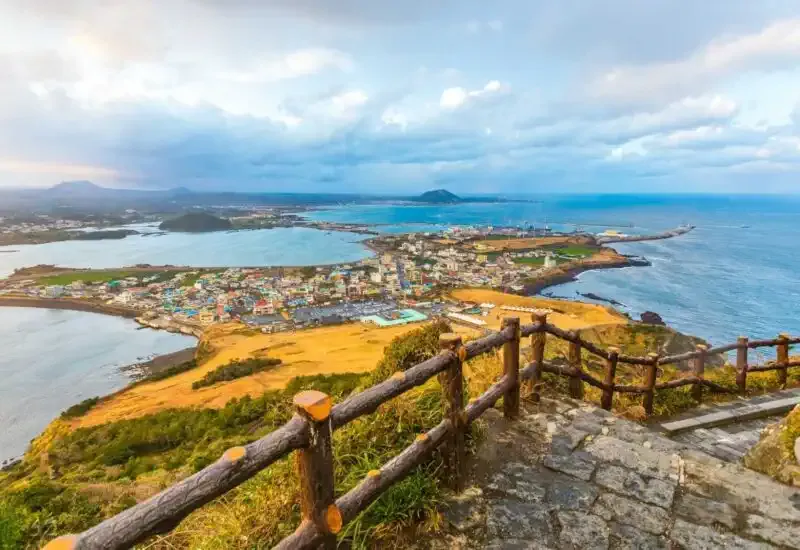
Jeju Island
"Jeju Olle," or the narrow path of Jeju Island
As we mentioned earlier, a Jacobean pilgrim named Suh Myung-suk, a journalist in South Korea and a native of Seoul, was captivated by her Jacobean experience and, upon returning home, decided to develop a route in her country. She explored the island with the intention of creating tourist and hiking routes, and subsequently founded the Jeju Olle Foundation to implement the development of her new project, the "Jeju Olle" path. It was necessary to choose the correct paths and connect them, as well as prepare the trails by widening them, removing obstacles, and marking them.
"The birth of Jeju Olle Trail is inspired by the Camino de Santiago"
Once this was done, "Jeju Olle" was born, a network of long-distance trails along the coast of the island. There are a total of 21 connected routes, 5 sub-routes, and a final one that connects to Jeju International Airport (this girl is everywhere!). They are routes averaging 16 kilometers that total 425 kilometers, although the trails may be modified or redirected.
Things to consider
The difficulty of the stages ranges from easy to moderate. It can be done at any time of the year, although it is not advisable to undertake it in July and August, due to the usual warnings of extreme heat. The best months would be April, May, September, and October.
The "Jeju Olle" Foundation marked the route, and among the signs, the following should be highlighted: the "ganse" indicates the direction at forks, the blue and orange ribbons decorate the path, the arrows indicate the direction, and the "S" and "F" labels indicate the start and end of a section adapted for wheelchairs (as mentioned, they are on top of everything!). Hikers also have a kind of pilgrim passport, and it is necessary to stamp it three times per stage to obtain the final certificate and medals.
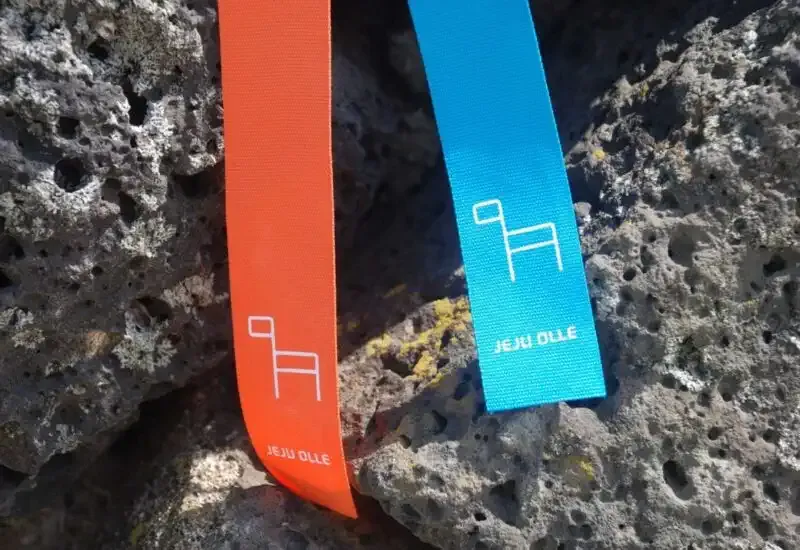
Jeju Olle Foundation
More than 135 cities and over 130 paradise beaches, as well as forests and mountains, is the heritage offered by this route, also encompassing the unique culture and people of the island. With the premise of minimally altering the landscape, this route is respectful of ancient trails. It is worth noting that along the route we will find the UNESCO World Heritage Site "Seongsan Ilchulbong" and the Geopark "Sanbangsan".
A tropical getaway
The pace of life for South Koreans is intense and even stressful, which is why this route offers an escape that is also very close by. As we well know, it is a culture that loves hiking, and if you have done any Camino de Santiago, you may have noticed the large number of South Koreans who pilgrimage to Santiago de Compostela, which in 2019 amounted to more than 8,000 on the Jacobean routes, making it the seventh country of origin for pilgrims.
As Rachel Kim, the spokesperson for the Foundation, states, Suh "wanted to showcase her hometown, Jeju Island, and the amazing nature that the island presents along with the unique culture found here, through a long walking path, like the Camino de Santiago. She also wanted to share the emotions she experienced on the way".
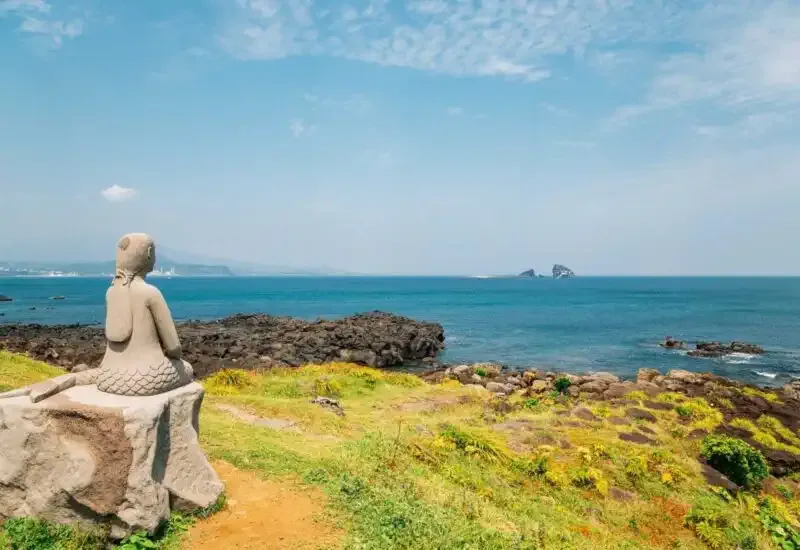
The coast of Jeju Island
An average of 600,000 hikers undertake the "Jeju Olle" each year, surpassing the Camino de Santiago itself. Nine out of ten are Koreans, with the rest being foreigners, mainly from nearby countries such as Singapore, Malaysia, Taiwan, Hong Kong, or Australia.
The truth is that we are very much captivated by this route, and we are already thinking about vacation plans to experience it, feel it, and savor it. And you, what do you have in mind for your vacation? Perhaps South Korea is very far away, but right here you have the inspiration of the "Jeju Olle," our Camino de Santiago.
Happy "Olle"!