


Discover the Irati Forest
04 November, 2021
The Irati Forest, in Navarra, is one of the best-preserved forests in Europe, famous for its biodiversity, including beech trees, firs, and endemic species. In addition to its ecological value, it offers active tourism activities such as hiking and cycling. Ideal for those starting the Camino de Santiago.

Forests in Spain? Indeed, even in Europe, where the famous Black Forest also exists in Germany. We typically associate the term "forest" with a wooded area typical of tropical regions, but in this post, we will understand why they are called that, and specifically, we will get to know in depth our Iberian forest, the Irati Forest, a natural space that receives many visitors each year. Below, we will tell you everything you need to know more about this beautiful place, take note!
The Irati Forest
The Irati Forest is predominantly located in the north of the Foral Community of Navarre, although a small extension crosses the border with France. Its Spanish part is situated in the valley of the Irati River, with the mountains of Roncesvalles and Orzanzurieta to the west and Mount Orhi to the east. To the south, we find the Sierra de Abodi, and to the north, the eastern Navarre Pyrenees and the border with France.
To reach it from the west, we can do so via Orbaizeta through the closure of the Irabia reservoir (with three parking areas) and the Aezkoa valley; on the other hand, from the east, we access through Ochagavía and the Salazar valley, where we will find the Nature Interpretation Center of Ochagavía, which we recommend visiting for more information.
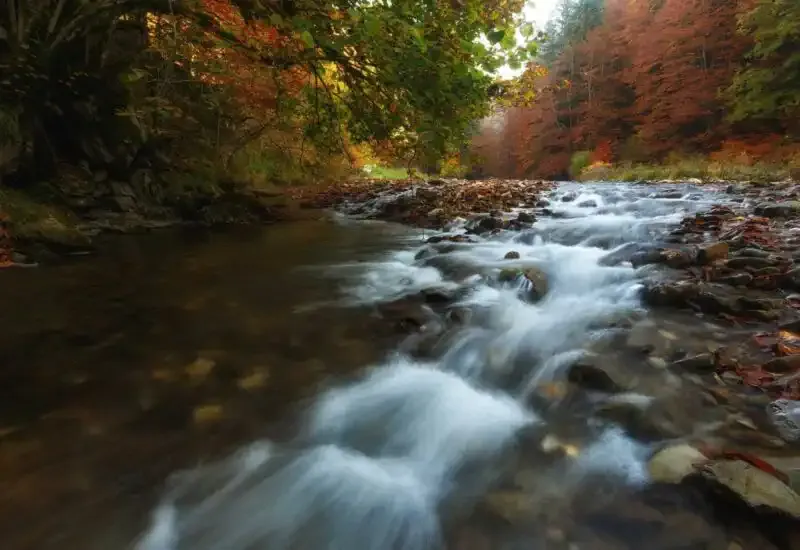
The Irati environment is a natural space with an area of 17,000 hectares that contains three natural reserves: the natural reserves of Mendilatz and Tristuibartea, as well as the integral reserve of Lizardoia. Additionally, it has been a Special Protection Area for Birds (ZEPA) since 1990.
In Irati, the contrasts of colors are much stronger in autumn, and we, who have experienced this season, recommend it 100%
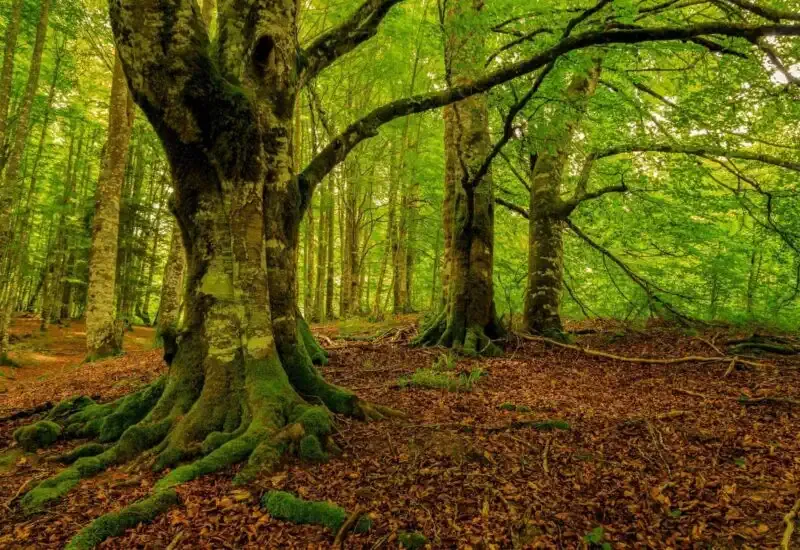
This area has an immeasurable ecological value that makes it truly important within the stages of Santiago de Compostela. Due to the characteristics of its vegetation, with one of the largest and best-preserved beech and fir forests in Europe, it is a true explosion of colors and life, depending on the season. Apart from the vegetation, there are a multitude of hidden ecosystems in the thickness of the forest, and on the other hand, in plain sight in its open and green pastures. Both are home to numerous populations of wild animals.
Natural heritage in detail
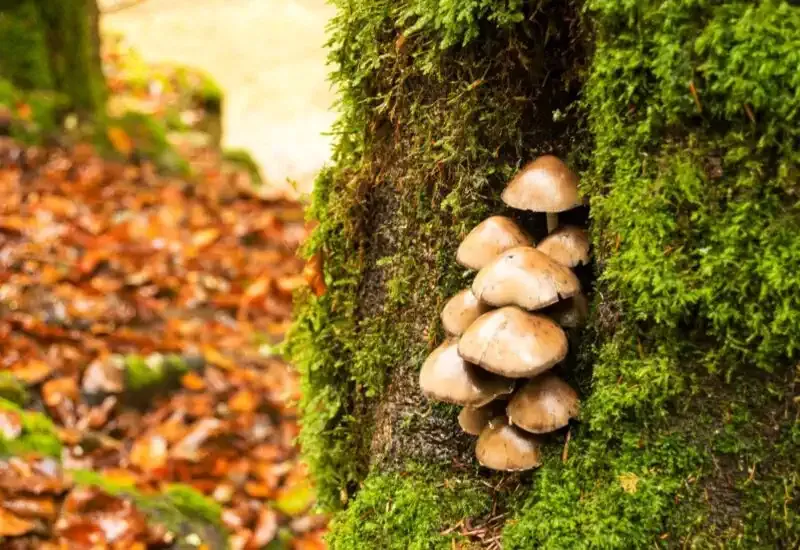
Regarding the flora, it is worth highlighting the common beech, as well as the birch, willow, downy oak, yew, holly, maple, lime, and rowan. Among conifers, the white fir stands out. Smaller in size but with great prominence are the blackberry and a wide variety of mushrooms, as well as mosses and ferns ("fern field" is the meaning of the word "irati" in Basque, which is also used as a feminine proper name). Furthermore, in 2015 a carnivorous plant, the Drosera Rotundifolia, as well as the Eriophorum Angustifolium, a woolly plant, were discovered, leading to the inclusion of the Irati Forest in a European protection project.
Irati is the home of a large family of animals, including mammals, birds, reptiles, and endemic species
All this vegetation provides shelter to the fauna that we can find in this unique space. The birds stand out, such as the kinglets, finches, robins, and others. Endangered are the woodpecker, the black woodpecker, and the white-backed woodpecker, among others. We will also find birds of prey such as the bearded vulture, the peregrine falcon, or the golden eagle. Among many, mammals such as the Pyrénées desman, the fox, the wild boar, the marten, the wolverine, the roe deer, and the deer stand out, whose rutting can mainly be heard in autumn. There are also some endangered reptiles, including the nose-horned viper, the ocellated lizard, and the Mediterranean tortoise. We must not forget another endemic species, the Pyrenean newt.
Cultural heritage, let it not be missing!
Yes, we can also talk to you about history and culture in the Irati Forest. As early as the 16th century, France and Spain were debating the "ownership" of this territory, perhaps due to the deforestation desires that had been present since the 15th century. King Charles III, in the 18th century, erected a factory for arms and ammunition, thanks to the abundance of wood and iron mines available in the area. With great economic importance until the 19th century, today it can be visited.
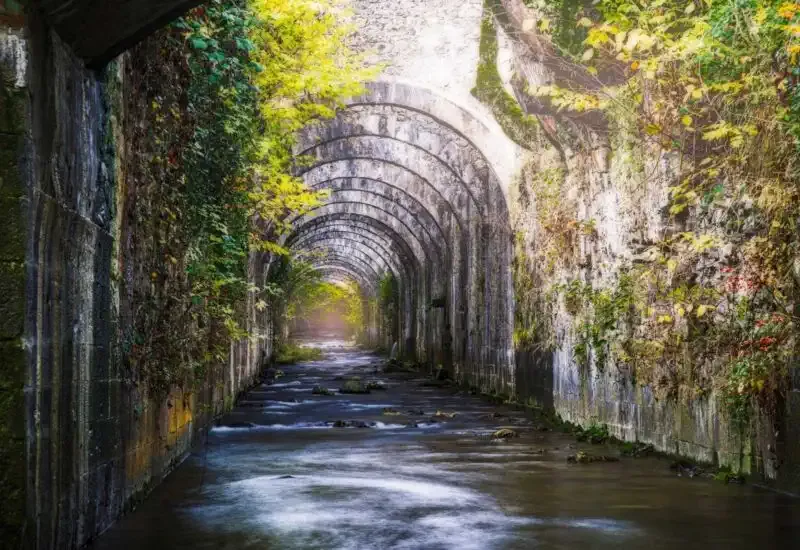
A locality that should not be missed in our visit is Ochagavía, whose origins date back to the 11th century and preserves beautiful examples of Pyrenean architecture. Furthermore, throughout the area we can contemplate 15 of the 22 Navarre granaries, the granaries of the Aezkoa valley, which are today declared a Cultural Interest Asset (BIC).
Active tourism
Of course, there are many active tourism activities that we can practice here, from hiking, mountaineering, snow sports, cycling or mountain biking, birdwatching, climbing, and canyoning, among others. Various rural accommodations await to offer you all their charm and rich gastronomy. You can learn more here.
In the words of Ernest Hemingway, "whenever I think of Irati, I get goosebumps"
Navarra is undoubtedly a region that, in addition to the Camino de Santiago, its grand festival of San Fermín, and its wines, offers you this natural gem that is only surpassed in size by the aforementioned Black Forest of Germany. For us, pilgrims, it is a wonderful complement if we decide to start a Jacobean adventure in Roncesvalles through the French Way, enjoying the beautiful nature of the Irati Forest and all the magic of the Camino de Santiago.