


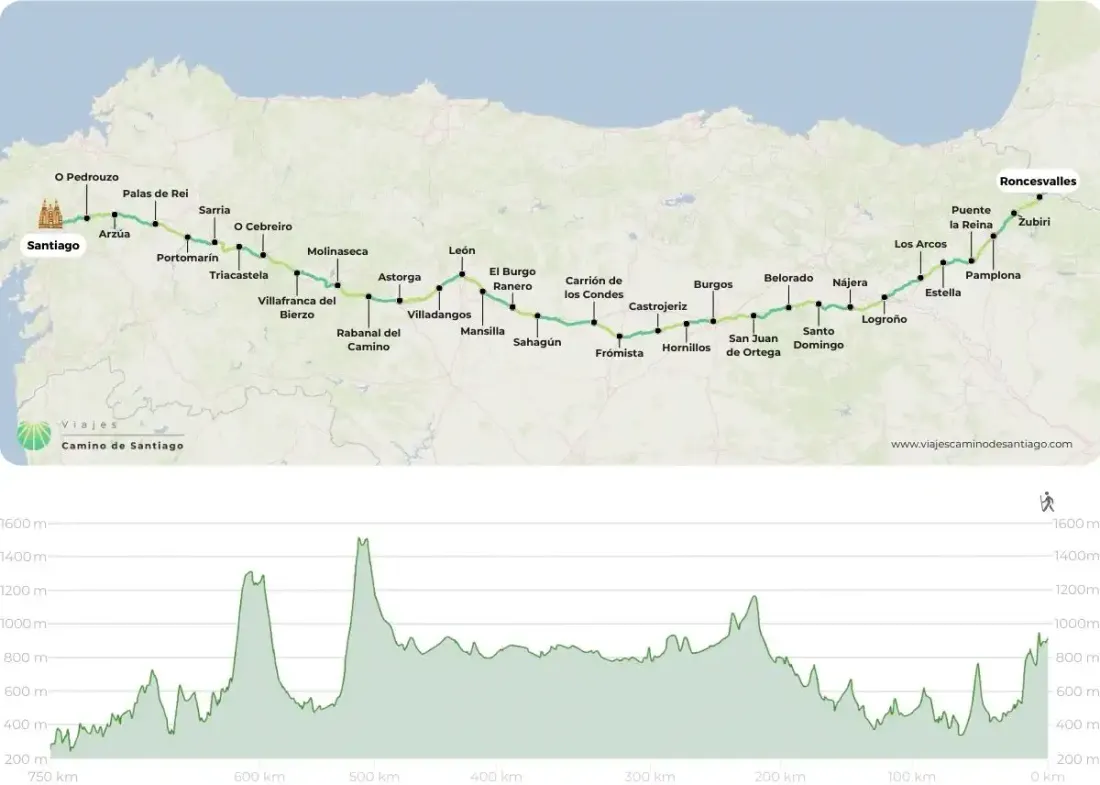
The Camino de Santiago in full by bike, from the Pyrenees to Santiago on two wheels. 749 kilometres crossing Pamplona, Logroño, Burgos, León and Ponferrada before entering Galicia: the great crossing of the French Way by pedal across Navarre, La Rioja, Castile and Galicia.
We handle all the logistics so you only have to pedal: accommodation, your pilgrim's credential, full documentation and travel insurance, from 621 €. Crossing Spain by bike is a serious haul: you can add the daily luggage transfer and ride without panniers.
The French Way by bike from Roncesvalles is an itinerary organised by Viajes Camino de Santiago®.
Services
Included in all our routes
- Accommodation
15 days / 14 nights
- 15 days / 14 nights accommodation
- Complete documentation (Dossier and material for the Camino)
- On-the-road emergency telephone assistance
- Pilgrim's Credential
- Travel insurance
Optional
- Luggage transfer during the stages. (1 piece per person max 15 kgs)
- Supplement for single room
- Extra night in Santiago de Compostela
- Breakfast
- MP (Breakfast and dinner)
- Cancellation Insurance
Accommodations
- Most popular
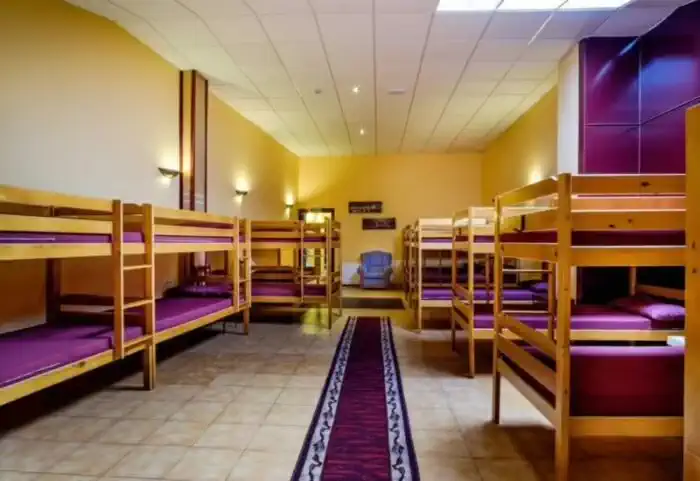
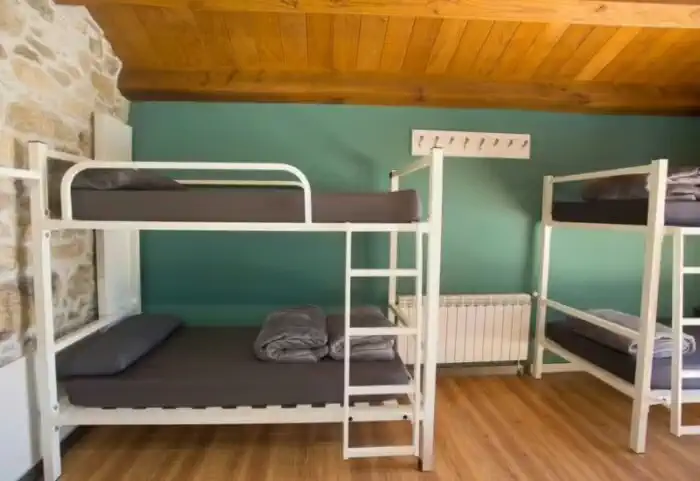
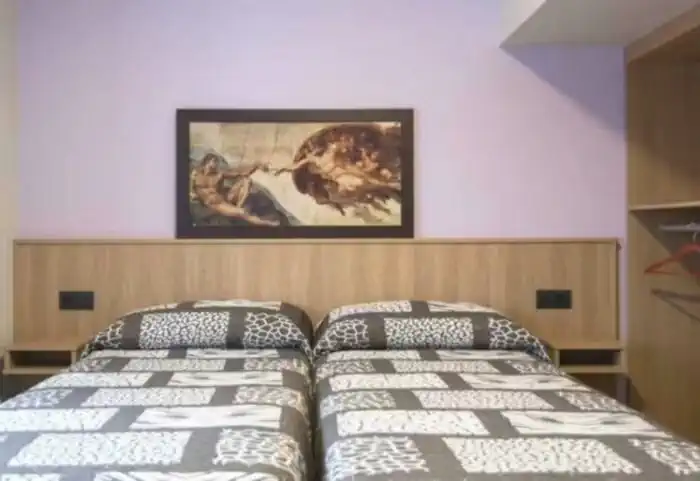
Basic accommodation (Private hostels)
621 €
The most authentic accommodation on the Camino. Hostels are the ideal option for those traveling on a tight budget, solo pilgrims, or anyone who wants to experience the Camino de Santiago in its purest form. They are the perfect place to socialize, share stages, and connect with fellow walkers along this ancient route.
- Most popular
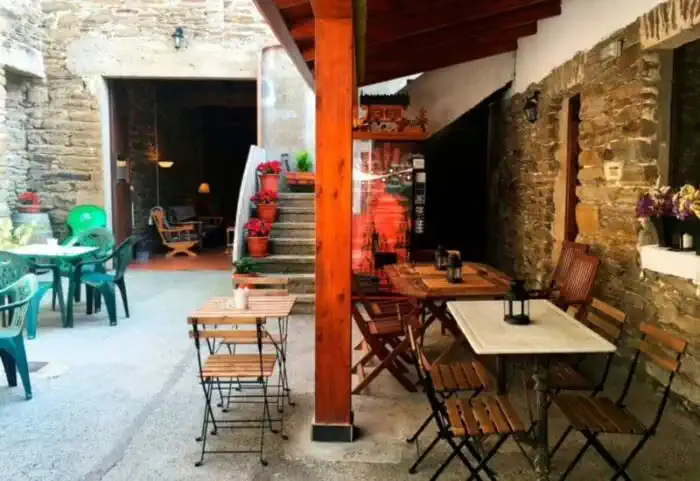
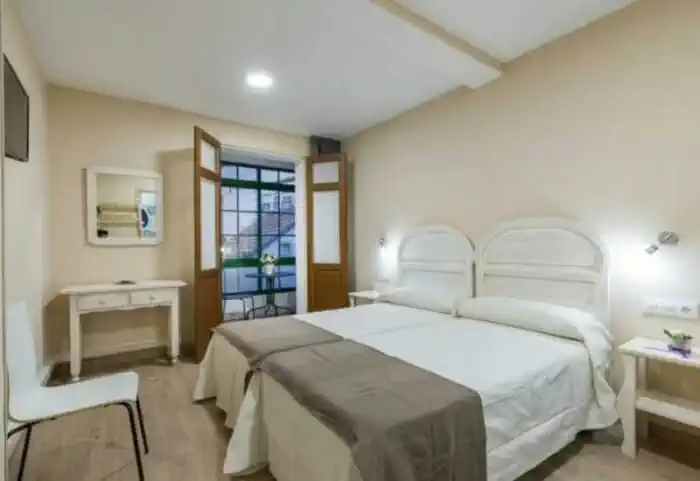
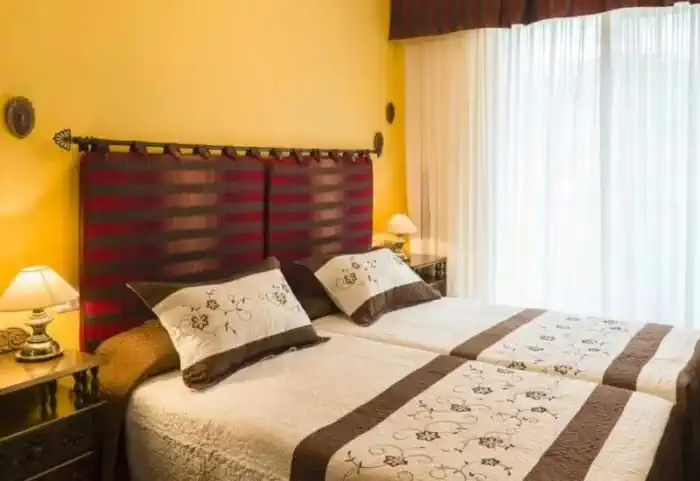
Private comfort (Guesthouses, rural houses and small hotels)
1310 €
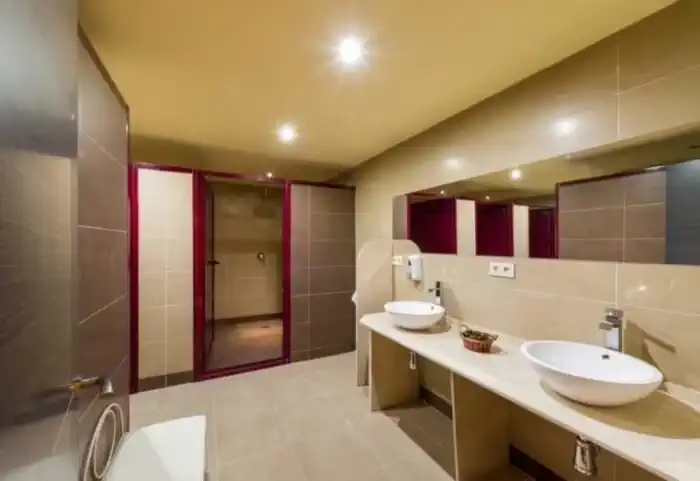
The perfect balance between charm and comfort. Guesthouses, B&Bs and country houses await you in the villages along the Camino with private rooms, private bathrooms, TV, and daily cleaning service. Simple and welcoming, they are the ideal place to truly rest and enjoy the peaceful rural essence that only the Camino can offer.
- Most popular
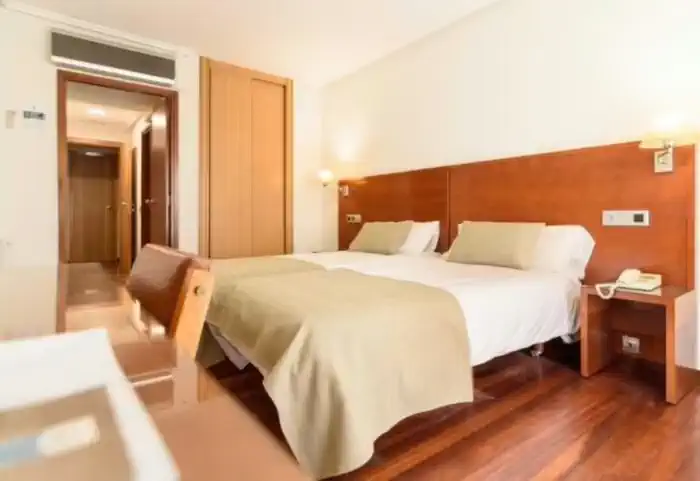
Superior accommodation (Charming hotels)
1575 €
For those who want to reach each stage and recover in complete comfort. The best hotels and manor houses along the Camino de Santiago, featuring elevators, restaurants, private bathrooms, and quality services. Gardens, terraces, and swimming pools to end each day the way a pilgrim who values well-being deserves.
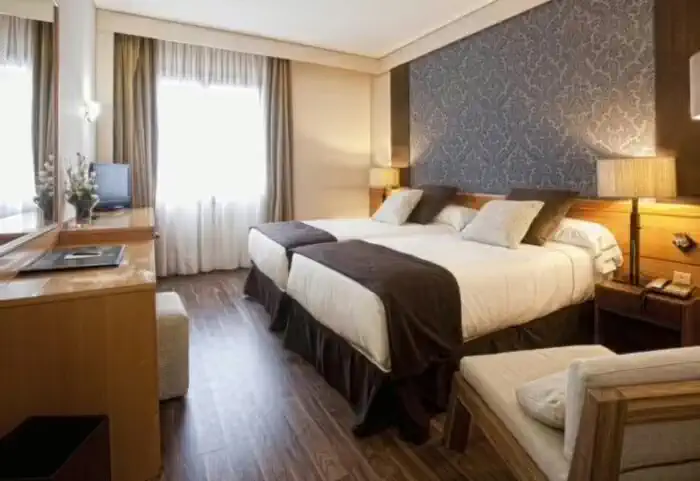
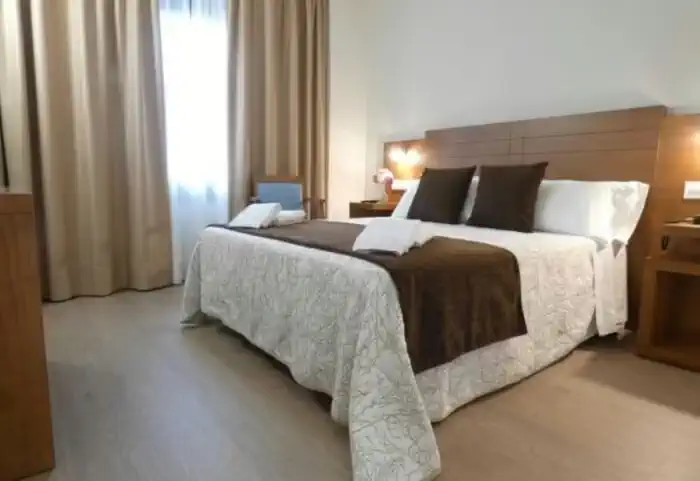
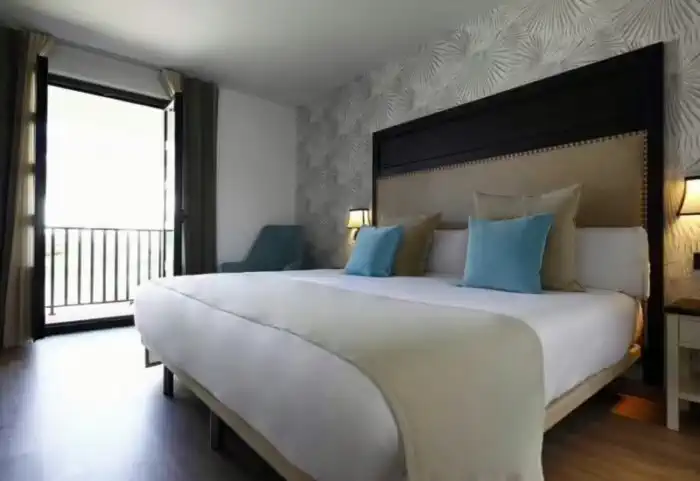
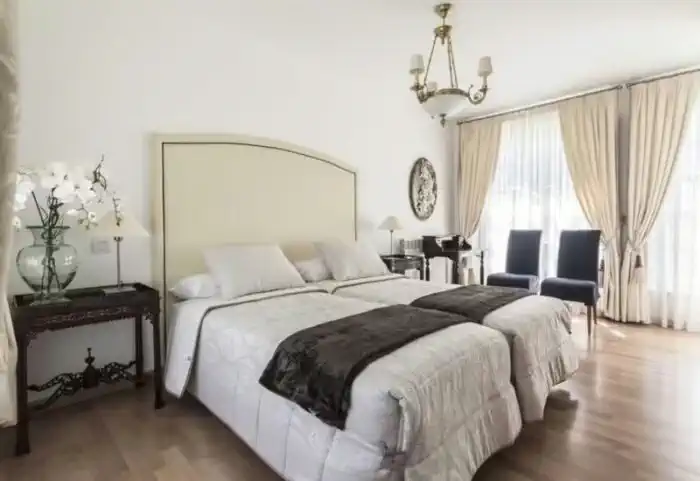
Photos
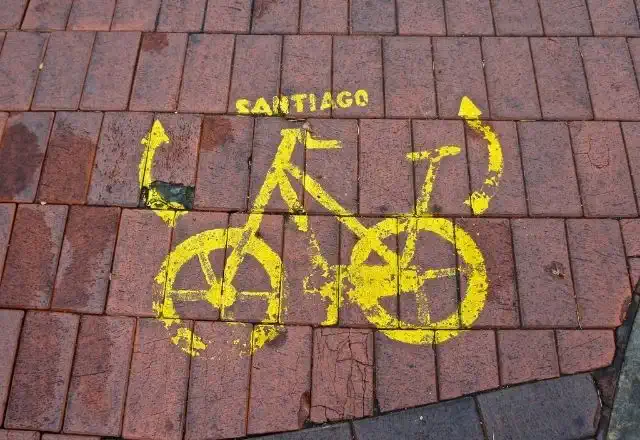
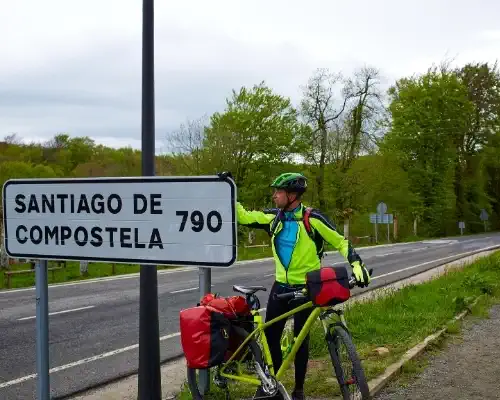
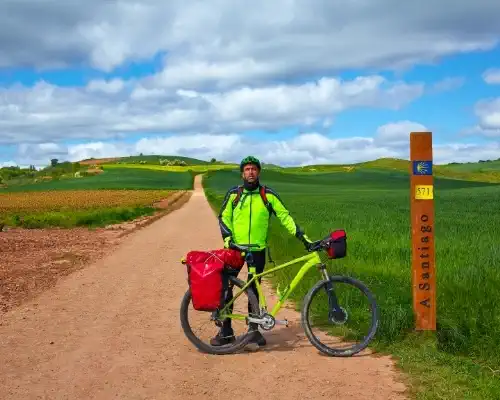
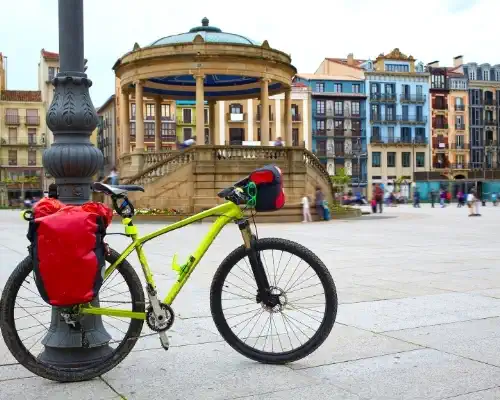
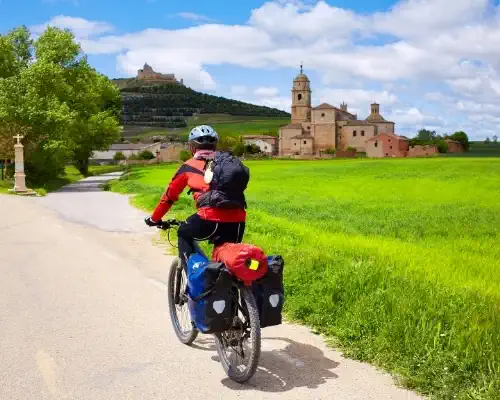
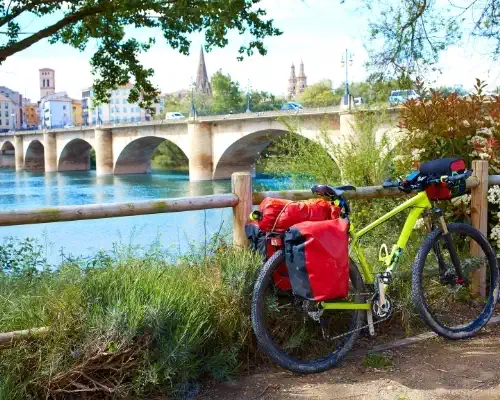
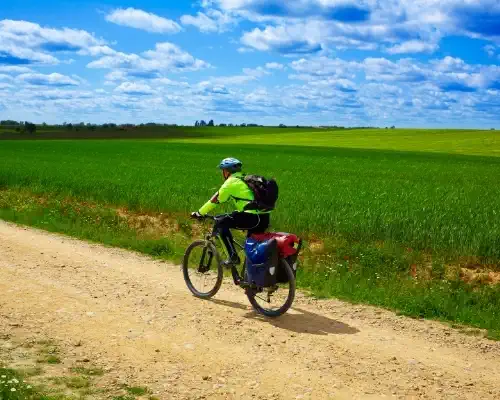
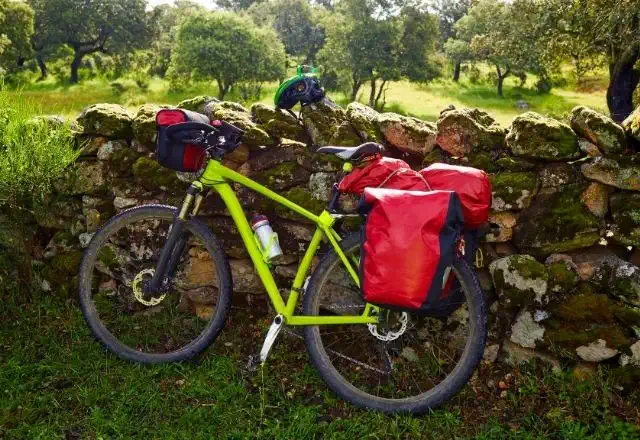
Map of the French Way by bike from Roncesvalles
Stages
- day 1
Arrival at Roncesvalles
- day 2
Stage 1. Roncesvalles - Pamplona (42 km)
Your first day on the bike starts at the border with France, along the N-135, with light traffic and a tendency to descend all the way to Zubiri. Then the terrain gets flatter and flatter until Pamplona, a walled city of medieval origin with its Gothic cathedral and famous pintxos. And if you happen to arrive in the second week of July… get ready for San Fermín!
- day 3
Stage 2. Pamplona - Estella (42 km)
42 kilometres of steady climbing up to the Alto del Perdón, the day's high point, with its famous row of iron pilgrims and spectacular views. After the obligatory photo, a steep descent to Uterga and a gentler profile on to Estella (Lizarra), a town bathed by the Ega river, known as the "Toledo of the north." Get lost in its old town before resting.
- day 4
Stage 3. Estella - Logroño (49 km)
Today you leave Navarra and enter fully into wine-country La Rioja. 49 kilometres pedalling along tracks between vineyards, with one unmissable landmark: the Fuente del Vino at Irache, which flows with free wine for pilgrims. The stretch from Torres del Río to Viana is the most technical —patience and stamina—. At the end, once in Logroño, it's time to rest and enjoy its tapas.
- day 5
Stage 4. Logroño - Santo Domingo de la Calzada (50 km)
A friendly stage for the cyclist! You leave Logroño via a bike lane to the La Grajera reservoir, with good views of the city behind you, and continue without difficulty between vineyards and fields to Navarrete and the charming town of Nájera. One last very gentle stretch, through villages with services, leaves you in Santo Domingo de la Calzada.
- day 6
Stage 5. Santo Domingo de la Calzada - Burgos (72 km)
A long, demanding day, with one of the toughest ramps of the route: take it calmly and don't obsess over getting there. From Santo Domingo you cross into Castilla y León via Redecilla and head for the Montes de Oca —the original path crossing the mountain is well worth it—. After San Juan de Ortega and the Sierra de Atapuerca, you reach your goal: Burgos.
- day 7
Stage 6. Burgos - Carrión de los Condes (86 km)
Yes, 86 kilometres… but don't worry: today you cross the entire Tierra de Campos to Palencia over flat terrain. The effort is more mental than physical, with the meseta and its golden grain fields stretching out in a straight line as scenery. You pass through pilgrim villages with all services —Hornillos, Castrojeriz, Frómista— on to Carrión de los Condes. In summer, set off well protected from the sun: there's little shade.
- day 8
Stage 7. Carrión de los Condes - León (96 km)
The longest stage of the trip, but a flat one: you ride across the Tierra de Campos, with long straights and few villages in the first kilometres —leave Carrión with water and something to eat— to Sahagún, then carry on along the track beside the N-120 and through Mansilla de las Mulas to León. The approach to the city has traffic: stay alert. León is one of the great cities of the Camino. Its Gothic cathedral, with 1,800 square metres of stained glass, leaves everyone speechless; nearby stand the Basílica de San Isidoro with its Romanesque frescoes, and Gaudí's Casa Botines. As evening falls, it's time for the Barrio Húmedo, where every glass of wine still comes with a free tapa.
- day 9
Stage 8. León - Astorga (49 km)
A long day that begins with a somewhat tedious departure from León, through industrial areas. But the reward arrives: the impressive medieval bridge of Hospital de Órbigo, setting of the Paso Honroso, and the panoramic views from the Cruz de Toribio. You finish in Astorga, a millennia-old crossroads of cultures, with its cathedral and the modernist Palacio de Gaudí as its jewels.
- day 10
Stage 9. Astorga - Ponferrada (54 km)
Mountain day: from Astorga you ride through the Maragatería, via Rabanal del Camino and Foncebadón, up to the Cruz de Ferro, the highest point of the Camino Francés. Then comes a long, stony and demanding descent through El Acebo and Molinaseca —brake sensibly— down into the Bierzo. Ponferrada, capital of El Bierzo, is dominated by its imposing Templar castle, one of the best-preserved of the order and almost entirely open to visitors. Nearby stand the Basilica de la Encina and an old town full of good terraces. The region is mencía wine, botillo and pepper country: the food here is excellent.
- day 11
Stage 10. Ponferrada - O Cebreiro (55 km)
Get ready: today brings the toughest climb of the whole route. You cross the green Bierzo valley to Las Herrerías, and that's where things get serious: a demanding climb —better on asphalt— up to magical O Cebreiro. This village of thatched pallozas, with the oldest church on the Camino, is pure ethnographic and Celtic treasure: the best reward for recharging your batteries.
- day 12
Stage 11. O Cebreiro - Portomarín (62 km)
A long mountain day. You leave O Cebreiro behind with a pang of regret and crest two passes: the Alto de San Roque, with its statue of the pilgrim battling the wind, and the Alto do Poio, the highest point of the Camino in Galicia. You descend to Triacastela and continue —via San Xil or the monastery of Samos— to Sarria. The final kilometres, through hills and woodland, bring you to Portomarín.
- day 13
Stage 12. Portomarín - Arzúa (54 km)
You start with a tough warm-up climb and reach Palas de Rei, a good first stop. You continue to Melide, the day's big reward: there's no better place on the Camino for pulpo á feira, so grab a table at a pulpería. With a full belly you tackle the final kilometres, through woodland and the odd leg-breaking climb, to Arzúa, land of good cheese.
- day 14
Stage 13. Arzúa - Santiago de Compostela (38 km)
A long final day to Compostela. The high point comes at Monte do Gozo, with your first view of the cathedral towers. Shortly after, your triumphant arrival at Plaza del Obradoiro. You've completed your Camino and you're in Santiago!
- day 15
End of the trip
After your last night, you check out of your accommodation and your trip comes to an end.
Related Trips
 7 days / 6 nights
 34 days / 33 nights
French Way from Roncesvalles to Santiago de Compostela
32 Stages 745 Kms
From 1099 €Explore this Camino 8 days / 7 nights
Frequently Asked Questions
-
How many kilometres are cycled per day on the Camino de Santiago?
Doing the Camino by bike allows the ‘bicigrino’ to cover more kilometres per day than a pilgrim on foot, easily double. The number of kilometres cycled per day depends on several factors:- physical capabilities of each person;
- time available;
- route and section chosen (technical difficulty of the terrain);
- availability of accommodation.
-
What are the most important towns on the French Way?
The French Way of Santiago passes through a series of towns and cities rich in history, culture, and unique landscapes. Some of the most important towns and cities along the French Way are:- Saint-Jean-Pied-de-Port (France): The starting point of the French Camino, this picturesque town at the foot of the Pyrenees is known for its cobbled streets and the impressive Santiago Gate.
- Roncesvalles: After crossing the Pyrenees, Roncesvalles marks the entry into Spain. Its collegiate church and historical significance make it a key spiritual stop for pilgrims.
- Pamplona: Famous for its San Fermín running of the bulls, Pamplona is a vibrant city with rich medieval heritage, highlighted by its cathedral and city walls.
- Logroño: The capital of La Rioja, known for its wines and delicious gastronomy. Logroño is an excellent place to enjoy tapas on the famous Laurel Street.
- Burgos: Burgos boasts one of the most impressive Gothic cathedrals in Spain, a UNESCO World Heritage Site. Its historic center is also a must-see on the Camino.
- Carrión de los Condes: This small town in the province of Palencia stands out for its rich medieval history and Romanesque churches, offering a more intimate experience on the Camino.
- León: With a majestic Gothic cathedral, the Convent of San Marcos, and vibrant urban life, León is one of the most important cities along the route, ideal for taking an extended break.
- Astorga: This city features the Episcopal Palace designed by Gaudí and a beautiful cathedral, serving as a crossroads between the French Camino and the Via de la Plata.
- Ponferrada: Famous for its Templar castle, Ponferrada is the gateway to the El Bierzo region and an important stop before tackling the mountains of Galicia.
- O Cebreiro: This charming mountain village is one of the most iconic stops on the Camino, known for its traditional palloza houses and its connection to the Holy Grail.
- Sarria: A starting point for many pilgrims who wish to complete the final 100 kilometers required to earn the Compostela. Sarria is an essential stop.
- Portomarín: This town is notable for its unique history, having been relocated stone by stone after the construction of the Belesar reservoir. Its fortress-like church of San Nicolás and its location by the Miño River make it a special stop before reaching Santiago.
-
What services are included in the Camino de Santiago by bike?
The Camino de Santiago by bike includes the following services:
- Accommodation
- Dossier with information about the stages
- Pilgrim's credential
- On-the-road helpline
- Travel insurance
In addition, you can customize your trip by adding the following optional services:
- Luggage transport between stages
- Breakfast or half board
- Extra night at the beginning or end of the stage
- Bicycle rental
Unlike the group trips, no guide or support vehicle is included between stages. However, you will have a 24-hour hotline where you can contact us in case of any problem or unforeseen event, which we will solve quickly.
-
Can I bring my own bicycle for a trip on the Camino de Santiago?
Yes, you can do the Camino with your own bike. The important thing is that it is in good condition before starting to avoid problems. Remember that you can also rent a bicycle with us (MTB, e-Bike, etc., with equipment included) which you will find directly at your first shelter, and we will indicate where to return it at the end of your journey.
-
Where will I leave the bicycle each night at the accommodations?
Do not worry, most accommodations on the Camino have secure spaces for bicycles. They are usually garages or enclosed areas with security measures. When we organize your trip, we ensure that each accommodation guarantees this service. Additionally, if it is an e-Bike and you need to charge it overnight, the accommodations will provide you with a power outlet and electricity.
-
If I choose to use an electric bike, can I rely on sufficient battery life?
The electric bike's battery is designed to provide ample autonomy, typically lasting around 80 km when using a moderate assistance level (level 2). However, the battery's performance may vary depending on the level of assistance required; more assistance will deplete the battery faster, and vice versa. To recharge the battery, you'll need to connect it to a power source using a special charger. The battery can either be charged while attached to the bike frame or removed and taken elsewhere for charging convenience. -
How many days does it take to ride the Camino Francés by bike from Roncesvalles?
On this trip, 15 days and 14 nights: you arrive in Roncesvalles, ride 13 stages to Santiago, and the last day is for heading home. It is 749 km across Navarre, La Rioja, Castile and León and Galicia.
Most stages are between 42 and 62 km, and there are three long ones: the ride into Burgos (72 km) and the two across the Meseta (86 and 96 km). If you want more time at the end, you can add an extra night in Santiago.
-
Does the Camino Francés by bike from Roncesvalles qualify you for the Compostela?
Yes, easily. It is 749 km to Santiago, far above the minimum of 200 km by bike that the Pilgrim's Office requires to obtain the Compostela.
Get your pilgrim passport, which is included in the trip, stamped at least twice a day over the last 200 km (at accommodation, churches or bars along the Camino) and finish your journey at Santiago Cathedral.
-
Why are there 86 km and 96 km stages on the Camino Francés by bike?
Because they cross the Meseta, the flattest section of the whole Camino. From Burgos to Carrión de los Condes (86 km) you ride across Tierra de Campos on well-surfaced tracks and paved country roads, with no hard climbs: it tires the mind more than the legs.
From Carrión to León (96 km) the profile is even easier, but there are long stretches without villages: set off with plenty of water and food and, in summer, well protected from the sun. Take care riding into León, where the streets have heavy traffic.
-
Is it better to ride from Roncesvalles to Pamplona by road or on the original trail?
If you are not very experienced technically, by road. The first stage follows the N-135, which has little traffic: there are a few short climbs as far as Zubiri, but the trend is downhill, and then the terrain gradually flattens out towards Pamplona.
The original trail is hard, demands good technique and is full of pilgrims on foot, so if you choose it, take extra care. When you arrive, Pamplona awaits with its walled old town and its pintxos.
-
Which is the most technical section of the Camino Francés by bike from Roncesvalles?
The stretch from Torres del Río to Viana, on the Estella–Logroño stage: about 10 km of climbs, descents and abrupt changes of terrain. Before that, from Azqueta, the trail gets steeper and narrower; don't hesitate to get off the bike if you need to.
The other demanding day is Santo Domingo de la Calzada–Burgos (72 km), with one of the toughest ramps of the route. There it is worth following the original trail through the Montes de Oca.
-
What is the Irache Wine Fountain?
It is a fountain on the Camino Francés that offers pilgrims free wine, and you will find it on the stage from Estella to Logroño, the day you leave Navarre and enter La Rioja. It is the first stop of the day and a must for a photo.
A little further on is the Fuente de los Moros, another of the best-known fountains on the route. Take it easy: the most technical stretch of the day, between Torres del Río and Viana, comes afterwards.
From Roncesvalles
From 621 €

Reviews
Hugo saul Cayzac
Aitor Montalbán Sanz
Lidia Sanjuán Perales
Sergio Balmaseda Ríos
Mónica Téllez Valcárcel
Rubén Castelló Mínguez