Attention: Route not available for walking between November 1 and January 15
The Portuguese Way from Porto by bicycle is the perfect route for all those who cannot live without the sea. An ideal route for beginners as it features flat and comfortable terrain that follows the coastline, always keeping an eye on the Atlantic Ocean. From the bohemian city of Porto, you will discover important towns in northern Portugal, beaches, and estuaries until you cross the border and enjoy the beautiful panoramas offered by the mouth of the Miño River. Once in Galicia, you will ride through charming fishing villages and important cities such as Vigo and Pontevedra until you venture into the interior of Galicia following the traditional itinerary of the route to Santiago de Compostela.
Photos
Accommodations
- Most popular
Hostels, guesthouses, and rural houses
1076 €
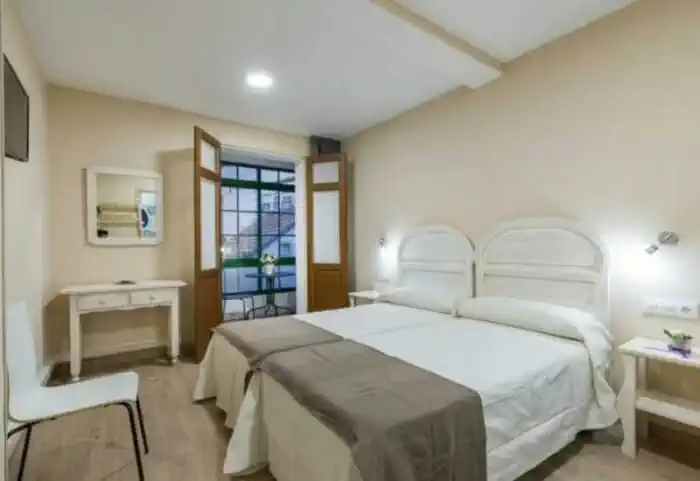
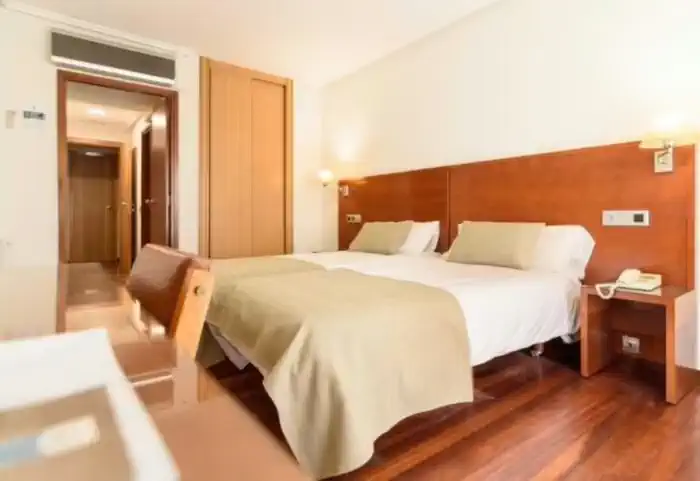
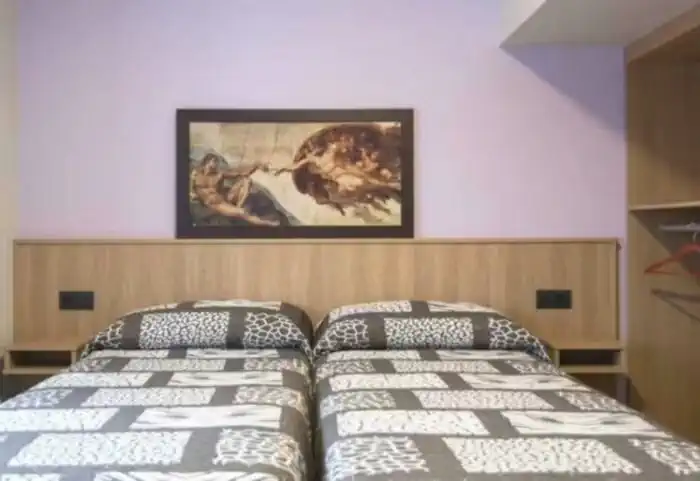
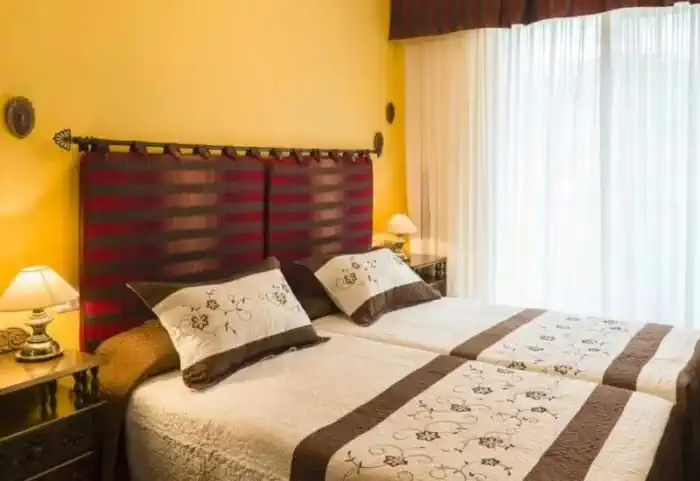
Hostels, Guesthouses, and Rural Houses are ideal in the towns of the Camino de Santiago. Simple and charming accommodations with private bathroom, TV, and impeccable cleanliness. Perfect for resting and enjoying the rural essence and tranquility at each stage.
Services
Included in all our routes
- Accommodation
7 days / 6 nights
- Complete documentation (Dossier and material for the Camino)
- Luggage transfer during the stages. (1 piece per person max 15 kgs)
- On-the-road emergency telephone assistance
- Pilgrim's Credential
- Travel insurance
Optional
- Supplement for single room
- Extra night in Santiago de Compostela
- Breakfast
- Cancellation Insurance
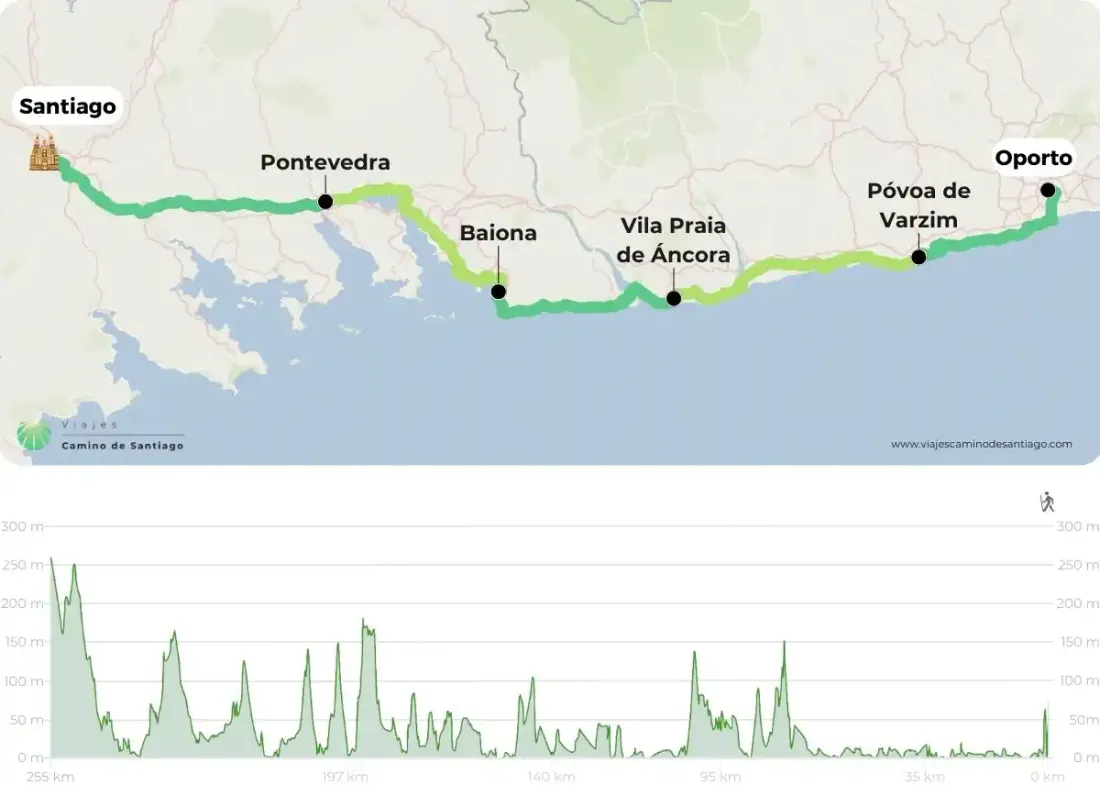
Map of the Portuguese Way by bike from Oporto – Coast
Stages
- day 1
Arrival at Oporto
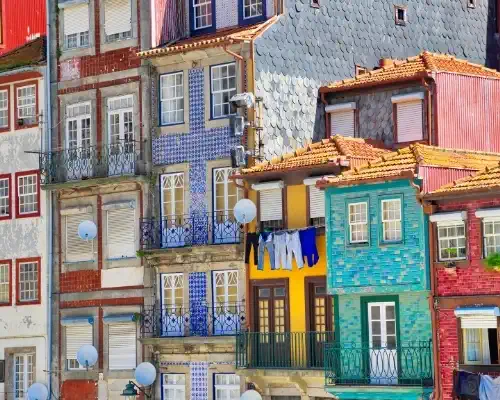
You will begin your adventure in the bohemian and beautiful city of Porto, which houses a large number of heritage sites and cultural legacies of Portuguese history. We recommend arriving in the city in the morning, dropping off your things at your accommodation, and heading out into the street. You can start your visit at Avenida dos Aliados, the heart of the city, a symbol for the locals and a meeting place for a multitude of cultural events. Make sure to stop by Praça da Liberdade and stroll to the famous and beautiful Livraria Lello e Irmão. Subsequently, right next door, it is mandatory to visit the Torre dos Clérigos. The town of Porto is, in short, a magnificent starting point for the Portuguese Way by bike. For a snack, we recommend trying the famous francesinhas and for dessert, a pastel de natas. After lunch, you can take a walk down to the Ribeira, passing by the São Bento station and the Cathedral. Porto is a wonderful city to get lost in among the streets of its monumental area… cobblestones, tiles, colors, wine, culture, and tradition come together in its narrow alleyways. - day 2
Stage 1. Oporto - Póvoa de Varzim (37 km)
The route starts at the cathedral of Oporto, to go down to the banks of the Douro and continue along the river promenade to its mouth in the Atlantic Ocean, in the place of A Foz. And from this locality to the exit of Oporto, you will follow the route through wooden walks that alternate with well paved cycle paths, crossing the localities of Matosinhos, Leça de Palmeira, Lavra, Angeiras and Labruge.
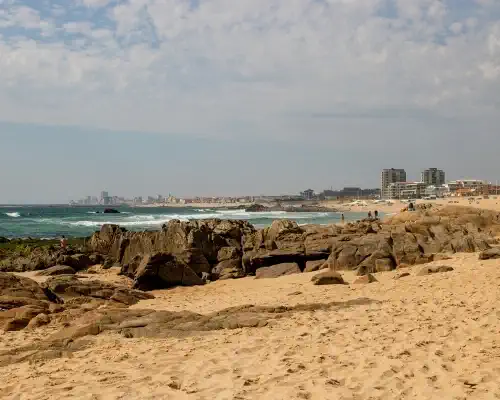
On your way, you will find several forts (such as the Forte de São Francisco Xavier or Castelo do Queijo), chapels and churches of great beauty, as well as countless beaches and several parks. You will pass by the Castro de Sampaio, the ruins of a small Iron Age settlement, and continue along the beach passing by the Ornithological Reserve of Mindelo, leaving behind churches, aqueducts and convents, until you reach Póvoa de Varzim.Póvoa de Varzim is a perfect stop to enjoy a relaxing day at the beach on its large sandy beaches.
One of the iconic places of this town is its aqueduct, declared a National Monument. Of great cultural interest are also: the Fortress of Nuestra Señora de la Concepción, the Church of La Misericordia and the Chapel of Santiago. But you can't miss a walk through the traditional fishermen's quarter, along Paseo Alegre and Rua da Junqueira, appreciating the beautiful tiles of the Manueline architecture and enjoying the rich local gastronomy: fresh fish and, for the more carnivorous, the famous picanha.To consider
Since leaving Porto can be excessively long and tedious, an option widely used by pilgrims is to leave Porto by public transport to Matosinhos and start walking from there, just 13 kilometres from Labruge. In this way, 30 kilometres will separate you from Póvoa de Varzim.Places of interest
- Foz do Douro seafront promenade
- Jardim do Passeio Alegre
- Lighthouse of San Miguel O Anjo
- Forte Sao Joao Baptista da Foz
- Felgueiras Lighthouse
- Forte de São Francisco Xavier "Castelo do Queijo" (Castle of Queijo)
- Beaches: Molhe, of the English, Senhora de Luz, of Ourigo, Gondarém,
- Man of Leme...
- Castro Sampaio - Labruge
- Mindelo Ornithological Reserve
- Fisherman's Neighborhood - Póvoa de Varzim
- Fortress of Our Lady of the Conception - Póvoa de Varzim
- Aqueduct - Póvoa de Varzim
Typical dishes
- Francesinhas
- Tripas a moda do Porto
- Cream cake
- Fish
- Picanha
- Caldeirada de peixe
- day 3
Stage 2. Póvoa de Varzim - Vila Praia de Ancora (60 km)
You will say goodbye to Póvoa de Varzim pedaling happily along a bike lane that crosses the town. Upon reaching the end of the beach, you will continue your peculiar walk by the sea. The first kilometers of the day will take you along beaches, momentarily moving away from the sea to pass through some greenhouse areas and fields. After reaching the small town of Apulia, you will approach an area of forests and pine groves that lead to Bofins Beach. A few more kilometers and you will be in Esposende, a perfect place to take a break. You will continue the route climbing up to the cemetery of Castelo de Neiva on a fairly steep slope, but it will be rewarded with the pilgrim atmosphere that the area has due to the presence of hostels. Once on more bike-friendly terrain, you will arrive at Chafé and after a slight ascent of 2 kilometers, you will have unbeatable views of the first city of the day: Viana do Castelo. Be careful on the descent, as the signs can be confusing; you must not leave the road at any time. You will continue pedaling towards the higher part of the city, towards the beautiful basilica of Santa Luzía. Moving north, you will reach the sea again, riding parallel for a few kilometers. After passing through an area of labyrinthine streets, stone walls, and cobblestones, you will arrive at a small ravine, in an area of rivers, waterfalls, and watermills. The last 20 km of the stage run through forests of pines and eucalyptus and some hills. After crossing a bridge and a stream, we arrive at the first houses of Vila Praia de Ancora. - day 4
Stage 3. Vila Praia de Ancora - Baiona (30.7 km)
Our tour today is very simple. We will set course for Oia following the coastline, with the Atlantic always open to our left. We will leave A Guarda from the promenade, following the route of the cetarias. Once we have arrived at the Cetaria Redonda, we will have to follow the indications to go out to the PO-552 road. The route now runs along the side of the road, sometimes signposted, crossing the counties of A Guarda and O Rosal, a land of excellent wines, towards the town of Baiona.
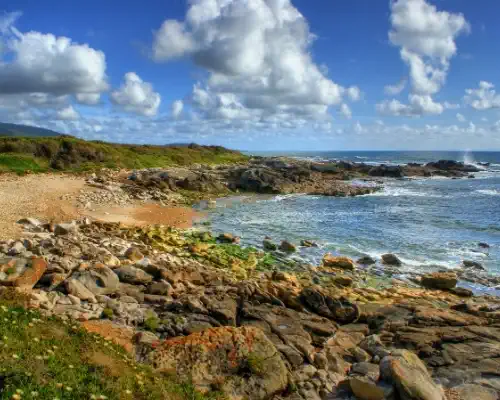
The hermitage of San Sebastián will greet us on our arrival in the town of Oia. From here, the road becomes more interesting as you get closer to the ocean. At this point there are only a few metres left to reach the village of Portecelo in Oia. After a couple of kilometres along the Estrada Real, we will descend again on a track to a level of the road closer to the coast.We walk a few meters and reach the main town of Oia, perfect for a stop, rest and even eat.
We take the track that goes down to the beach of Oia, at the height of Punta Ourelluda, we will come out again to the road. The Glasgow Hotel and a petrol station will serve as a reference to cross the road to the right after passing them. Now the path runs along a higher level of road, from where the views of the coast will be breathtaking. The path will take us back to the road at Porto Mougás.
From Porto Mougas there is very little time left to reach our destination in Baiona. We will only have to cross the places of Pedra Rubia, A Ermida, As Mariñas and Baredo, and we will arrive to Baiona.
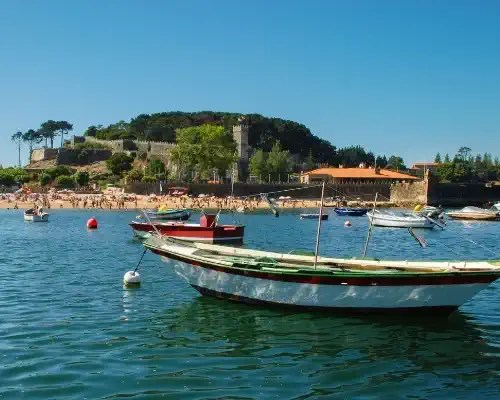
Baiona is a perfect place to make a stop on the way, as well as being one of the most beautiful coastal towns in the region. Galicia, has emblematic monuments such as the Monterreal Fortress, the replica of the Carabela Pinta or the Virgin of the Rock; not to mention its beaches, located just a stone's throw away from the route.To consider
Those who wish to visit the Hillfort of Santa Tecla can go to the Archaeological Museum, from where the guided tours organised by the Municipal Board will depart on weekends and holidays in July, August and September. The visits begin at 12:30 and 17:00 hours and will last 90 minutes, with a tour starting at the Museum and continue the descent on foot to theSanta Trega Hillfort. Because of this and the length of the stage, it is very important that you plan well the stage before leaving A Guarda, if you want to visit these places and not arrive too late to Baiona.Places of interest
- Round Cetaria
- Hermitage of San Sebastian
- Monastery of Santa Maria de Oia
- The Gamboa
- Castro of Chavella
- Cabo Silleiro Lighthouse
- Fortress of Monterreal
- Virgin of the Rock
- Caravel La Pinta
Typical dishes
- We continue with fish and seafood
- Seafood rice
- Fish stew
- White wine from Rías Baixas
- day 5
Stage 4. Baiona - Pontevedra (57 km)
You will say goodbye to Baiona cycling through a residential area that will gradually lead you to a more rural environment with scattered villages, interspersed with some wooded sections. After riding a stretch on the road, you will arrive at a series of villages before reaching the first stop of the day, the city of Vigo. After the mandatory stop, you will leave Vigo following a long road through quiet villages; after several kilometers, the houses will be replaced by trees and stunning views of the city of Vigo and the estuary, full of bateas; in the distance, you will also be able to see the Cíes Islands. You will descend with this wonderful view to the city of Redondela, where you can make another technical stop. From this point, only 6 km separate you from Arcade, a small fishing village famous for its oysters. So you know, a good place to eat. Shortly after saying goodbye to Arcade, you will enjoy one of the most iconic scenes of the entire Portuguese Way, Ponte Sampaio. It is a colossal stone bridge that spans the Verdugo River and where, during the War of Independence, a battle took place that resulted in the withdrawal of French troops in Galicia. After crossing the bridge, you will cycle past pazos, hórreos, cruceiros, and small villages until you reach Pontevedra. - day 6
Stage 5. Pontevedra - Santiago de Compostela (58 km)
Last stage of your Portuguese Way along the coast by bike from Porto! Today we recommend leaving early to make the most of the day in the Galician capital. After crossing the Lérez River, the path leaves Pontevedra and leads you to the Alba Marshes Observatory, a large wetland of 80 hectares that is home to hundreds of plant species and 123 bird species. The route runs along roads where many crossroads and level crossings converge, so you should exercise extreme caution. Once you reach Briallos, we recommend detouring half a kilometer to visit the Barosa Waterfalls, a natural setting of extraordinary beauty, with a beautiful sixty-meter drop and fourteen mills along the waterfalls. Shortly after, you will arrive at Caldas de Reis, one of the most renowned spa towns in Galicia and a good place to stop and regain strength. The next stop will be Padrón, from where you cannot leave without trying its famous peppers and discovering if they are as spicy as they say... or not. In Padrón, you will also find the famous "Pedrón," the stone with which they tied the boat that carried the remains of the Apostle Santiago. The last stretch goes through forests, crossroads, bridges, and ancient churches until you reach the parishes of Teo and Ames, the gateway to Santiago de Compostela. You just have to savor the last kilometers and stroll through the old town of Compostela until you make your triumphant entrance into the Plaza del Obradoiro. You are in Santiago! Feel happy and proud to have completed your Portuguese Way from Porto along the coast by bike. Now all that’s left is to collect your Compostela certificate and enjoy an incredible day getting to know the Galician capital. - day 7
End of the Camino
After arriving... End of the Camino
Frequently Asked Questions
-
What to see on the Portuguese Coastal Way?
The Portuguese Coastal Way offers a unique experience for pilgrims, with a combination of stunning natural landscapes and charming coastal towns. Throughout its 270 kilometers, from Porto to Santiago de Compostela, you will find a wide variety of places that will make your pilgrimage unforgettable.- Oporto: Starting point of the route, Porto is a vibrant city famous for its architecture, its UNESCO World Heritage-listed old town, and, of course, its Port wine cellars.
- Vila do Conde: This charming coastal town is known for its fishing port and beaches. You can also visit the Vila do Conde aqueduct and the Santa Clara Convent.
- Viana do Castelo: Considered one of the most beautiful cities in Portugal, Viana do Castelo stands out for its imposing Basilica of Santa Luzia, from which you can enjoy spectacular views of the Atlantic coast.
- Caminha: Located at the mouth of the Miño River, this picturesque town offers incomparable natural beauty. From here, you will cross into Galicia, entering Spain.
- Baiona: In Galicia, Baiona is a popular destination among pilgrims for its history and beauty. Here you can visit the Monterreal Fortress and enjoy the views of the Cíes Islands.
- Vigo: The largest city in Galicia on the route, Vigo is famous for its port and lively urban atmosphere. If you have time, you can explore the Atlantic Islands National Park, a natural paradise just a few kilometers from the coast.
- Pontevedra: This city is famous for its well-preserved old town and the Church of the Pilgrim Virgin, one of the symbols of the Camino de Santiago.
- Caldas de Reis: Famous for its hot springs, Caldas de Reis is an ideal stop to relax in the middle of the pilgrimage. In addition, it offers a charming old town and the Umia River that runs through the city.
- Padrón: Known for its connection to the legend of the translation of the body of the Apostle Santiago. Padrón is famous for its peppers and its historic Roman bridge, as well as the church of Santiago de Padrón.
- Santiago de Compostela: The goal of all paths, with its majestic Cathedral of Santiago, is the place where your pilgrimage ends and you can obtain the Compostela.
-
How many stages does the Portuguese Coastal Way have?
The Portuguese Camino de Santiago along the Coast is divided into 12 stages. It begins in Porto and has 270 kilometers to go to Santiago de Compostela. It must be taken into account that this distance may vary depending on the possible variants or complementary and alternative paths that the pilgrim decides to take during the route. Each stage would be the distance you travel in one day, from the starting location to the end of the walk, where you will spend the night. The stages can vary in distance and difficulty, and it is important to note that they can be adjusted according to your pace and physical condition. Some pilgrims choose to divide certain long or difficult stages, or lengthen those that are shorter or easier to walk. It all depends on having a place to sleep. -
How many kilometers is the Portuguese Way along the Coast?
The total kilometers of the Portuguese Way along the Coast are about 270 km from Porto, its beginning. It must be taken into account that this distance may vary depending on the possible variants or complementary and alternative paths that the pilgrim decides to take during the route. -
Do all accommodations have a lockable place to store my bike?
Yes, we make sure that all assigned accommodations have a place where you can leave your bike safe and sound. -
What services are included in the Camino de Santiago by bike?
The Camino de Santiago by bike includes the following services:
- Accommodation
- Luggage transport
- Dossier with information about the stages
- Pilgrim's credential
- On-the-road helpline
- Travel insurance
In addition, you can customize your trip by adding the following optional services:
- Breakfast or half board
- Extra night at the beginning or end of the stage
- Bicycle rental
Unlike the group trips, no guide or support vehicle is included between stages. However, you will have a 24-hour hotline where you can contact us in case of any problem or unforeseen event, which we will solve quickly.
-
What is on-the-road telephone assistance?
In your travel documents, you'll find an emergency telephone number where we're accessible while you're on the road. This ensures you'll journey with peace of mind, knowin our team members will assist you with any problems, incidents, or questions you encounter along your Camino de Santiago.
-
What is travel insurance?
It is the guarantee that you can enjoy your Camino in a safe way. In our trips you already have an insurance included with your trip to be protected during the Camino de Santiago. We will send you the insurance policy along with all the documentation of your trip, so you will have everything you need to enjoy the Camino with peace of mind. Walk without worries! -
Where are the accommodations located?
In your travel documents, you will find the names of the accommodations assigned to you, as well as their contact telephone number and location. As a general rule, all accommodation are located in the centre of the different towns along the Pilgrims' Route to Santiago de Compostela, without the need to deviate too far from the route. But sometimes, due to lack of availability, it is possible that some accommodation may be a little far from the village or even in neighbouring towns. For all the accommodations that are at a considerable distance from the route of the Camino, we will provide you with a free taxi service that you can use to get to your accommodation and return to the Camino the next morning. In any case, these are exceptions that we will inform you at the time of booking. -
What coverage does the travel insurance have?
The basic travel insurance included in our packages offers extensive coverage against unforeseen events, ensuring you'll receive guaranteed medical assistance and numerous benefits. You can review the specifics in the General Conditions of Travel Insurance.
-
What kind of bicycles can I rent to do the Camino de Santiago?
We have high quality mountain bikes and electric bikes that you can rent during the whole Camino. Check the details here.
-
How do I make a reservation?
To make a reservation, you can follow these steps:
- Through our website: Select the route you want and follow the steps indicated in the form. Provide your personal information and that of your companions, choose the type of accommodation, room distribution, meals, transfers, bike rental, etc.
- By email: If you prefer to make the reservation by email or need a personalized trip, you can send us an email to info@viajecaminodesantiago.com. We will provide you with the necessary information to complete the reservation via email.
It is important to note that if the routes or services available on the website do not meet your specific needs, you can request a personalized quote by sending an email to info@viajescaminodesantiago.com.
-
Can I choose the dates I want?
Yes, you will have total freedom to choose your departure date. However, if you want to do your Camino de Santiago in the months of December, January and February, we recommend that you check availability before making your reservation. At this time of year most accommodation is closed and many services may not be available. -
What is luggage transport and how does it work?
Luggage transport service by default is included in all our trips and it is not necessary to request it. You can enjoy the Camino de Santiago without the burden of carrying your luggage on your back, knowing that your suitcase will be waiting for you at your next accommodation upon your arrival. Along with your credential, you'll also receive stickers. Cover these stickers with the requested information and stick them in a visible place on your suitcase. Upon arrival at your accommodation, we suggest asking at the reception where you can leave your luggage. You'll need to leave your luggage at the designated spot early in the morning for our carrier to pick it up. This ensures that when you arrive at your next accommodation, your luggage will already be waiting for you.
Portuguese Way by bike from Oporto – Coast
From 1076 €


Reviews
Montse