


By car along the Lifghthouse Route: 200 kilometres of wild nature
19 February, 2026
Route by car along the Route of the Lighthouses in Galicia, traversing coastal landscapes, iconic lighthouses, and viewpoints of the Costa da Morte, with recommendations for stages, distances, and points of interest to plan an excursion along the northern coast between Cabo Ortegal and Fisterra.

The Way of the Lighthouses is a network of nearly 200 kilometers of fascinating trails, divided into about eight stages of approximately 25 kilometers each, traversing the Costa da Morte from Malpica to Finisterre. While it is true that the route is designed to be walked or even cycled, we propose to discover this route by car, trying to follow the road closest to the coast, with the sea accompanying us and unmatched views of impossible cliffs. Stops in those fishing villages of Galicia filled with tradition, lighthouses that tell stories, beaches to arrive at and never leave… In short, kilometers of wild nature, tradition, and culture that begin at the beautiful port of Malpica and reach the lighthouse at the end of the world: Finisterre, where all the routes of the Camino de Santiago extend.
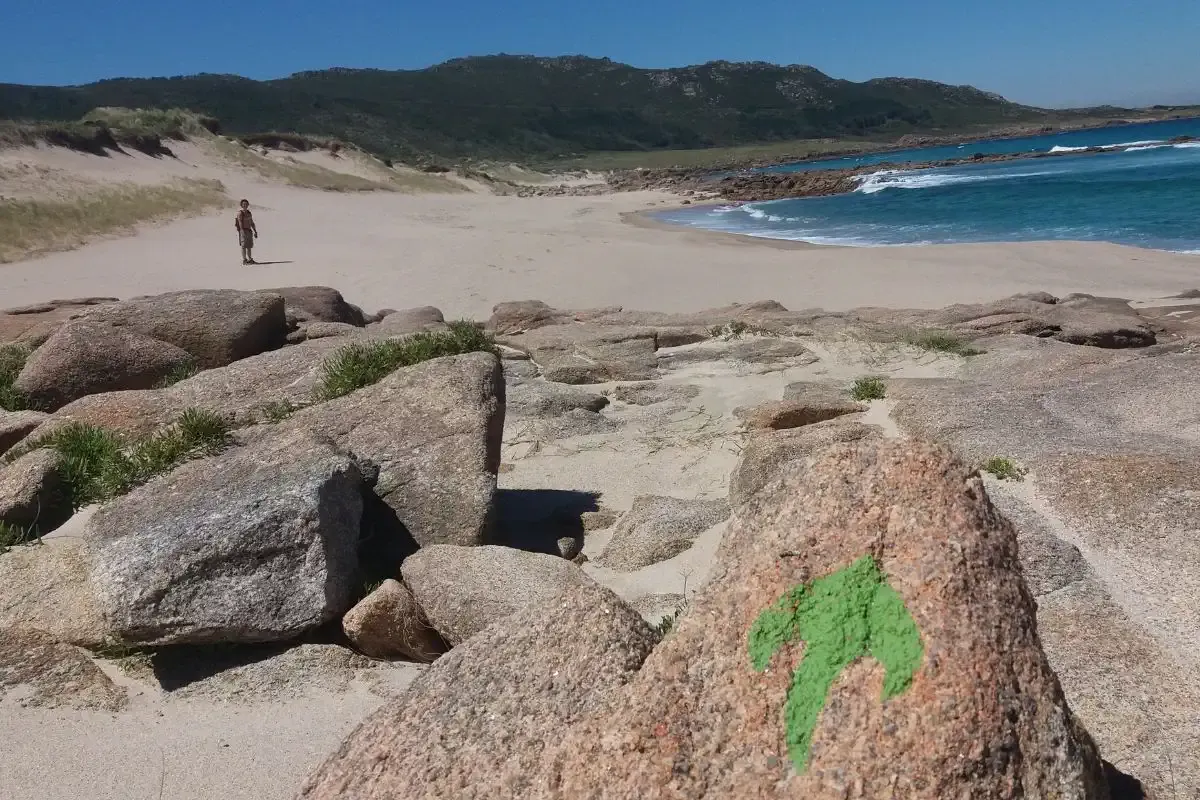
A hiker on the Way of the Lighthouses, passing through the beaches of Trece
Itinerary of the Way of the Lighthouses
From Malpica to Finisterre, we will travel this unique route by motor on the Way of the Lighthouses in a division of five sections, so you can cover them in about five days with your car. Shall we begin?
Malpica, 100% maritime tradition
We begin the Lighthouse Route in Malpica, a fishing village that has been shaped by the crashing waves against the pier of the port. A port that once served as a base for whaling and that today continues to operate at full capacity. It will be at this first stop where we enjoy the beach of Area Maior, the hermitage, and the viewpoint of San Adrián. From here, we will see the Islas Sisargas, which have housed the first of the lighthouses on our route since 1919. Before we leave, we will pass by Beo beach, stopping to see its cross, the beach of Seiruga, and continue on to Punta Nariga. Here we find the second of the lighthouses on this route, surrounded by rocks shaped by the sea and the wind, creating a breathtaking and fascinating landscape.
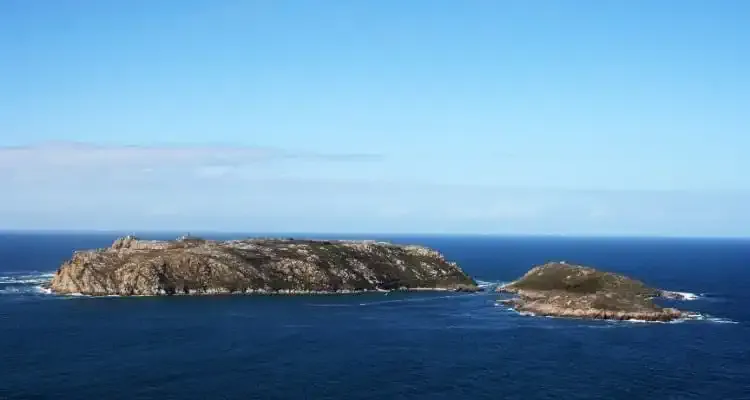
View of the Sisargas Islands
From Niñons to Ponteceso with the sea as the protagonist
In this part of the journey, we will stop at many corners that will be hard to forget due to their uniqueness. The port of Santamaría is one of them, as it offers us a beautiful view of Punta Nariga. However, the most significant sight will be the houses of the village of Roncudo, where the construction adapts to the harshness of the area, and where the sea does not forgive.
In this area, we will find the third of the lighthouses crowning a gray rock outcrop where the sea lashes mercilessly, producing a deafening, hoarse noise that gives this lighthouse its name, Roncudo. There will be several beaches where we can stop: Osmo, Ermida, etc. It is impossible not to stop to see Pedra da Serpente, a unique vestige in Europe, dating back to the Roman era where paganism and Christianity shake hands. And before continuing on our way, a stop in Ponteceso to see its bridge over the Anllóns River and the pazo where the poet Eduardo Pondal was born.
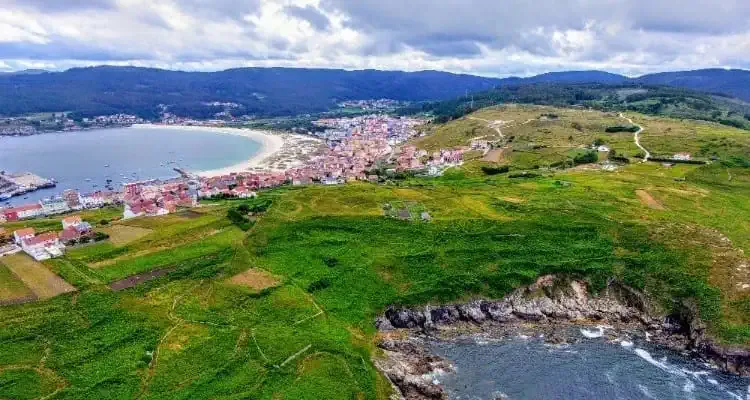
View of Laxe
From Laxe to Arou, unique ecosystems and much history
Once we leave Ponteceso, we will divert inland to discover two unique archaeological sites: the settlement a Cibda de Borneiro, inhabited between the 6th century BC and the 1st century AD and discovered in 1924 by Isidro Parga Pondal. Additionally, we highlight the Dolmen de Dombate, a gem of megalithic art that surprises with its grandeur and magnificent state of preservation, including an interpretation center. From there, to enjoy one of the best views of the Atlantic Ocean on this Lighthouse route, we will ascend to Monte Castelo or Monte Insua, where the Faro de Laxe is located. Here we find the sculpture "A Espera". A tribute to all those women and children who patiently wait on solid ground for their fathers, sons, grandsons, and sailor husbands.
Its location is privileged, with the infinite ocean to the left, the estuary of Laxe to the right, a spectacle for the senses. A must-visit is the beach of the crystals, where the ocean returned the crystals from various bottles; it was a dumping ground, transformed into small colorful tears. The lagoon and beach of Traba gift us a peculiar ecosystem with the dunes as the protagonists on the beach, and a walkway in the lagoon from which to contemplate the flora and fauna of the area. Leaving Arou, we should not miss the opportunity to stop at the viewpoint of Lobeiras.
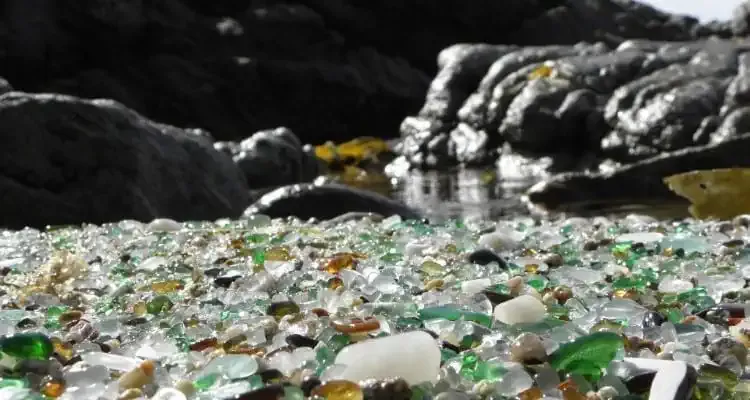
Beach of the Crystals, in Laxe
From Camariñas to Muxía, pure Costa da Morte
In Camariñas we find the Cabo Vilán Lighthouse, the first electric lighthouse in all of Spain, where we can visit the Interpretation Center of shipwrecks, lighthouses, and maritime signals, as well as the Faro Vello, which operated on steam and is still standing. The path that takes us through this area is pure Costa da Morte. A rugged road with views of those dizzying cliffs, where stone is our companion, showing us impossible sculptures forged by waves, wind, and time. We arrive at a must-stop, Punta do Boi, where we find the well-known Cemetery of the English.
Here, in the mid-19th century, three shipwrecks occurred, cursing this part of the Costa da Morte. In 1883, the 'Iris Hull' departed from Cardiff never to return. In 1890, the 'Serpent' left Plymouth for Sierra Leone but a storm crashed the vessel against the rocks of Punta Boi, and it never reached its destination. Finally, in 1893, the 'Trinacria', which left Glasgow bound for Gibraltar, would never arrive at its destination. Here, in this place as beautiful as it is tragic, lies this cemetery, a tribute to those British subjects who lost their lives on the Galician coast, making this an iconic location.
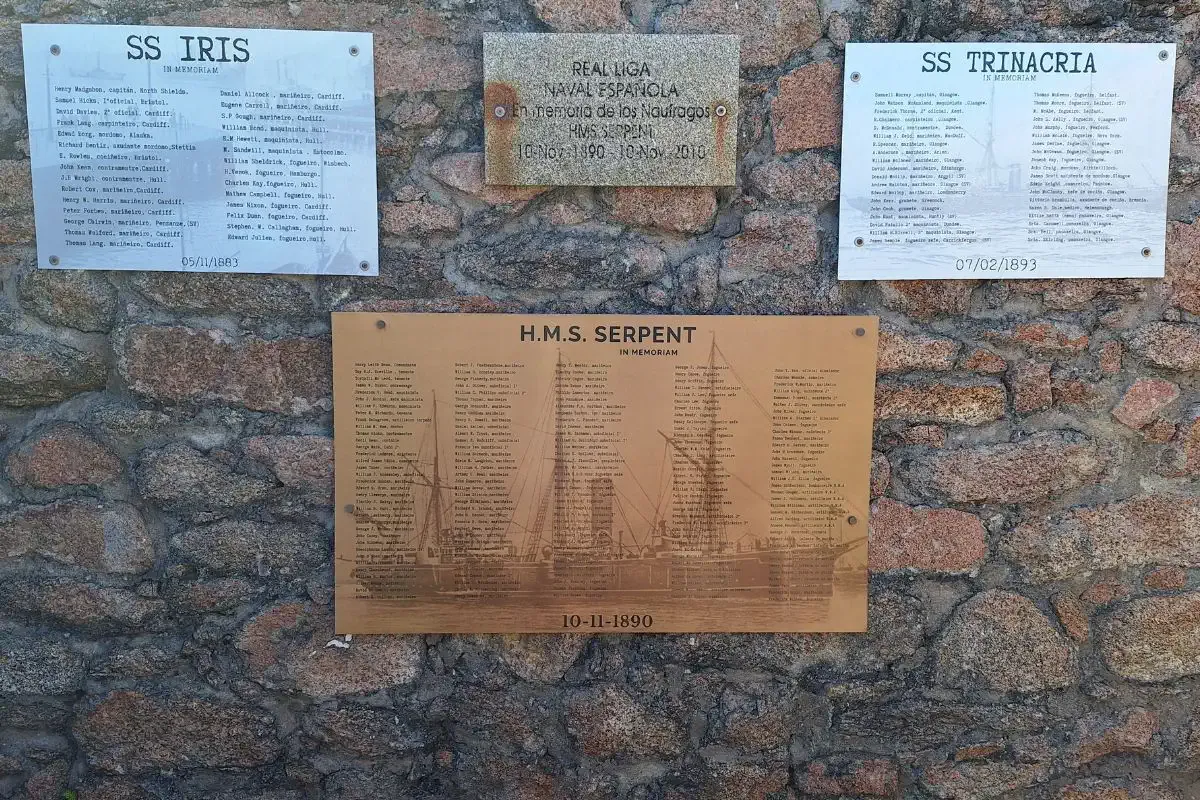
The Cemetery of the English pays tribute to all the shipwrecks that occurred in the area
From Muxía to Finisterre, where the Sun dies
And we arrive at Muxía. If Santander is the bride of the sea, this emblematic Galician city is the bride of the wind. The port, which feeds the locals, welcomes us, the one that was struck by the disaster of the 'Prestige' in 2002 (a promenade has been created in memoriam) welcomes us, but we are going to continue towards the Shrine of Our Lady of the Boat. We climb the steep staircase to Mount Corpiño: the effort is worth it, as before us lies a panoramic view of Muxía, the Vilán Lighthouse, the sea, the green of the meadows… Our next stop is the Muxía Lighthouse, whose location is privileged. A visual spectacle at dawn, at sunset, with the rough sea shaking the rock mercilessly. Impressive.
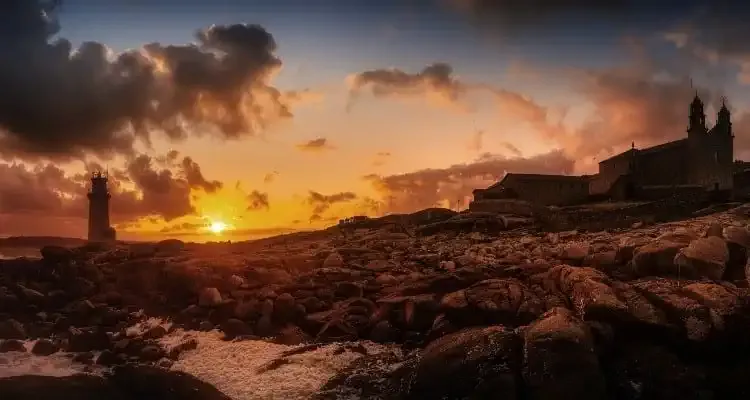
Sunset in Muxía
We continue towards Touriñán to see the Cape of the same name. A rocky place, with its lighthouse, from which one can contemplate the last sunset of the European continent. And we arrive at the end, at the Cape of Finisterre, the cape of the end of the world, the final stop of the Camino de Santiago. A set formed by the octagonal lighthouse, the Cow of Fisterra, with a warning siren and the Semaphore, from where signals were sent to warships since it was built in 1879. And what a wonder to say goodbye to this fantastic route with the Atlantic Ocean at our feet. Like a carpet of water and salt, with that scent that permeates everything, contrasting with the green of the meadows surrounding the lighthouse.
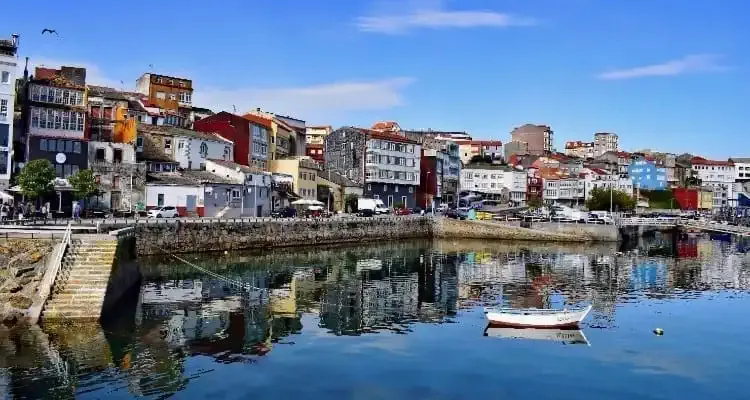
Port of Finisterre
A route full of sensations that we cannot stop enjoying. Fishing villages with a special charm, immense beaches, impossible cliffs, regal lighthouses, rocks that are art. Nature in its purest state or viewpoints that gift us with priceless views, are some of the incentives to consider taking this Lighthouse route on a unique getaway in Galicia.
Comments (1)
MARIA JESUS TAMARIT
Jorge Severo Medina Martín
Leave a comment