


Map of the Portuguese Way along the Coast
11 October, 2026
The Portuguese Way along the Coast connects Porto and Santiago over around 270 km and 13 stages, following the Atlantic coastline of Portugal and Galicia. With little climbing and plenty of services, you can also start it in A Guarda, Baiona or Vigo.

The Portuguese Way along the Coast covers around 270 km between Porto and Santiago de Compostela following the Atlantic coastline, a different alternative to the traditional inland route. It's a more relaxed route, with less climbing, where you'll walk by the sea and enjoy the coast's cuisine. A 100% Atlantic route that will leave you with a great taste in your mouth.
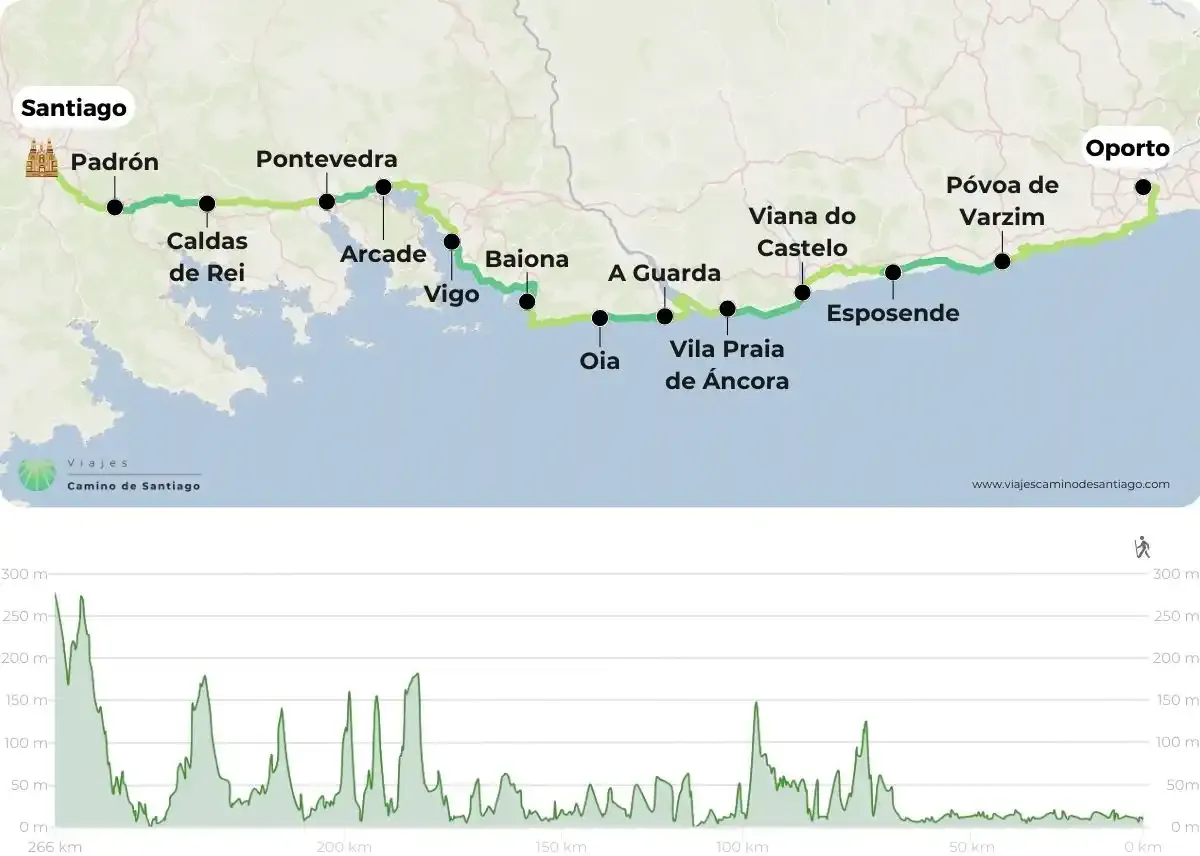
How to read this map of the Portuguese Way along the Coast?
On the map you have the full route from Porto to Santiago, split into 13 stages: Póvoa de Varzim, Esposende, Viana do Castelo, Vila Praia de Âncora, A Guarda, Oia, Baiona, Vigo, Arcade, Pontevedra, Caldas de Reis, Padrón and Santiago. Below you'll see the elevation profile, so you can tell at a glance where the climbs are.
Along the way you'll cross 2 countries, 3 Portuguese districts and 2 Galician provinces. In Portugal you'll pass through the districts of Porto, Braga and Viana do Castelo; once in Galicia, through the provinces of Pontevedra and A Coruña. On reaching Redondela, past Vigo, the coastal route joins the traditional Portuguese Way, and from there the two share the final stages into Santiago.
If you want to compare it with the inland route, here's also the map of the Portuguese Way from Lisbon.
As it passes through beach areas that are major holiday destinations, you'll find plenty of towns with services: shops, bars and accommodation appear along the way very frequently.
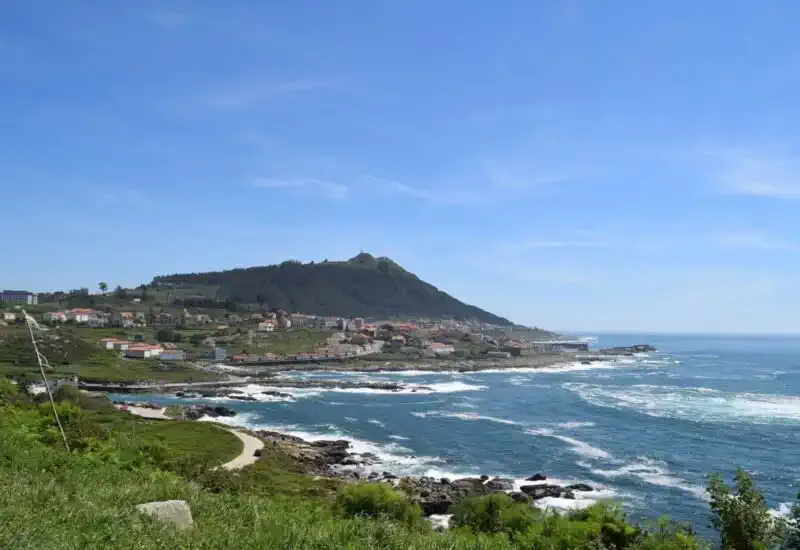
A Guarda, at the mouth of the Miño
Something to keep in mind!
When it comes to climbing, this is one of the easiest Caminos. On the Portuguese section the profile is nearly flat, with long stretches of seafront promenade and wooden boardwalks along the beaches. The most noticeable climbs come once you're in Galicia, and, as you can see in the map's elevation profile, the highest point of the whole route, at around 270 m of altitude, is on the last stage, between Padrón and Santiago.
That said, good infrastructure has its downside. The Coastal route has become one of the most popular, as you can see in our Camino statistics, and in summer it overlaps with beach season. If you're travelling then, it's worth booking accommodation in advance, or leaving it in the hands of a specialized agency, so you don't end up without a bed.
Beyond that, it's one of the Caminos you'll enjoy the most: good surfaces, mild temperatures and the sea almost always in sight. If you feel like a swim between stages, take a look at our selection of beaches on the Camino de Santiago.
But… where do I start the Camino?
The usual way is to start the Portuguese Way along the Coast in Porto, a wonderful city that deserves a prominent place on your map. If you'd rather do only the Portuguese section, you can also walk from Porto to A Guarda in 5 stages.
If you don't have that many days, there are other options. One is to set off from Porto on the Portuguese Way along the Coast by bike, very manageable since it has hardly any climbs.
Another is to start already in Galicia and travel through the Rías Baixas. Setting off from A Guarda, right on the border with Portugal, it's about 150 km to Santiago in 8 stages. And if you're tighter on time, you can start in Baiona, in 6 stages.
You can also set off from Vigo, in 5 stages. In all of these cases you'll earn the Compostela, which is awarded for walking at least the last 100 km into Santiago.
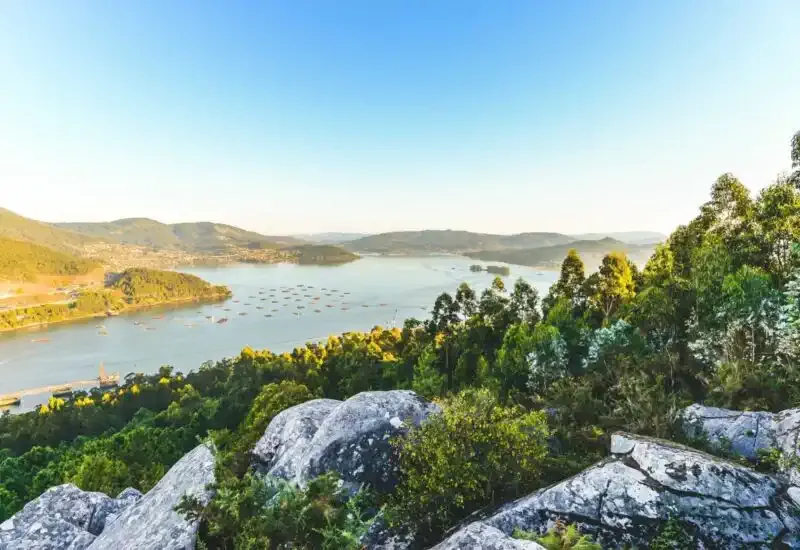
The Vigo estuary and its mussel rafts
And if you want to enjoy the Rías Baixas while staying in top-level hotels, you can combine the pilgrimage with a luxury Camino from Baiona.
From Pontevedra onwards, anyone wanting to stay close to the sea can take the Spiritual Variant, which approaches the ría de Arousa and goes up the River Ulla by boat to Pontecesures, at the gates of Padrón, following the Traslatio of the Apostle.
If what you're after is walking while enjoying the scenery and alternating stages with the beach, don't miss the best beaches of northern Portugal and the Rías Baixas.
Can you already picture yourself walking toward Santiago with the Atlantic by your side? Work out the price of your Camino by the Coast here and start putting it together to suit you.