


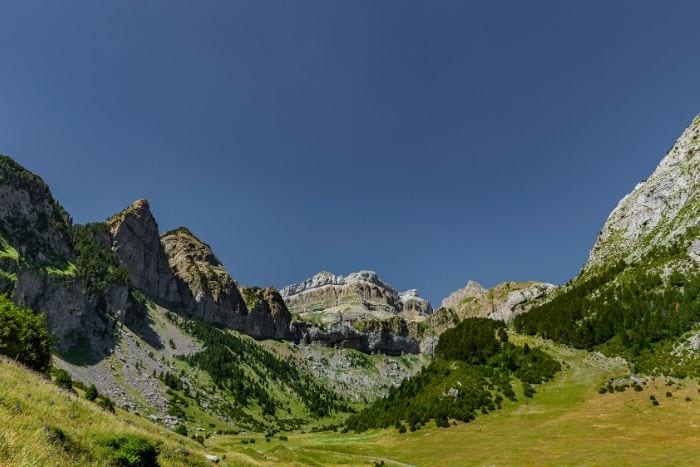
There are places that don’t need to make noise to win you over. Somport is one of them. A mountain pass, yes, but also an ancient frontier, a bright fissure between two countries, a threshold that has spent centuries teaching people how to cross a mountain range and, along the way, how to walk through history itself. Sitting at around 1,640 meters above sea level, it is one of the great natural gateways of the central Pyrenees and one of the few routes that often remain accessible for much of the year.
Whoever reaches this point —by road, in silence, as the forest closes in around them— senses that something shifts. It’s not just the altitude or the early snow. It’s the certainty that for centuries this pass was the main Pyrenean gateway to southern Europe. On one side lies the Aragón Valley, in Aragon; on the other, the Aspe Valley, in the heart of the Béarn Pyrenees. Long before pilgrims, long before kings and legends, came the Romans, who called this place Summus Portus: the highest pass, the name that said it all.

Snowy Somport
Somport, a frontier crossed countless times
In Somport, history walks slowly, as if it struggled with the same slope as the traveler. In the Middle Ages, thousands of pilgrims entered Spain through here following the Via Tolosana, which arrived from Arles. They crossed the pass through fog and snow, descended toward the Aragón Valley, and left behind a trail of languages, fears, prayers, and blisters. Some sought miracles, others forgiveness. All sought to reach their destination.
For centuries, the Hospital of Santa Cristina operated here, one of the most important pilgrimage care centers in Europe. Today, only ruins remain, but the idea persists: someone carved a way through these mountains so that others would not have to walk alone. From the pass, a simple path descends toward the remains, reminding the traveler that this frontier was, for a long time, a gateway to Christendom for those arriving from the north.
And Somport has never been just a place to pass through. It is also somewhere one stops to look. To breathe. To understand why this natural corridor was coveted by merchants, kings, shepherds, and travelers alike. Goods, news, and languages crossed here long before tourist maps ever existed. The mountain has a memory.
A nature that rules
On a clear day, it becomes obvious that Somport resembles a natural amphitheater. Dense forests on the French slopes. Meadows opening toward the Spanish side. A high-mountain wind that caresses and cuts at the same time. And a clean silence heard only at such elevations.
Here the mountain is not a backdrop: it is the protagonist. Chamois at dawn, marmots standing guard on the rocks, birds of prey drawing wide circles over the valleys. Water running crystal clear. Rocks that speak of centuries. The Aspe Valley on the French side forms part of a vast natural corridor of peaks, forests, and ravines preserving exceptional Pyrenean biodiversity, while on the Spanish side the Aragón Valley stretches toward Jaca amid summits, fortresses, and mountain stations.
In winter, a white mantle covers everything. The paths disappear beneath the snow, and the landscape slows down, as if time itself needed to rest. Around the pass, a Nordic ski area offers groomed circuits for cross-country skiing and snowshoe trails winding through woods and open clearings—suitable both for beginners and for those seeking long winter traverses. When the snow melts, the same gentle slopes become suitable terrain for walks, hiking routes, and outdoor activities for all ages.
In summer, the colors shift: intense greens, tiny flowers clinging to the heights, a sky that seems somehow closer. Former winter trails become easy paths that allow visitors to explore the Pyrenean landscape without being expert mountaineers, and the pass becomes a privileged viewpoint over two valleys, two countries, and a single mountain chain.
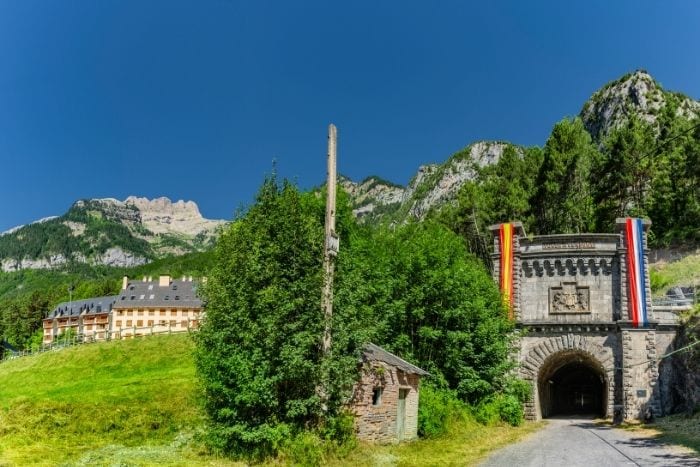
Somport in the summer season
Somport is the starting point of the Aragonese Way, but it doesn’t need to be explained in stages. Here, the Camino de Santiago is not only an itinerary: it is also an echo. One thinks of medieval pilgrims, of harsh weather, of footsteps lost under a blizzard. One also thinks about what it means to begin a journey by crossing a natural frontier, leaving one country behind to enter another on foot, following a track carved centuries ago.
It doesn’t matter whether the visitor plans to walk the Camino or not: Somport leaves the impression of being a place where something begins. The simple act of stopping the car, stepping out, looking around, and feeling the cold air is, in a way, a small pilgrimage.
How to reach this remote and peaceful place
The most common way is to ascend from Jaca, following the Aragón Valley upstream. The road traces the river’s course and passes through mountain villages before climbing toward the border. From Huesca or Zaragoza, trains and buses connect with the area, reaching Canfranc, from where the road continues upward until it crests the pass.
From France, the route up the Aspe Valley rises slowly from villages such as Bedous or Urdos, wrapping the traveler in the landscape before revealing the threshold of the frontier. In any case, it is advisable to check the weather forecast and road conditions before heading up: here, the mountain always rules.
Somport: the pass that remains a pass
In a country full of beautiful places, Somport has something one remembers without trying: a mixture of frontier, silence, and altitude. A place where nothing much seems to happen, and yet everything happens. A precise point where the Pyrenees open and allow passage to those willing to look at them. Perhaps that is why those who cross it once often feel they have traversed not only a mountain range, but also a small dividing line in their own journey.












Leave A Comment