


Altamira Caves: soak up prehistory with its cave art
05 December, 2025
Guide to the Altamira Caves in Cantabria, explaining their historical and artistic value as a reference of rock art, what to see in the neocave and the museum, how to organize the visit, and practical tips to enjoy this key cultural site on a route through northern Spain.

The Altamira Cave, located in Santillana del Mar (Cantabria) and very close to the route of the Northern Way, is one of the most important archaeological sites in the world. Considered the "Sistine Chapel of rock art," it houses a unique set of prehistoric paintings due to their artistic quality, state of preservation, and immense historical and cultural value.
This site is part of the National Museum and Research Center of Altamira, an institution responsible for its conservation, research, and visitor management, due to the extraordinary fragility of the cave. Before explaining how to visit it today, it is essential to know its history, its discovery, and the importance of the legacy it preserves.
The human occupation of the Altamira Cave
The archaeological investigations conducted in the vestibule of the cave have documented different moments of human occupation during the Upper Paleolithic. The excavated levels date approximately from the end of the Gravettian (around 26,400–26,000 BP, that is, approximately 24,450–24,050 BC), through the Solutrean (24,000–20,500 BP, approx. 22,050–18,550 BC), to the Magdalenian (19,000–16,800 BP, approx. 17,050–14,850 BC).
For thousands of years, groups of hunter-gatherers used this space both as a refuge and as a place for symbolic expression. The rock art of Altamira was not created at a single moment, but over different phases, which explains the diversity of techniques, styles, and motifs represented.
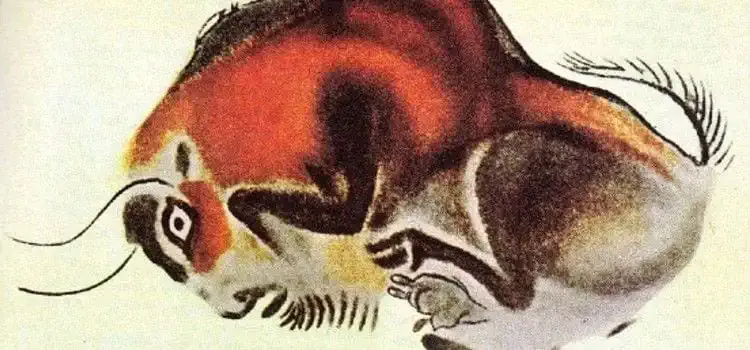
Bison painting
What does BP mean and why is it used in archaeology?
In archaeological and prehistoric studies, it is common to use the abbreviation BP, which stands for "Before Present". By scientific convention, the "present" is set at the year 1950. For example:
- 20,000 BP means 20,000 years before 1950, that is, approximately 18,050 B.C.
- 16,800 BP is approximately equivalent to 14,850 B.C.
This system is used because it is more precise for scientific dating, especially those carried out using carbon-14, and avoids cultural or religious references. In this article, both formats (BP and B.C.) are shown to facilitate understanding for the general reader.
The discovery of the Altamira cave
The discovery of the cave dates back to 1868, when Modesto Cubillas, a local resident, casually located the entrance. Years later, he informed Marcelino Sanz de Sautuola, a local owner with an interest in prehistory, who began to explore it systematically in 1875.
The decisive finding occurred in 1879, when Sautuola visited the cave accompanied by his daughter María. While her father was excavating in the vestibule, the girl ventured into a deeper area and, upon looking at the ceiling, distinguished the famous polychrome bison painted on the vault. That moment marked a before and after in the history of prehistoric art.
The controversy and scientific recognition
When Sautuola presented his conclusions in 1880, arguing that the paintings were prehistoric, the scientific community reacted with skepticism. At that time, it was believed that Paleolithic humans did not possess the artistic ability necessary to create such complex works.
The recognition came after the discovery of other sets of rock art in France, such as La Mouthe, Les Combarelles, and Font-de-Gaume, which confirmed the existence of similar Paleolithic art. Ultimately, the authenticity of Altamira was accepted and its universal value recognized.
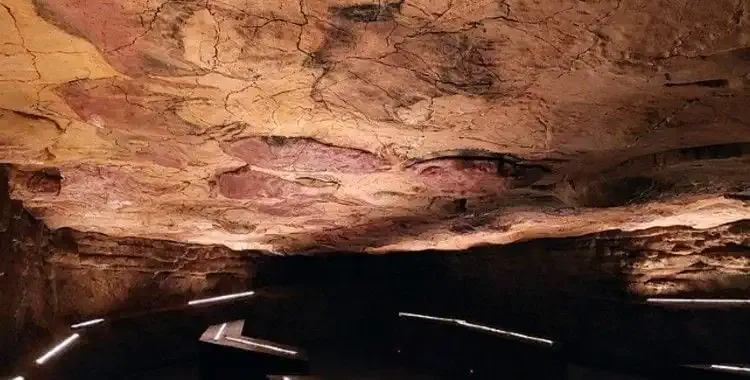
Main hall of Altamira
In 1985, the Altamira cave was declared World Heritage by UNESCO, a distinction that was later extended to the group of caves with Paleolithic rock art in northern Spain.
The cave and its rock paintings
The Altamira cave has an approximate length of 300 meters, with a main gallery and several branches. The most famous area is the Hall of the Polychromes, located in a deep part of the cave, away from natural light.
The famous polychrome bison were created using natural pigments such as iron oxides, charcoal, and other minerals, mixed with water or animal fat. The artists took advantage of the natural reliefs of the rock to create volume, movement, and a surprising sense of realism.
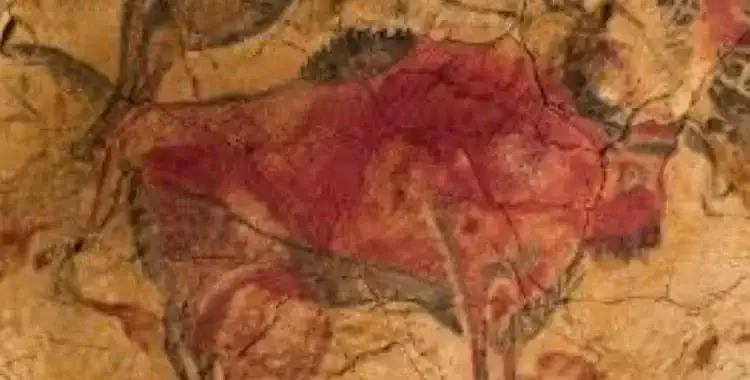
Original bison of Altamira
To illuminate the interior of the cave, animal fat lamps were used, demonstrating remarkable technical knowledge. In addition to animals such as bison, deer, or horses, the collection includes abstract signs, engravings, and monochrome paintings that continue to be the subject of study.
How to visit the Altamira cave today
To ensure its conservation, the original Altamira cave is not generally open to the public. Instead, visitors can explore the Neocueva, a faithful reproduction integrated into the Altamira Museum, which allows for an understanding of the artistic ensemble under conditions very similar to the originals.
Exceptionally, there is a restricted access program to the original cave, limited to a maximum of five people per week. The visit lasts approximately 37 minutes, is conducted with specific clothing, and under strict environmental control. Photography is not allowed.
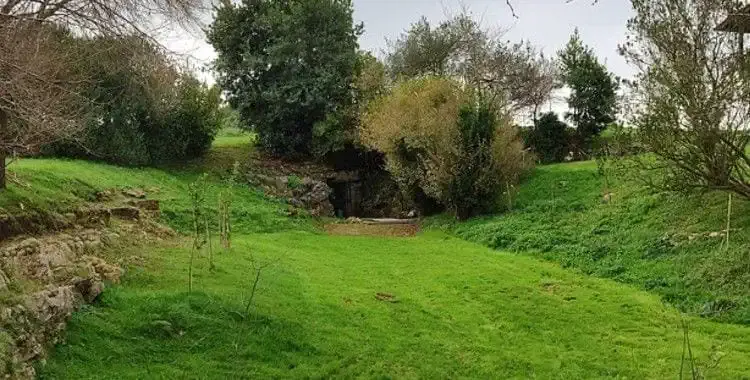
Entrance to the Altamira Cave
The access system is usually conducted through selection or in-person lottery among the museum visitors, although this procedure may vary, so it is recommended to always check the updated official information.
The Altamira Museum is closed every Monday of the year (except for exceptional holidays) and ticket sales end 30 minutes before closing.
Altamira and the Northern Way
For those traveling the Northern Way, a visit to the Altamira cave is an essential cultural stop. Santillana del Mar, moreover, is one of the best-preserved medieval ensembles in Spain, making this stage a perfect combination of history, art, and spiritual experience.