


The Botafumeiro of Santiago Cathedral: history, curiosities and how to see it
13 October, 2026
The Botafumeiro is the great flying censer of Santiago Cathedral and one of the symbols of the Camino. We tell you its history, its figures, when it works and why it is now temporarily out of action due to restoration works.

The Cathedral of Santiago, besides holding the tomb of the Apostle and being the destination of every pilgrim, hides one of the most famous objects in the Christian world: the Botafumeiro, the great flying censer that swings from one side of the church to the other. It is, without doubt, one of the symbols of the Camino de Santiago, and here we tell you its history, how it works and what you should know if you want to see it.
Those who see it for the first time are left speechless. It is not just an object that "flies": it is a blend of faith, craftsmanship and historical engineering. Watching it in motion, with the organ playing and the incense rising towards the vaults, is one of those moments that every pilgrim of the Camino de Santiago routes remembers forever.
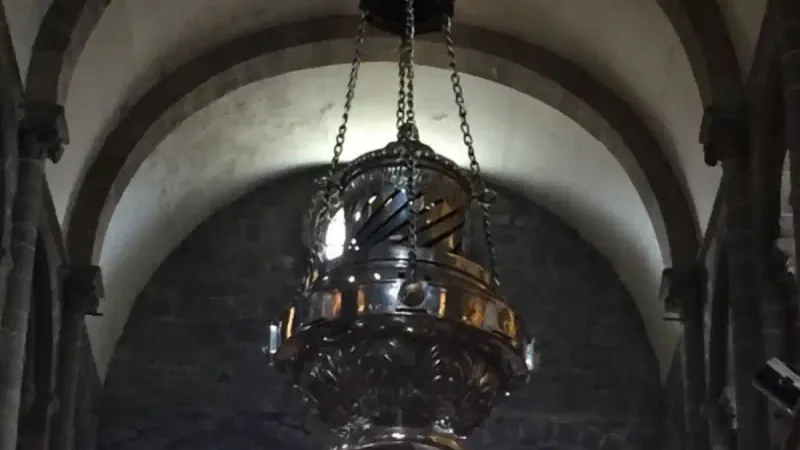
The Botafumeiro, a symbol of Santiago Cathedral and the Camino
Does the Botafumeiro work now?
First of all, an important notice: the Botafumeiro is temporarily not working due to the restoration works at the Cathedral, and it will not fly again until further notice. In addition, because of the works in the main chapel, from 16 October 2026 and until further notice the Pilgrim's Masses are held in the Church of San Agustín. The church remains open for visits.
If you are arriving in Santiago soon, check beforehand the Cathedral's official website, where it will be announced when it starts working again.
History of the Botafumeiro: from the Middle Ages to today
The use of incense in Christian liturgy is very ancient. In Santiago, the earliest written reference to the great censer is an annotation on a page of the Codex Calixtinus, which calls it Turibulum Magnum, that is, "great thurible".
Its current name, botafumeiro, means in Galician "the one that gives off smoke". Besides its religious meaning, it is said that it also had a practical function: perfuming the interior of the Cathedral at a time when pilgrims, after long days on the Camino, would sometimes spend the night inside the church.
According to tradition, the old silver censer was stolen by Napoleonic troops in 1809. The one used today is made of brass and was made in 1851 by the silversmith José Losada. There is also a silver replica, given to the Cathedral in 1971 by the Alféreces Provisionales.
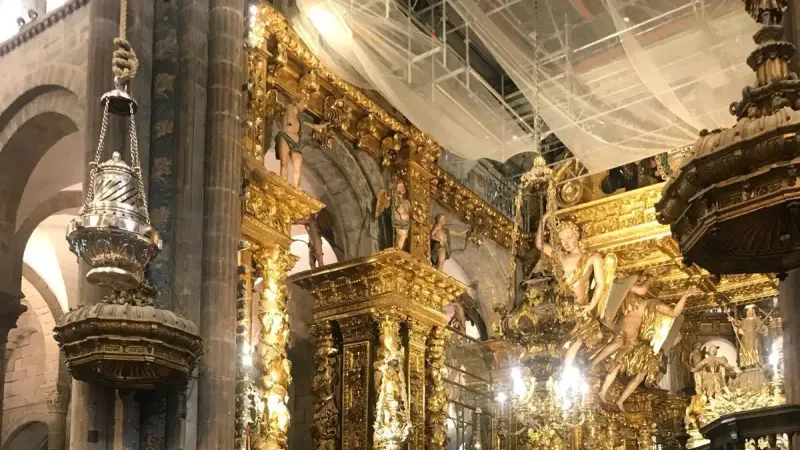
The Botafumeiro at rest beside the main altar
The mechanism: pulleys beneath the dome
The Botafumeiro hangs from a system of pulleys installed in the central dome of the crossing, known as the mechanism, which has been working since the early seventeenth century. Thanks to it, the censer swings from the centre towards the side aisles of the transept.
This historic mechanism was restored in 2024: the drums were inspected, the wooden axle was reinforced with a steel axle inside it, and its original polychrome finish was recovered.
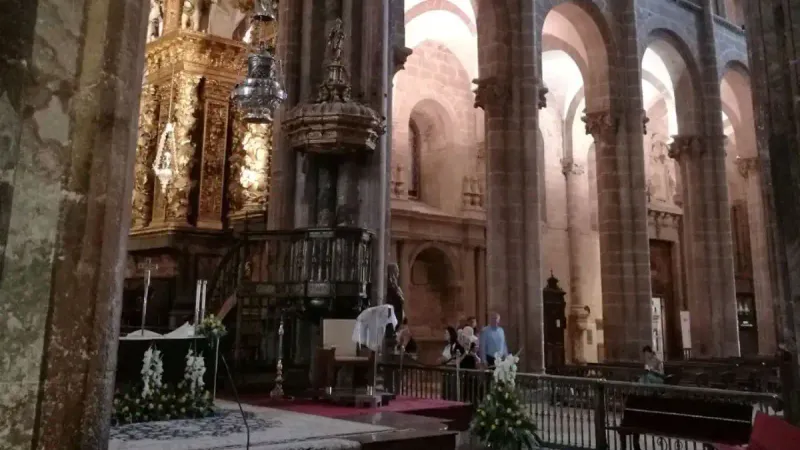
The Botafumeiro beneath the dome, ready for its flight
Meaning: prayer rising to heaven
Today the Botafumeiro is used for liturgical reasons. As the Cathedral itself explains, the incense that rises symbolizes the prayers of the faithful ascending towards God, and its fragrance represents the witness that every Christian leaves behind. That is why it is set in motion at specific moments of the Mass, such as the entrance procession or the end of the celebration.
Design and figures of the Botafumeiro
Its figures are impressive:
- Weighs about 53 kilos.
- Measures 1.50 metres in height.
- Hangs at a height of about 20 metres.
- In flight it can reach 68 km/h.
- It is moved by 8 people, the tiraboleiros.
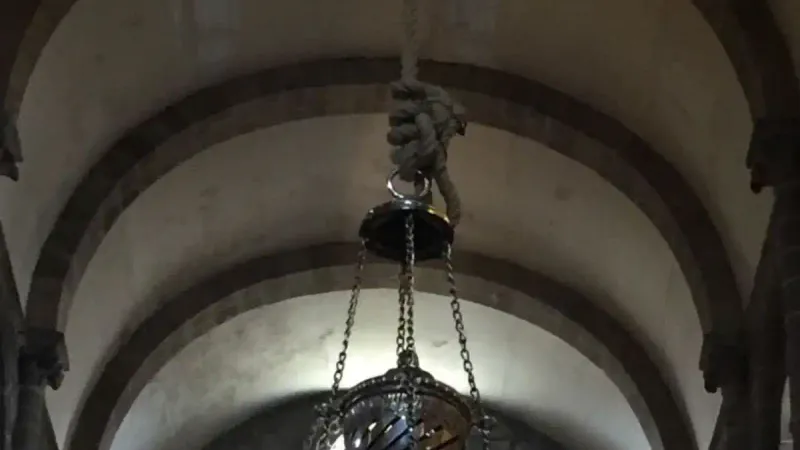
Detail of the knot and rope of the Botafumeiro
The flight: technique and precision
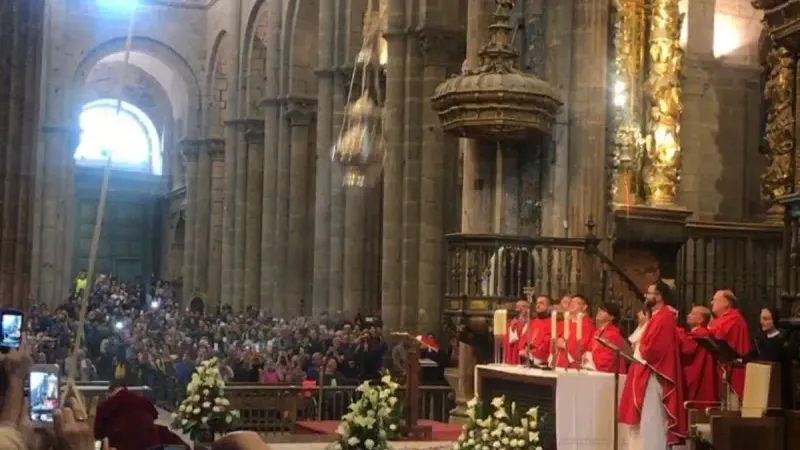
Inside the Botafumeiro the embers and incense are placed. Then, the tiraboleiros set it moving with a gentle swing and, working together, pull the rope at a very precise rhythm. Within a few seconds, the censer traces a huge arc from one end of the transept to the other, leaving behind a trail of smoke and fragrance.
The result is a scene that is hard to forget: the stone, the metal, the smoke and the music of the organ come together in a moment that many pilgrims forever associate with their arrival in Santiago.
The Botafumeiro in full flight during a Mass
When does the Botafumeiro work
The Botafumeiro is not used at every Mass. When it works as normal, it does so on the main solemnities of the liturgical calendar:
- Epiphany of the Lord: 6 January
- Easter Sunday
- Ascension of the Lord
- Apparition of the Apostle (Clavijo): 23 May
- Pentecost
- Martyrdom of Saint James: 25 July
- Assumption of Mary: 15 August
- All Saints: 1 November
- Christ the King
- Immaculate Conception: 8 December
- Christmas: 25 December
- Translation of the Apostle Saint James: 30 December
It can also work at other Masses when a group of pilgrims has requested it from the Cathedral in advance. That is why, outside these dates, it is never guaranteed.
To plan your visit, the most practical thing is to confirm dates and times at the Pilgrim's Office or at the Cathedral itself. If you want a good view, arrive early: the sides of the crossing offer the best perspective of the complete flight.
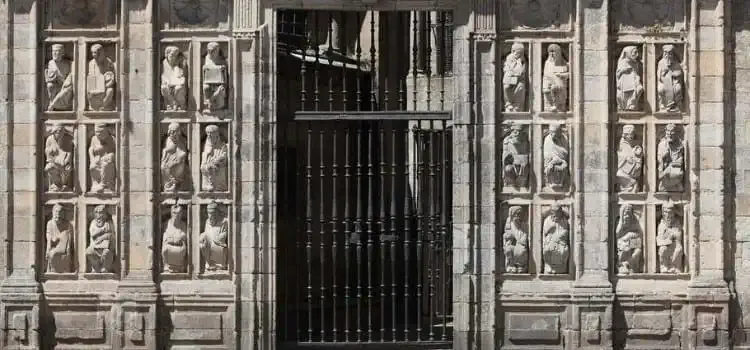
The Holy Door of Santiago Cathedral
If you are thinking of making your pilgrimage in the Holy Year 2027, keep in mind that the Cathedral will experience a very special year.
Throughout that year the Holy Door of the Cathedral, which only opens in Holy Years, will remain open.
Curiosities about the Botafumeiro
With centuries of history behind it, the Botafumeiro holds a few curiosities:
- It is, possibly, the largest censer in the world.
- It is so famous that a 5-peseta coin from 1993 had it engraved on it.
If you want to know what else to see inside the church, we tell you all about it in what to see in Santiago Cathedral.
Experience it as part of your Camino
For many pilgrims, entering the Cathedral after days on the Camino and hearing the organ beneath the dome is the crowning moment of the journey, and if it also happens to coincide with the flight of the Botafumeiro, the memory becomes unforgettable. If you are thinking about doing the Camino, we take care of the accommodation and luggage transfers so that all you have to do is walk: calculate the price of your Camino de Santiago here.