


The Camino de Santiago de la Plata in full by bike from Seville, the great southern route on two wheels. 969 kilometres through Mérida, Cáceres, Salamanca, Zamora and Ourense to Santiago, crossing half of Spain among dehesas, Roman roads and monumental cities.
We handle all the logistics so you only have to pedal: accommodation, your pilgrim's credential, full documentation and travel insurance, from 950 €. With so many kilometres ahead, add the daily luggage transfer and ride without panniers.
The Vía de la Plata by bike from Seville is an itinerary organised by Viajes Camino de Santiago®.
Services
Included in all our routes
- Accommodation
18 days / 17 nights
- 18 days / 17 nights accommodation
- Complete documentation (Dossier and material for the Camino)
- On-the-road emergency telephone assistance
- Pilgrim's Credential
- Travel insurance
Optional
- Electric bike rental
- Bicycle rental (Max Comfort)
- Extra night in Santiago de Compostela
- Breakfast
- MP (Breakfast and dinner)
- Bicycle rental (Basic)
- Cancellation Insurance
Accommodations
- Most popular
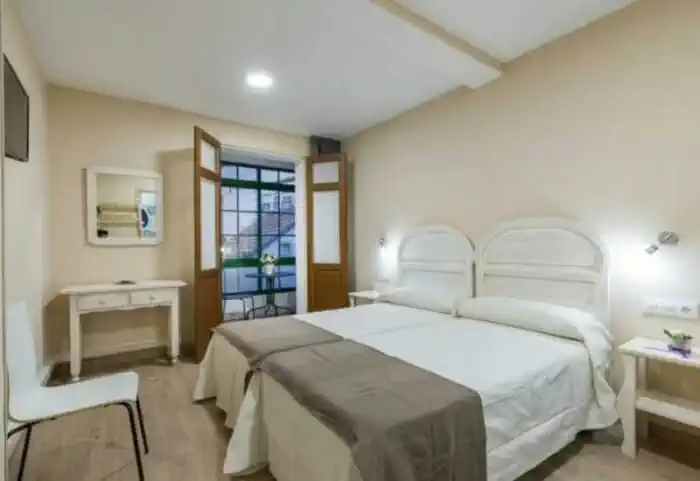
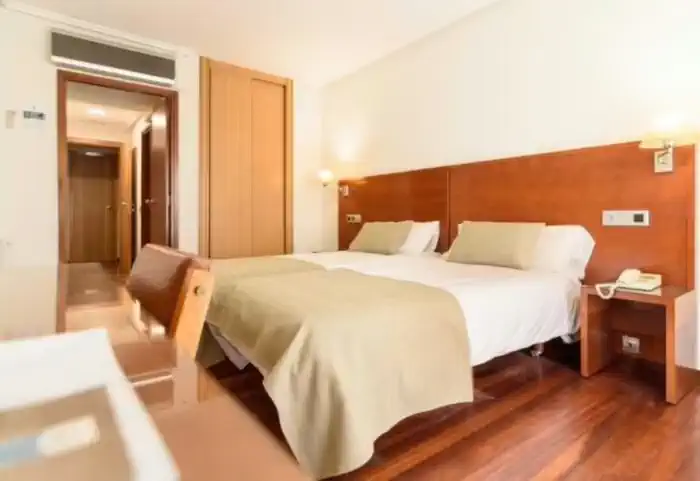
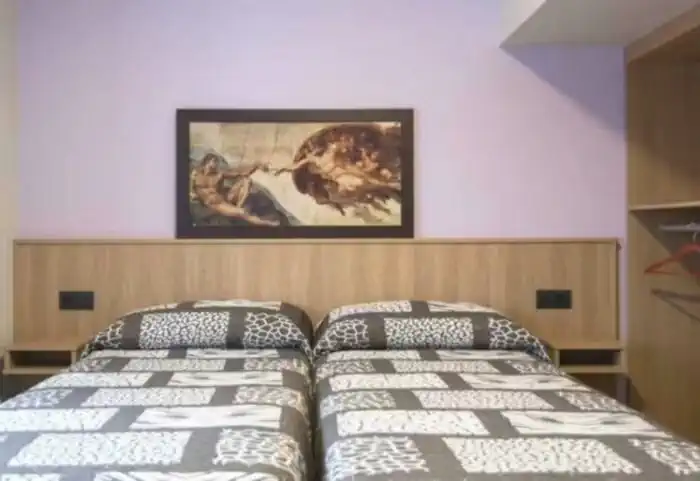
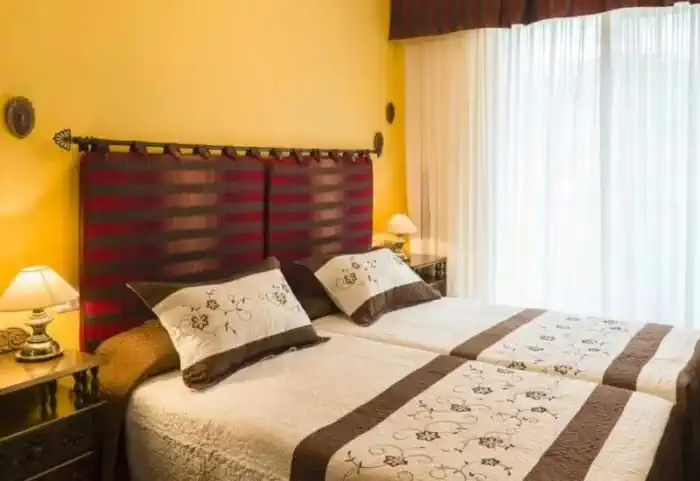
Private comfort (Guesthouses, rural houses and small hotels)
The perfect balance between charm and comfort. Guesthouses, B&Bs and country houses await you in the villages along the Camino with private rooms, private bathrooms, TV, and daily cleaning service. Simple and welcoming, they are the ideal place to truly rest and enjoy the peaceful rural essence that only the Camino can offer.
Photos
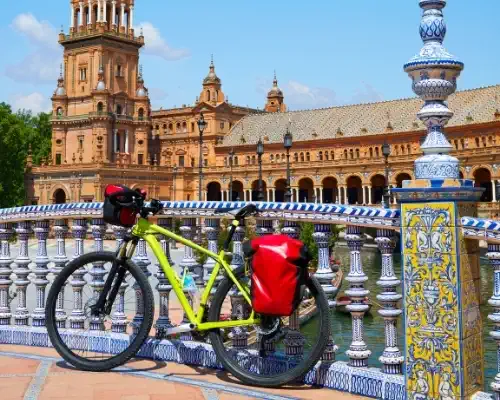
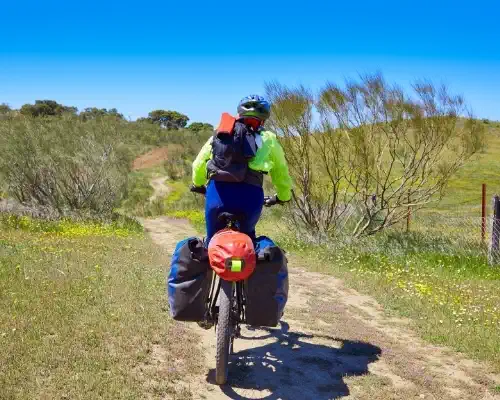
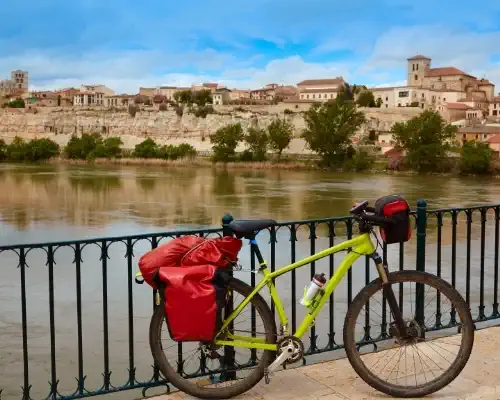
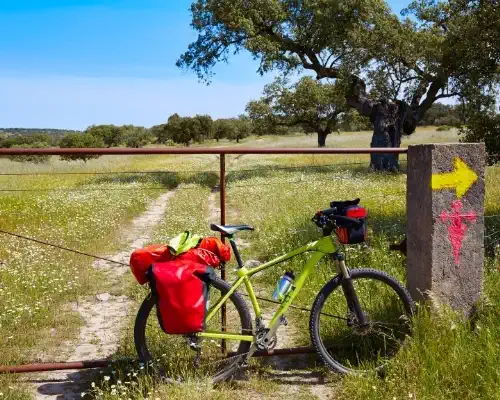
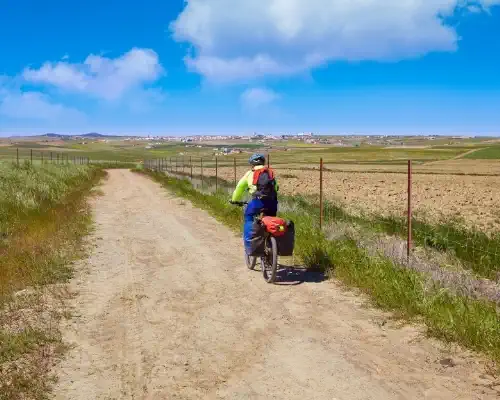
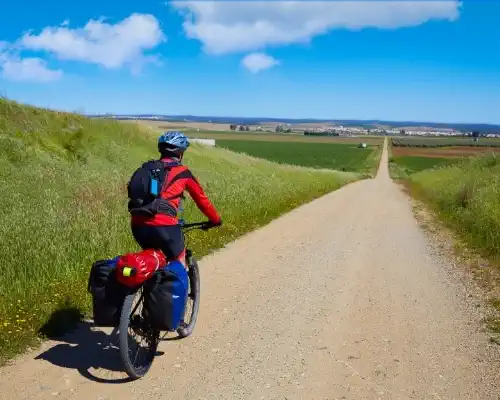
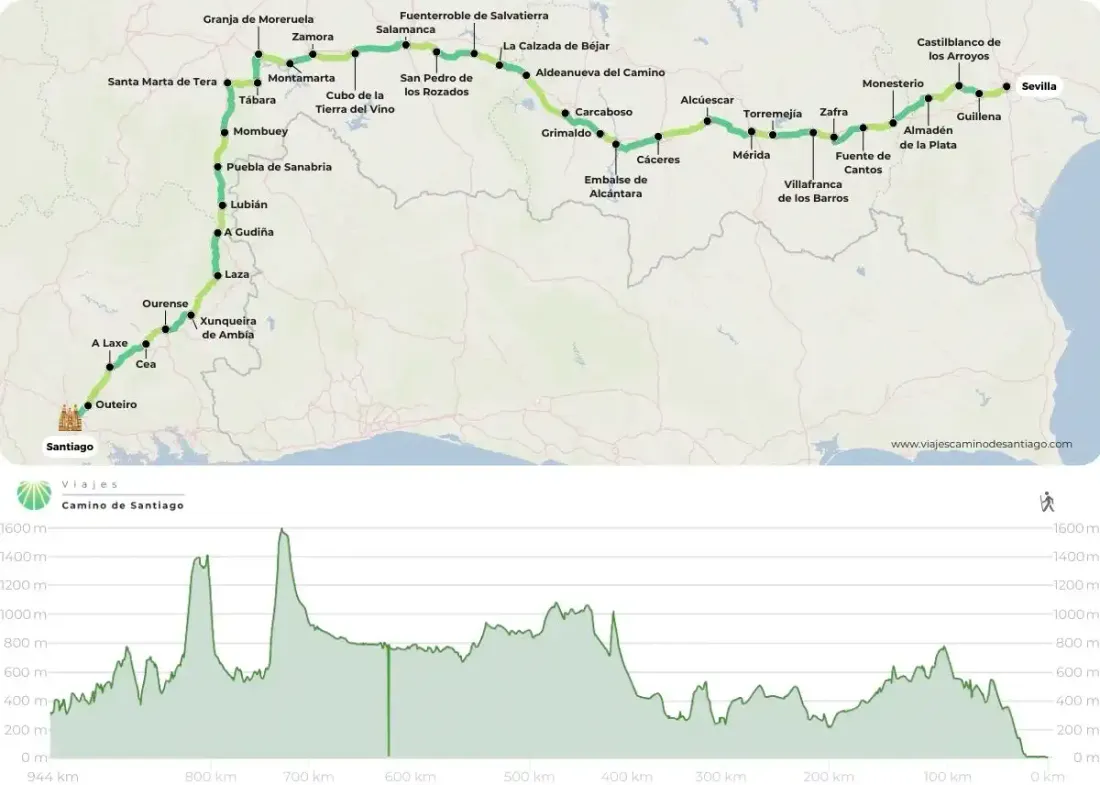
Map of the Vía de la Plata by bike from Seville
Stages
- day 1
Arrival at Sevilla
- day 2
Stage 1. Sevilla - Castilblanco de los Arroyos (40 km)
The Vía de la Plata begins by crossing the Guadalquivir and leaving Seville via Camas and Santiponce, at the foot of the Roman site of Itálica. The first third is flat and shadeless; after Guillena the surface becomes track and the profile climbs some 360 metres steadily to Castilblanco de los Arroyos, already in the Seville sierra. Set off with water: the final stretch has no services. - day 3
Stage 2. Castilblanco de los Arroyos - Monesterio (61.8 km)
A serious day: 61.8 kilometres and close to 1,200 metres of positive gain. You start with a moderate climb on a local road and continue on the tracks of the El Berrocal estate and the ramps of Alto del Calvario. After Almadén de la Plata and El Real de la Jara you climb the Puerto de la Cruz and enter Extremadura at Monesterio, land of Iberian ham. Start early and carry water. - day 4
Stage 3. Monesterio - Zafra (45 km)
After the mountains comes the breather: 45 kilometres of gentle descent across open plains and wide tracks that roll by themselves. You pass Fuente de Cantos, where the painter Zurbarán was baptised, and Calzadilla de los Barros and Puebla de Sancho Pérez, between cereal fields, on the way to Zafra. They call it Little Seville: walk from the Plaza Chica to the Plaza Grande. - day 5
Stage 4. Zafra - Mérida (65 km)
Sixty-five kilometres over gently rolling terrain that only bites on the ramp up to Los Santos de Maimona. From Villafranca de los Barros the Camino turns into long straight tracks between the vineyards of Tierra de Barros, with no shade or services until Torremejía. The finish is Mérida, the Roman Augusta Emerita: save the afternoon for the Theatre and the Milagros Aqueduct. - day 6
Stage 5. Mérida - Valdesalor (61 km)
Leaving Mérida by the Milagros Aqueduct is one of the most rewarding starts on the route. You pass the Roman reservoir of Proserpina, cross El Carrascalejo and Aljucén and enter the Cornalvo Natural Park on lonely tracks through Mediterranean scrub. You finish in Valdesalor, at the gates of Cáceres. Demanding for its distance rather than its climbs: ration your water. - day 7
Stage 6. Valdesalor - Cañaveral (55 km)
From Valdesalor you soon reach Cáceres, whose old town is a World Heritage Site and is best enjoyed pushing the bike. The Vía de la Plata then continues through Casar de Cáceres, where you should try its torta cheese, and opens onto the dehesa as far as the Alcántara reservoir on the Tagus. Fifty-five comfortable kilometres closing with the final climb to Cañaveral. - day 8
Stage 7. Cañaveral - Aldeanueva del Camino (78 km)
The longest day of the route: 78 kilometres starting towards Grimaldo and continuing on tracks through dehesa to Galisteo, overlooking the river Jerte and ringed by its Almohad wall. After Carcaboso comes the stretch that made the Vía de la Plata famous: lonely holm-oak woods, little climbing and the Roman arch of Cáparra still standing over the road. You sleep in Aldeanueva del Camino. - day 9
Stage 8. Aldeanueva del Camino - Fuenterroble de Salvatierra (43 km)
A transition stage that gains height: 43 kilometres of gentle but constant climbing alongside the N-630, heading for Baños de Montemayor and its Roman baths. Then comes the Puerto de Béjar, some 200 metres of ascent in under three kilometres on restored Roman road, and the crossing from Extremadura into Castilla y León. You finish in Fuenterroble de Salvatierra, near a thousand metres: bring warm clothes. - day 10
Stage 9. Fuenterroble de Salvatierra - Salamanca (51 km)
Fifty-one kilometres that begin by climbing the Pico de la Dueña, the highest point of the Vía de la Plata between Seville and Astorga. The profile then eases and you roll through dehesa and open country to San Pedro de Rozados, before dropping to the Tormes valley and entering Salamanca over its Roman bridge. A World Heritage university city awaits: Plaza Mayor and Casa de las Conchas. - day 11
Stage 10. Salamanca - Zamora (66 km)
One of the fastest-rolling days of the trip: 66 kilometres with almost no climbing, between firm dirt tracks and stretches beside the road, with Calzada de Valdunciel and El Cubo de la Tierra del Vino as landmarks. Then cereal plains with very little shade until you cross the medieval stone bridge into Zamora, overlooking the Duero. Start early and carry plenty of water. - day 12
Stage 11. Zamora - Santa Marta de Tera (87 km)
The longest stage of the route: 87 kilometres from Zamora via Montamarta and the shore of the Ricobayo reservoir to Granja de Moreruela, where the Vía de la Plata splits in two and the Camino Sanabrés begins. The ruins of the Cistercian monastery of Moreruela are close by. Then Tábara and the Tera valley to Santa Marta and its Romanesque monastery. Pace yourself: services are scarce. - day 13
Stage 12. Santa Marta de Tera - Puebla de Sanabria (67 km)
The Camino climbs the Tera valley towards the mountains: 67 kilometres via Rionegro del Puente and Mombuey, on comfortable surfaces with height gained steadily and without surprises. The cereal plain gives way to oak and heather until the last ramps reveal Puebla de Sanabria, perched on its hill at 941 metres. Take your time in its castle and arcaded square. - day 14
Stage 13. Puebla de Sanabria - A Gudiña (53 km)
Short in distance and demanding in climbing: 53 kilometres with two passes ahead. First you go up the Requejo valley to the Padornelo pass, at 1,356 metres; then you drop to the Lubián valley and climb again to the Portela da Canda, at 1,265, the natural gateway to Galicia. The descent leaves you in A Gudiña, already in Ourense. Check the forecast: in the cold months it snows here. - day 15
Stage 14. A Gudiña - Xunqueira de Ambía (66 km)
At A Gudiña you must choose: the variant via Laza, the prettiest, or the one via Verín, easier. Via Laza it is 66 kilometres of Ourense mountains, among the hardest of the route on two wheels: Campobecerros, the long climb to A Alberguería and the Talariño pass, close to a thousand metres. The terrain then opens up at Vilar de Barrio as far as Xunqueira de Ambía and its collegiate church. - day 16
Stage 15. Xunqueira de Ambía - Castro Dozón (64 km)
Sixty-four kilometres taking you from the highlands of Ourense to the heart of Galicia. First you drop towards Ourense and cross the Miño by the Ponte Vella; stop at As Burgas, its thermal springs at over 60 degrees. On the way out comes the hardest ramp of the day, towards San Cristovo de Cea, land of PGI bread, and then rolling terrain to Castro Dozón. - day 17
Stage 16. Castro Dozón - Santiago de Compostela (66 km)
Final day: 66 kilometres with the Vía de la Plata now given over to Galician green. You pass through Lalín, capital of the Deza and a good spot for a last long coffee, then Silleda and Bandeira, and face the descent to Ponte Ulla. What remains is the final ramp before entering Santiago from the south. The cathedral from the Obradoiro justifies every pass in your legs. - day 18
End of the trip
After your last night, you check out of your accommodation and your trip comes to an end.
Related Trips
 7 days / 6 nights
Frequently Asked Questions
-
How many kilometres are cycled per day on the Camino de Santiago?
Doing the Camino by bike allows the ‘bicigrino’ to cover more kilometres per day than a pilgrim on foot, easily double. The number of kilometres cycled per day depends on several factors:- physical capabilities of each person;
- time available;
- route and section chosen (technical difficulty of the terrain);
- availability of accommodation.
-
How long does it take to travel the Silver Route?
The Silver Route starts in Seville and has almost 1,000 kilometres to Santiago de Compostela. In terms of days and stages, it can be divided in two ways, as it depends on which Camino you end up on. This route shares the final stretch with the French Way from Astorga (León), or with the Sanabrés Way in Granja de Moreruela (Zamora):- For the French Way, it has 38 stages, therefore, 38 days;
- For the Sanabrés Way, it has 36 stages, therefore, 36 days.
-
How many stages does the Silver Route have?
The Silver Route starts in Seville and has almost 1000 kilometres to Santiago de Compostela. As for the stages, it can be divided in two ways, as it depends on which Camino you end up on. This route shares the final stretch with the French Way from Astorga (León), or with the Sanabrés Way in Granja de Moreruela (Zamora):- For the French Way, it has 38 stages;
- For the Sanabrés Way, it has 36 stages.
-
Which rivers does the Silver Route cross?
The Silver Route, one of the historic routes of the Camino de Santiago, crosses several important rivers, streams, creeks, reservoirs and lakes along its route from Seville to Santiago de Compostela. Among the most prominent rivers crossed by pilgrims on this route are:- Guadalquivir (Seville)
- Guadiana (Mérida)
- Tagus (Cáceres)
- Tormes (Salamanca)
- Duero (Zamora)
- Esla (Zamora)
- Órbigo (León)
- Sil (León)
- Miño (Lugo)
- Miño (Ourense)
- Ulla (A Coruña)
- Sar (A Coruña)
-
Who created the Silver Route?
The Silver Route was not originally created as a pilgrimage route, but as a Roman road built during the Roman Empire. Its main purpose was to connect the cities of Emerita Augusta (present-day Mérida) and Asturica Augusta (present-day Astorga), facilitating trade, military transport and communications throughout the Iberian Peninsula. Over time, this route became a strategic route for trade, warfare and the pilgrims from southern Spain who used it to reach Santiago de Compostela. Silver’ has nothing to do with the transport of this material. The name of this route comes from the pronunciation of the Arabic term ‘balath’, which means ‘paved road’, in relation to the Roman road. -
How many kilometers are there on the Silver Route?
The total kilometers of the Silver Route from Seville depend on how you get to Santiago de Compostela. This historic route has two possible ‘endings’: By the French Way from Astorga (León): about 1000 kilometres; By the Sanabrés Way from Granja de Moreruela (Zamora): about 970 kilometres. It should be borne in mind that this distance may vary depending on the possible variants or complementary and alternative paths that the pilgrim decides to take during the route. -
What kind of bicycles can I rent to do the Camino de Santiago?
We have high quality mountain bikes and electric bikes that you can rent during the whole Camino. Check the details here.
-
What services are included in the Camino de Santiago by bike?
The Camino de Santiago by bike includes the following services:
- Accommodation
- Dossier with information about the stages
- Pilgrim's credential
- On-the-road helpline
- Travel insurance
In addition, you can customize your trip by adding the following optional services:
- Luggage transport between stages
- Breakfast or half board
- Extra night at the beginning or end of the stage
- Bicycle rental
Unlike the group trips, no guide or support vehicle is included between stages. However, you will have a 24-hour hotline where you can contact us in case of any problem or unforeseen event, which we will solve quickly.
-
Can I bring my own bicycle for a trip on the Camino de Santiago?
Yes, you can do the Camino with your own bike. The important thing is that it is in good condition before starting to avoid problems. Remember that you can also rent a bicycle with us (MTB, e-Bike, etc., with equipment included) which you will find directly at your first shelter, and we will indicate where to return it at the end of your journey.
-
Where will I leave the bicycle each night at the accommodations?
Do not worry, most accommodations on the Camino have secure spaces for bicycles. They are usually garages or enclosed areas with security measures. When we organize your trip, we ensure that each accommodation guarantees this service. Additionally, if it is an e-Bike and you need to charge it overnight, the accommodations will provide you with a power outlet and electricity.
-
Can I do the Camino de Santiago by bicycle?
We have several routes prepared for cyclists, and the choice mainly depends on the number of days you have available. And, if you already have a bicycle, perfect, but if you do not have one, do not worry: you can rent with us either an MTB bicycle or an electric one.
Here you can see all the options:
