


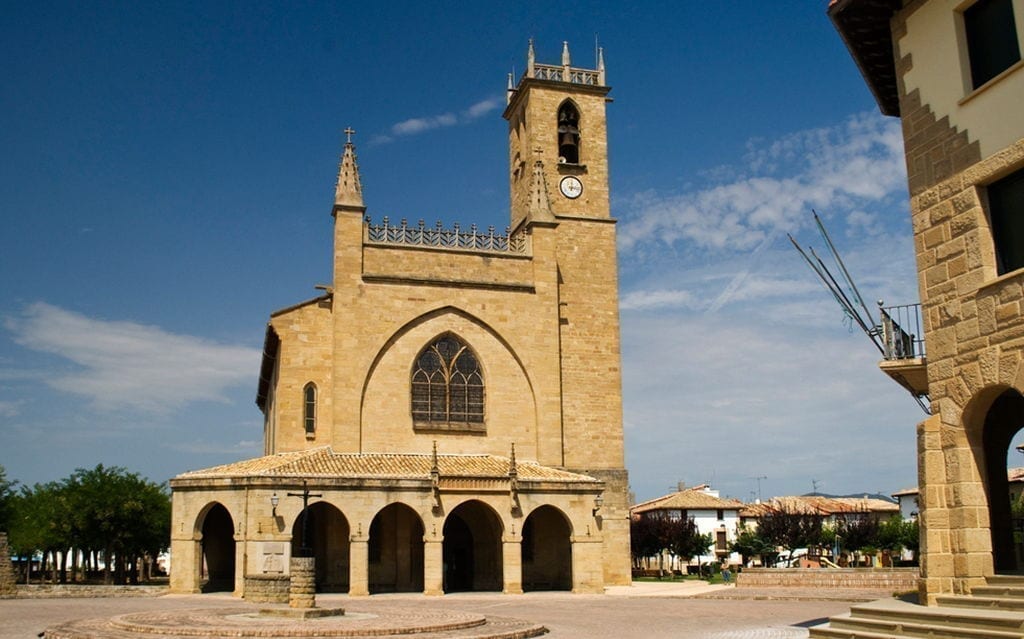
The legend of the Mystery of Óbanos is one of the most well-known and representative stories of the Camino de Santiago in Navarre. It is a medieval tale full of symbolism, faith and redemption, which is still alive today thanks to its theatrical performance in the village of Óbanos. Every year, around 25 July, the feast day of the Apostle Saint James, local residents recreate this story in an open-air choral performance, declared a Festival of National Tourist Interest, making it one of the most distinctive cultural expressions of the Camino.
The origin of the legend of the Mystery of Óbanos
The story stars Felicia, daughter of the Dukes of Aquitaine. Raised in a noble and privileged environment, Felicia led a peaceful life, devoted to the tasks expected of her social status in the Middle Ages: reading, music and domestic work.
Everything changed when she heard a troubadour speak of the tomb of the Apostle Saint James and of the pilgrimage undertaken by thousands of people to reach it. That story awakened in Felicia a deep spiritual calling and the desire to leave behind her privileged life and set out on the Camino.
Felicia and her pilgrimage to Santiago de Compostela
Despite the opposition of her father and her brother Guillén, Felicia decided to begin her pilgrimage to Santiago de Compostela. Along the way, she discovered a reality very different from her own: poverty, illness and suffering, but also solidarity and faith.
After arriving in Santiago and visiting the tomb of the Apostle, Felicia decided not to return to her former life. She remained for a time helping those most in need and later settled in the farmhouse of Amocaín, in the Egües Valley, near Pamplona. There she lived a simple life, devoted to working the land and serving others.
The reunion with Guillén and the tragedy
As time passed and his sister failed to return, Guillén set out to search for her. After travelling from village to village, he found her living humbly in Amocaín. He tried to persuade her to return to the castle and resume her life as a noblewoman, but Felicia refused.
Overcome by frustration and anger, Guillén lost control and killed his sister in a violent outburst. Repentant for the crime he had committed, he set off for Santiago de Compostela in search of forgiveness.
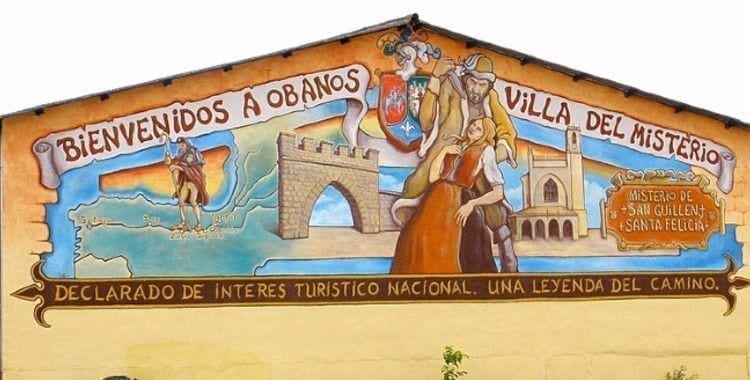
Entrance to Óbanos
The miracle and the origin of the Mystery of Óbanos
Felicia’s body was buried in Amocaín, but days later an event considered miraculous occurred: a flower sprouted from her tomb, emerging from the mortal wound and interpreted as a sign of holiness.
The villagers placed her body in a wooden oak coffin inside the church, but the following day it appeared mysteriously in the middle of the countryside. The coffin was so heavy that no one could move it. Finally, the priest ordered that mules should carry the coffin and that the place where they stopped would mark her final resting place.
The mules stopped in Labiano, in the Aranguren Valley, beside the Church of Saint Paul, today known as the Church of Saint Paul and Saint Felicia, where her remains now rest.
Guillén, the repentant hermit
After returning from Santiago, Guillén decided to withdraw as a hermit to the hermitage of Santa María de Arnotegui, located on the hill near Óbanos. He devoted the rest of his life to helping pilgrims and performing works of charity. After his death, the people regarded him as a saint.
A living legend on the Camino de Santiago
The legend of the Mystery of Óbanos has reached our days with minor variations, but its message remains intact: renunciation, faith, repentance and redemption. Today it forms part of the cultural and spiritual heritage of the Camino de Santiago and is an essential stop for those walking through Navarre with an eye for history.
At Viajes Camino de Santiago, we believe that walking also means discovering the stories that have given meaning to this ancient route. This and other Jacobean legends remind us that the Camino is not only walked with the feet, but also with the heart.












Hi
I walked the Camino near four years ago
For 25 years I had been wanting/needing to do it
It was truely the only thing in my life I new I had to do and that if I didn’t this life would not be complete
On return , I found out via my natural /birth family that I am actually a descendent to this family line
Soooooo no wonder my soul could not rest till I did it
I love this story
Wow, it’s an amazing experience! We hope the Camino has brought you as much joy as all our pilgrims or even more!