


What to see on the Camino de Santiago from Tui: stage-by-stage guide
12 March, 2026
This article details what to see on the Camino de Santiago from Tui along the Portuguese Way to Santiago de Compostela, with historical and cultural stops in places such as Tui, O Porriño, Pontevedra, Caldas de Reis, and Padrón, as well as Roman bridges, churches, and cruceiros that enrich the pilgrim experience.

The Camino de Santiago is not just a walking route. It is a journey full of history, spirituality, and heritage that unfolds step by step. Along the last one hundred kilometers of the Portuguese Way from Tui, pilgrims encounter historic churches, rural chapels, cruceiros, medieval bridges, ancient Roman roads, and numerous places linked to the Jacobean tradition that are an essential part of the Camino experience. If you want to know what to see on the Portuguese Way from Tui, you are in the right place. This final section of the Camino combines historical heritage, natural landscapes, and towns with a strong pilgrim tradition that accompany walkers all the way to Santiago de Compostela.
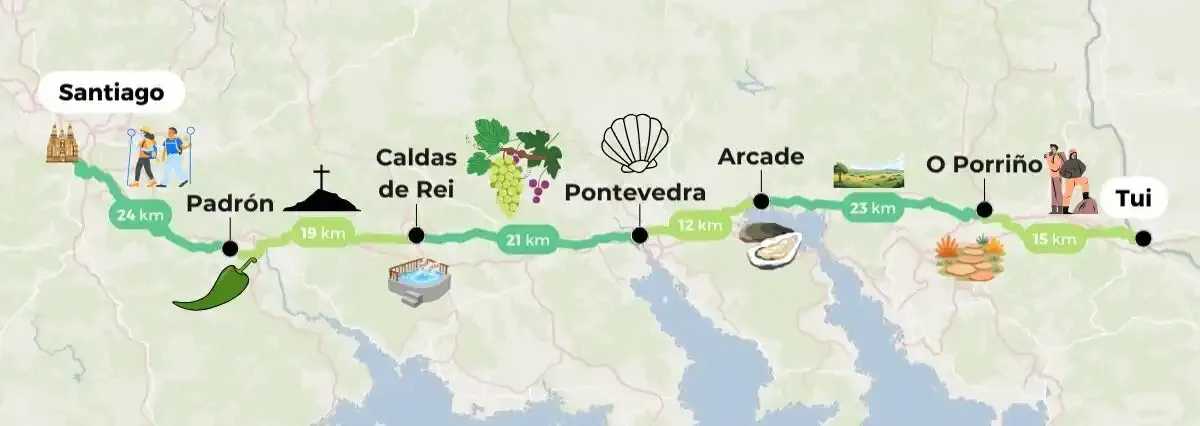
The Camino de Santiago from Tui hides many things to see, do, and even taste
What to see on the Portuguese Way from Tui
The section that begins in Tui is one of the most popular parts of the Portuguese Way. From this historic border city to Santiago de Compostela, the Camino crosses river valleys, traditional villages, historic towns, and rural landscapes characteristic of southern Galicia. Tui is one of the main starting points of the Portuguese Way in Spain. Located beside the Miño River and facing the Portuguese town of Valença, it preserves an important medieval historic center and one of the most remarkable temples on the Camino.
Stage 1: Tui – O Porriño
The first stage of the Portuguese Way from Tui begins in a city full of history. In the border area between Spain and Portugal stands the International Bridge of Tui, which connects both banks of the Miño River and symbolizes the passage of pilgrims between the two countries. In the historic center you can visit the Cathedral of Santa María of Tui, one of the most important temples on the Portuguese Way and one of the best examples of Romanesque and Gothic architecture in Galicia. Very close by are the Convent of the Poor Clares, the Tunnel of the Nuns, the Church of San Francisco, and the Chapel of San Telmo, dedicated to the patron saint of the city. Leaving Tui, around kilometer 118, the Camino passes through Rebordáns, where the Church of San Bartolomé of Rebordáns stands along with its characteristic cruceiro located in front of the temple. Continuing the route, at kilometer 116.870, the Roman-medieval bridge over the Louro River appears, one of the historical elements linked to the ancient route of the Camino; in fact, we can already notice the signs of the old Roman road Via XIX, which connected Asturica Augusta (Astorga) and ended in Bracara Augusta (Braga), and which we will also find along the entire route. Further ahead, after approximately kilometer 115.580, is the Chapel of the Virgin of the Camino. Shortly afterward, after kilometer 112.740, the Camino reaches one of the most symbolic places on this route: Ponte das Febres, next to the Cross of San Telmo, a site linked to the history of Tui.
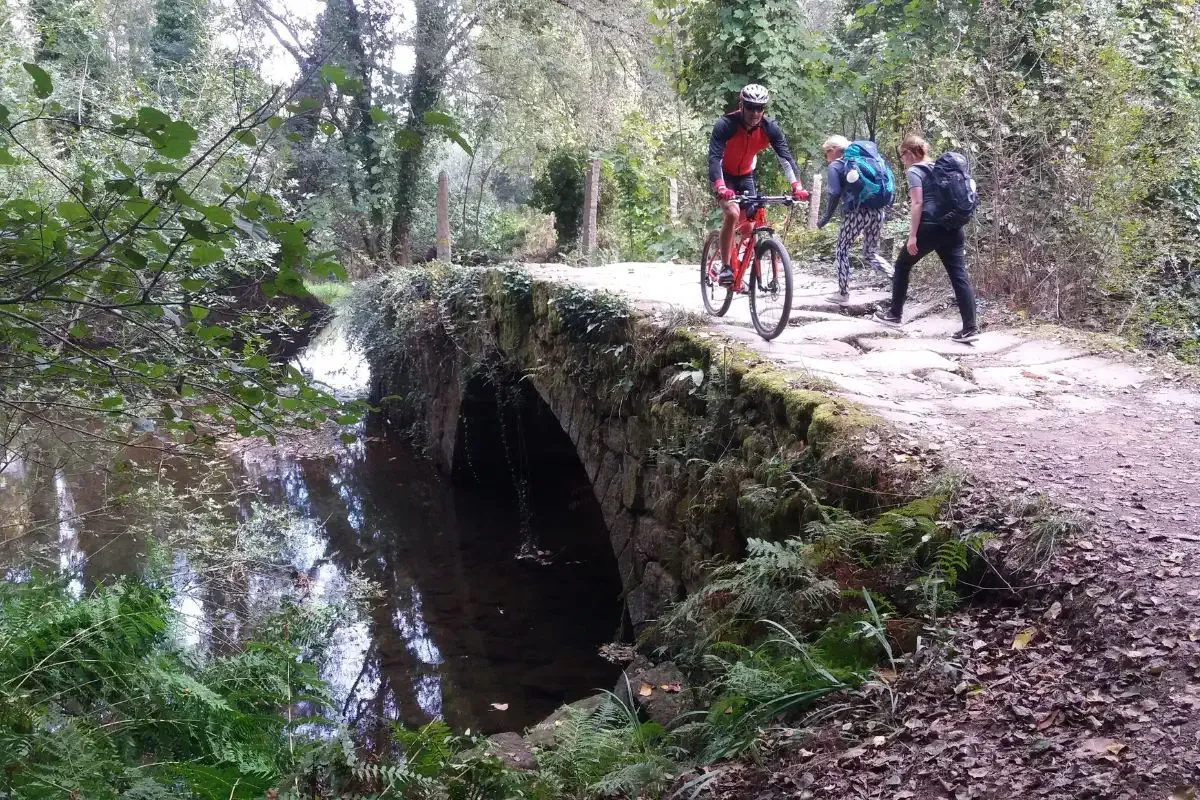
On the Camino from Tui you will cross the das Febres bridge and many more, like this one in Orbenlle
The Camino continues through Ribadelouro, where the Church of Santa Comba of Ribadelouro is located, around kilometer 111.420. Further ahead, after crossing the Orbenlle bridge, a fork appears at kilometer 110.040: to the right the Camino continues along a shorter route through the industrial area, while to the left you can take a complementary path along the Louro River, longer but much more pleasant. Along this alternative route you will find the cruceiro of San Campio and the Chapel of San Campio, before finally reaching O Porriño. This is one of the most important variants and complementary paths of the Portuguese Way. In the center of this town, approximately around kilometer 103, stands the town hall or Casa Consistorial of O Porriño, designed by architect Antonio Palacios, a native of the town and also the creator of the former Palace of Communications in Madrid, now the headquarters of the Madrid City Council. It is also worth visiting the Church of Santa María of O Porriño.
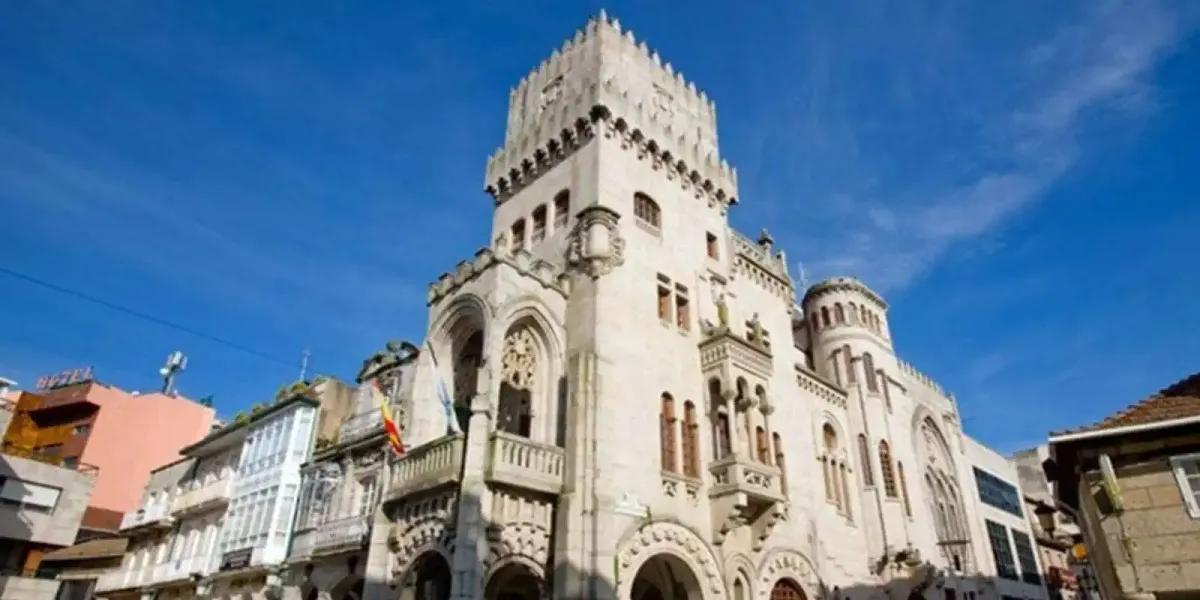
Town Hall of O Porriño
Stage 2: O Porriño – Arcade
The second stage continues through the Louro River valley and crosses small towns historically linked to the Camino. In Mos, specifically in the area of Camiño da Rúa (km 96.730), you will find the Church of Santa Baia of Mos, the Pazo of Mos, a historic cruceiro, and the Mos pilgrims' hostel, a common resting point for walkers. Shortly afterward, around kilometer 93.350, appears the Roman milestone of Vilar, once again reminding us that the Portuguese Way follows a Roman road. The Camino continues passing near some typical furanchos in the area (a kind of home tavern where surplus wine was sold along with homemade food), until reaching Redondela at kilometer 87.690, where the route joins the Portuguese Coastal Way. Here you can visit the Convent of Vilavella and walk through its historic center before continuing toward Arcade. The stage continues through Cesantes, near its beach, and ends in Arcade, a town located at the beginning of the Vigo estuary, around kilometer 80.620. Here the medieval bridge of Ponte Sampaio stands out, the setting of the Battle of Ponte Sampaio in 1809 during the Peninsular War against Napoleonic troops. It is also worth visiting the Arcade pier. The town is especially known for its gastronomy, particularly its famous oysters from the Vigo estuary.
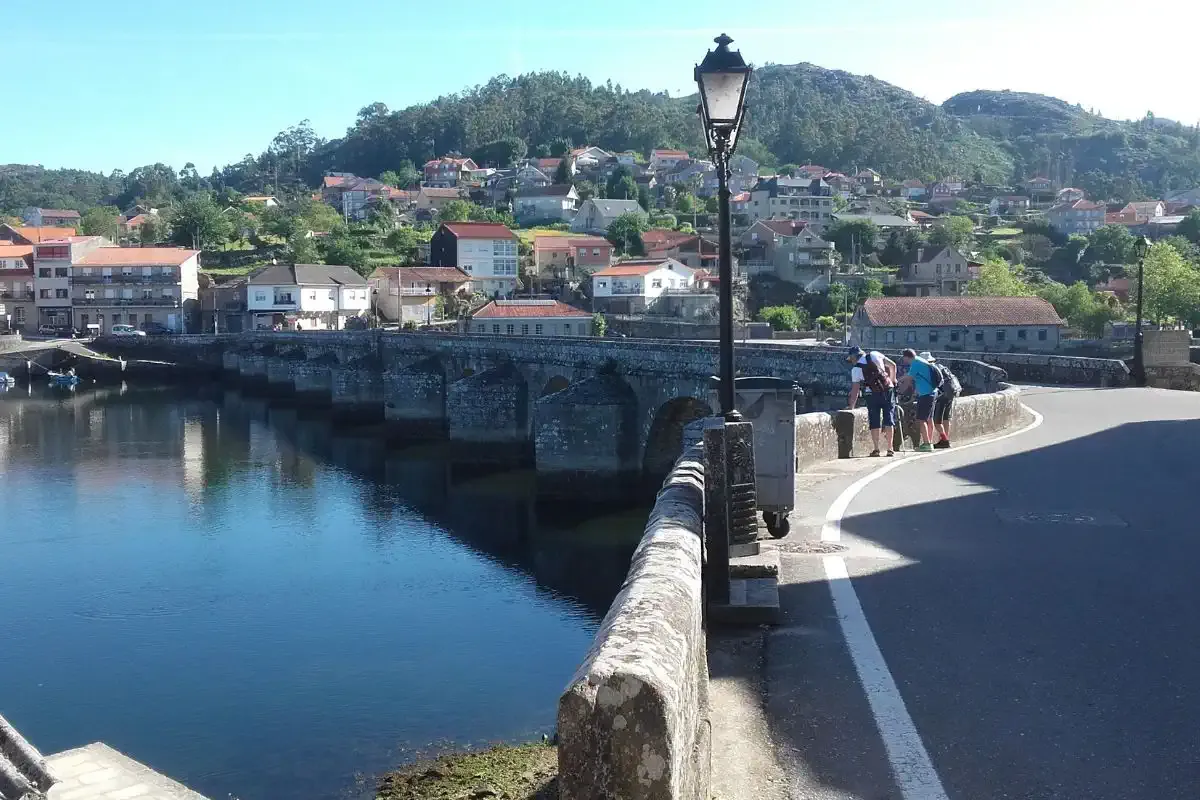
Pilgrims walking the Portuguese Way before crossing the Pontesampaio bridge
Stage 3: Arcade – Pontevedra
The stage begins by crossing the historic medieval bridge of Ponte Sampaio, which spans the Verdugo River. Shortly afterward the Camino crosses the Ullóo River and climbs along an old cobbled Roman road that passes through a beautiful forest. Around kilometer 76.700 you may meet Manolito, who offers drinks, stamps, advice, and encouragement to pilgrims, as well as Camilo Cacheiro or a traveling food-truck. Already in the area of Ganderón stands the Chapel of Santa Marta, and a little further ahead there is a famous fork: to the right the Camino reaches Pontevedra more directly along the EP-002 regional road, while to the left you can take the complementary path along the Tomeza-Gafos River, a very pleasant route among wooded paths and winding meanders. Finally, around kilometer 67.780, you arrive in Pontevedra, one of the most interesting historic cities on the Portuguese Way. In its historic center stand the Church of the Pilgrim Virgin, with its unique scallop shell-shaped floor plan, the Peregrina Square, the Leña Square, and the Herrería Square. You can also visit the Convent of San Francisco, the ruins of Santo Domingo, the bullring, the Five Streets Square, and the cruceiro of Adam and Eve, located next to the former residence of the Galician writer Ramón María del Valle-Inclán.
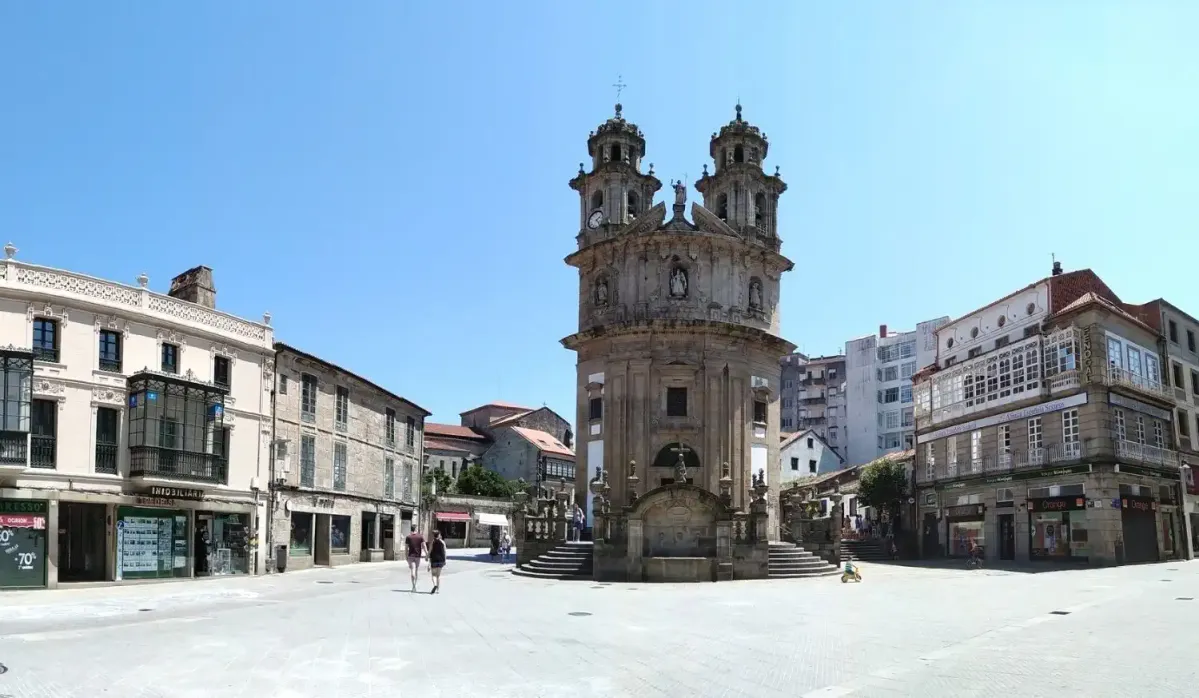
Church of the Pilgrim Virgin, a must-stop for every pilgrim in Pontevedra
Stage 4: Pontevedra – Caldas de Reis
Leaving Pontevedra involves crossing the historic Ponte do Burgo over the Lérez River, at kilometer 65.920. Further ahead appears another famous fork, marking the beginning of the Spiritual Variant of the Portuguese Way, which heads toward Armenteira. Our route continues to the right, following the milestone km 63.280 toward Caldas de Reis. In Santa María de Alba, at kilometer 62.780, stands the Church of Santa María de Alba, its cemetery, the House of Mercy, known for welcoming pilgrims, and the cruceiro of Santa María de Alba. Further ahead, around kilometer 57.500, appears the Chapel of San Amaro of Barro. This section of the Camino crosses rural areas dominated by vineyards of the Rías Baixas Designation of Origin. Before reaching Caldas there is the possibility of making a short detour to visit the Barosa waterfalls, a natural environment with traditional mills and a very popular resting spot. The stage ends around kilometer 45, already in Caldas de Reis, a paradise of thermal waters. Here you will find the Church of Santa María of Caldas, the Hotel Balneario Acuña, the also thermal Hotel Dávila, the Roman bridge, the Burgas thermal spring, the thermal washing place, and the botanical garden, as well as the riverside walk along the Umia River.
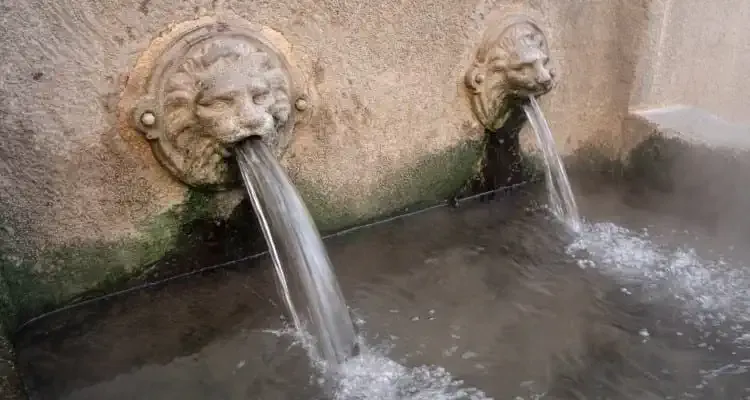
Thermal spring in Caldas de Reis
Stage 5: Caldas de Reis – Padrón
The fifth stage crosses rural landscapes and small villages, which appear when leaving Caldas de Reis from kilometer 44.270 onward. In Carracedo stands the Church of Santa Mariiña of Carracedo, at kilometer 39.260. Further ahead, in Valga, the Church of San Miguel of Valga stands out at kilometer 33. The Camino continues toward Pontecesures, where the Church of San Julián of Requeixo is located after kilometer 28.840. From here there is a detour toward the village of Herbón, where the historic Franciscan convent of Herbón is located. The town is also famous for its renowned Herbón peppers, although they are traditionally known as "Padrón peppers". Crossing the Ulla River you enter the province of A Coruña and shortly afterward reach Padrón, after kilometer 27.880. In this town stand the Espológn Promenade, the monuments to Camilo José Cela and Rosalía de Castro, and the Church of Santiago Apóstol, where the Pedrón is preserved, the stone where, according to tradition, the boat that transported the remains of the Apostle Saint James was moored in the episode of the Traslatio or translation of the Apostle Saint James. Because of this episode, pilgrims passing through Padrón today can request the Pedronía, the official document certifying that they have visited the town and its sacred places during their pilgrimage to Santiago. You can also visit the Convent of Carmen, Mount Santiaguiño, and the hermitage of Santiaguiño do Monte, a very Jacobean enclave, the place where tradition says the apostle preached in Galicia. Another interesting place is the Artistic Botanical Garden of Padrón.
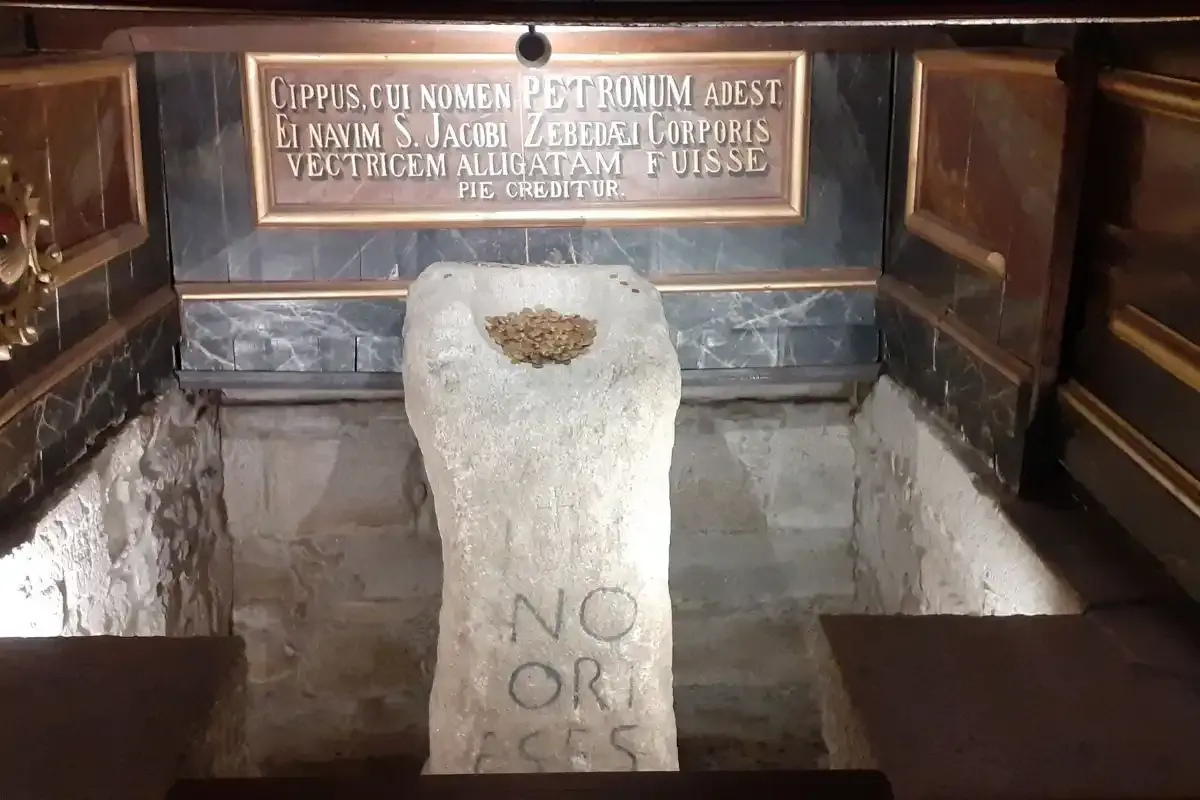
Pedrón in the Church of Santiago of Padrón
Stage 6: Padrón – Santiago de Compostela
The final stage begins leaving Padrón, at kilometer 25.570. In Iria Flavia the Camino passes beside the Church of Santa María of Iria Flavia (km 25.140), the town where the writer Camilo José Cela was born. In A Escravitude stands the Sanctuary of A Escravitude, one of the most important Baroque temples on the Portuguese Way, already at kilometer 19.560. A little further ahead appears the Church of Santa María of Cruces. The Camino continues through the area of O Faramello (km 15.150), a place linked to the tradition of Castro Lupario and to the legendary figure of Queen Lupa. In Francos stands the Chapel of San Martiño of Francos, already at kilometer 13.800. A few kilometers later appears O Milladoiro, the last large town before Santiago and the equivalent of Monte do Gozo on the French Way, because upon leaving the town (km 7.664) the Cathedral of Santiago can already be seen. Before that, however, the route passes through the area of Rocha Forte (km 5.373), where an ancient medieval fortress once stood, related to the Irmandiño revolts of the 15th century. After kilometer 3.478 the pilgrim encounters another fork before entering Compostela: to the right, longer, through Conxo, or to the left, shorter, through Santa Marta. Finally, the Camino enters Santiago through the surroundings of the South Campus of the University of Santiago and heads toward the historic center passing through Porta Faxeira and the well-known Rúa do Franco. The Camino culminates in the Obradoiro Square and the Cathedral of Santiago de Compostela, where the relics of the Apostle Saint James rest and where the pilgrimage comes to an end.
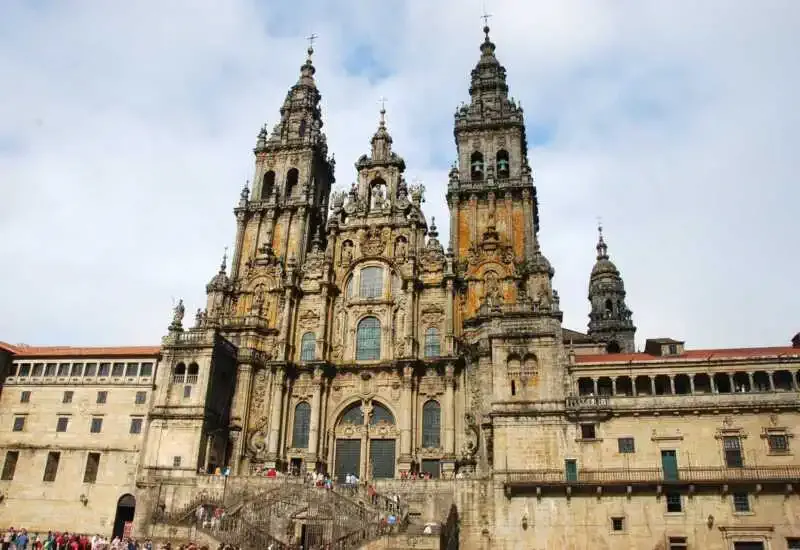
The Cathedral of Santiago de Compostela will be there waiting for you
A Camino full of history and heritage
The Portuguese Way from Tui offers an extraordinary combination of historical heritage, natural landscapes, and Jacobean tradition. Throughout its stages, pilgrims cross historic cities, rural villages, ancient Roman roads, and temples linked for centuries to the phenomenon of pilgrimage. Every church, every bridge, and every small sanctuary forms part of a story that accompanies pilgrims until their arrival in Santiago de Compostela. ¡Ultreia et Suseia!