


Walk the Camino de Santiago in reverse: complete guide and tips
07 February, 2026
Practical guide for doing the Camino de Santiago in reverse, starting from Santiago and moving towards the traditional origin, with advice on planning stages, accommodation logistics and transport, how it affects the pace, and useful tips for pilgrims who prefer this alternative perspective of the route.

The most common way to undertake the Camino de Santiago is to walk towards Santiago de Compostela, following the classic yellow arrows. Depending on the route you choose, the direction will be west, north, or south. However, if you have already completed the Camino, you have probably seen pilgrims walking in the opposite direction, that is, people who leave from Santiago de Compostela and walk the Camino in reverse. Far from being something strange, this is a more common practice than it seems, and it also has a clear historical basis.
The origin: the Camino was also a round trip
Originally, the pilgrimage did not only involve a one-way journey but also a return. Many pilgrims did not return to their homes, either because they passed away during the journey or because they decided to start a new life elsewhere. However, the initial goal was clear: to reach Santiago and return home. Nowadays, this idea has resurfaced, and more and more pilgrims are choosing to experience the Camino from a different perspective.
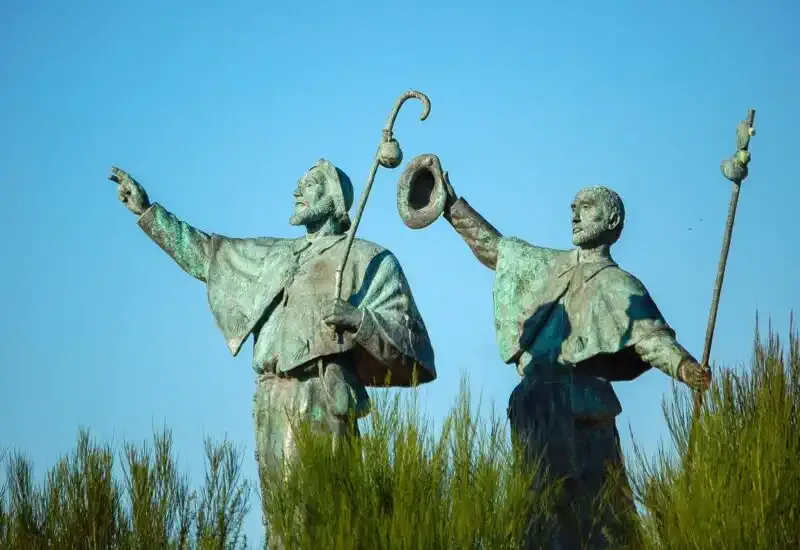 Statue of pilgrims at Monte do Gozo
Why walk the Camino de Santiago in reverse?
The reasons for walking the Camino in reverse can be very varied. In some cases, it is a practical decision; in others, a personal or even spiritual motivation.
For example, if you live in Galicia, it may make a lot of sense to consider a round trip pilgrimage. This is the case for towns located about 100 kilometers from Santiago de Compostela, such as Ferrol on the English Way, Villalba on the Northern Way, Lugo on the Primitive Way, Sarria on the French Way, Ourense on the Sanabres Way, or Tui on the Portuguese Way.
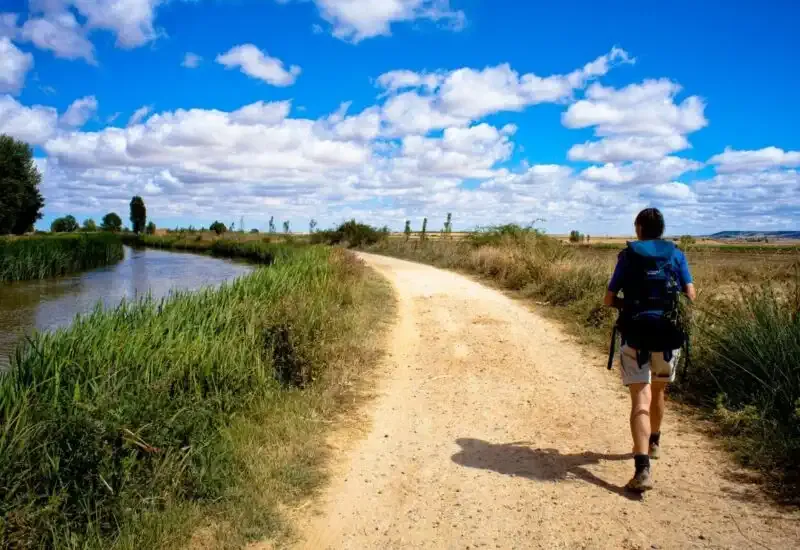 A pilgrim walking the Camino de Santiago backwards on the way home
In other cases, the appeal lies in the experience. Walking back to the starting point, retracing the route from a different perspective, or experiencing the Camino in a less conventional way are increasingly common reasons.
Moreover, walking the Camino backwards has interesting particularities: you will meet different people, you will not encounter the usual pilgrims, and you will see the same landscapes from a completely new perspective.
Is it a good idea to walk the Camino de Santiago backwards?
Walking the Camino de Santiago backwards can be a very enriching experience, but it is not for everyone. On one hand, it allows you to avoid crowds and enjoy a more tranquil and personal experience. On the other hand, it requires greater attention to signage and more careful planning. If you are looking for a different, more introspective, and less conventional experience, it can be a very interesting option.
Which Camino de Santiago to walk backwards?
In reality, you can walk any route of the Camino de Santiago backwards. There are no limitations in that sense, but some options are more advisable than others.
One of the most common is the Camino de Finisterre and Muxía. Many pilgrims, after reaching the "end of the world," decide to return to Santiago to obtain the Compostela. The French Way is also very common, as it is the route with the highest number of accommodations and services, making logistics easier even in reverse. Another interesting option is the Portuguese Way, which also partially coincides with routes to Fátima. In this case, you will find blue arrows in the opposite direction to the classic yellow arrows of the Camino.
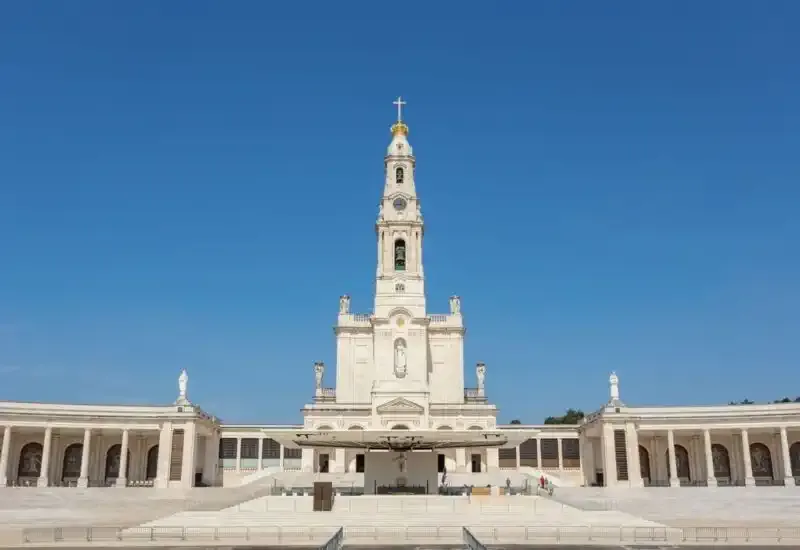 The Portuguese Way backwards can take you to Fátima
What you should keep in mind
Doing the Camino in reverse is entirely feasible, but it involves some challenges that are worth knowing before starting. The main one is the signage. The yellow arrows are oriented towards Santiago, so when going in the opposite direction, you will need to pay more attention. In many cases, the most practical approach is to follow other pilgrims going the opposite way or to use apps with GPS.
In this regard, using apps with maps of the Camino or downloaded GPS tracks can make a difference, especially at crossings or poorly marked sections.
It is also important to plan the stages well. Although accommodations usually accept pilgrims regardless of the direction they are walking, not all services are designed for the reverse Camino. Regarding luggage transport, many companies operate only towards Santiago, so it is advisable to check this in advance if you need this service.
Curious cases of pilgrims in reverse
Along the Camino, it is possible to encounter truly surprising stories. There are pilgrims who not only do the Camino in reverse but also chain routes for years, traveling to different pilgrimage destinations in Europe and the world.
Some manage to connect Santiago with places like Rome, Jerusalem, or Fátima, driven by personal or spiritual reasons. This is the case of pilgrims like José Antonio García Calvo, known as "José the Pilgrim," who embarked on his journey due to a personal promise. "I will visit all the Marian sanctuaries in the world if I am saved", he stated, after surviving a harsh shipwreck.
There are also more alternative cases, such as pilgrims who turn their journey on the Camino de Santiago into a lifestyle, carrying everything they need with them.
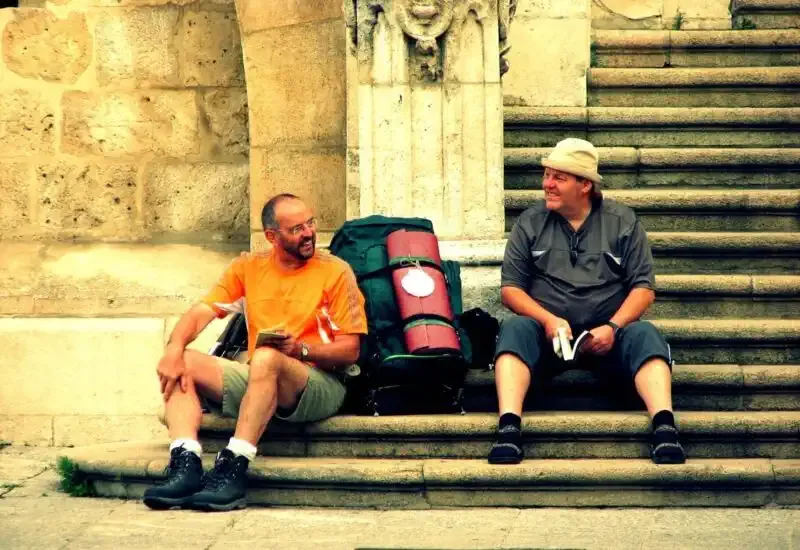 Pilgrims chatting
A different way to experience the Camino
Walking the Camino de Santiago in reverse is a different experience, more free and less conventional. It allows you to rediscover familiar routes, avoid overcrowding, and experience the pilgrimage from another perspective. If this idea appeals to you, it is important to plan every detail carefully to avoid unforeseen circumstances, especially regarding signage and the organization of the stages. With the right preparation, it can become a unique and very personal adventure. ¡Ultreia!