


The Camino de Santiago has witnessed steady growth over the past two decades, becoming one of the most heavily traveled pilgrimage routes in the world. Year after year, thousands of walkers set out on the journey to Santiago de Compostela along the Jacobean routes, motivated by spiritual, cultural, or sporting reasons. However, certain events—such as Holy Years or the COVID-19 pandemic—have marked significant milestones in the evolution of pilgrim numbers. By analyzing the Camino de Santiago statistics from recent years, we can observe how pilgrim figures have changed, which routes have gained popularity, and how this ancient tradition has evolved to reach record numbers today.
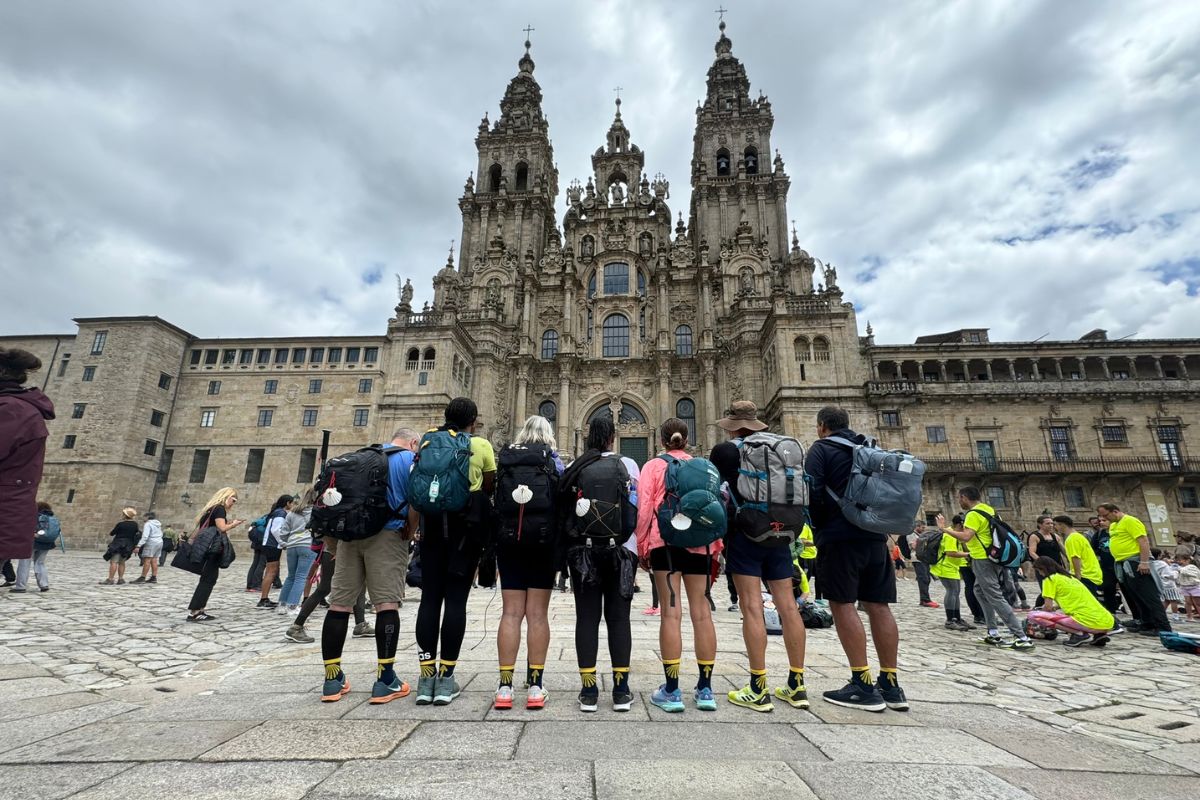
Pilgrims after completing their Camino in Obradoiro Square, in front of the façade of the Santiago Cathedral
The evolution of the Camino over the last 23 years
Here we present the total number of pilgrims from 2003 to 2025. We indicate when it was a Holy Year (*), an Extraordinary Holy Year (**), and the fateful COVID-19 year (***). Let’s take a closer look at the evolution of the Camino de Santiago in different years, which in one way or another have been very important milestones, shown both in a table and a chart.
| YEAR | TOTAL | YEAR | TOTAL |
|---|---|---|---|
| 2003 | 74,324 | 2014 | 237,882 |
| 2004 * | 179,870 | 2015 | 262,444 |
| 2005 | 93,923 | 2016 ** | 277,854 |
| 2006 | 101,056 | 2017 | 301,036 |
| 2007 | 114,377 | 2018 | 327,377 |
| 2008 | 125,601 | 2019 | 347,566 |
| 2009 | 147,254 | 2020 *** | 54,144 |
| 2010 * | 272,385 | 2021 * | 178,912 |
| 2011 | 183,374 | 2022 ** | 438,208 |
| 2012 | 192,458 | 2023 | 446,039 |
| 2013 | 215,879 | 2024 | 499,242 |
| 2025 | 530,987 |
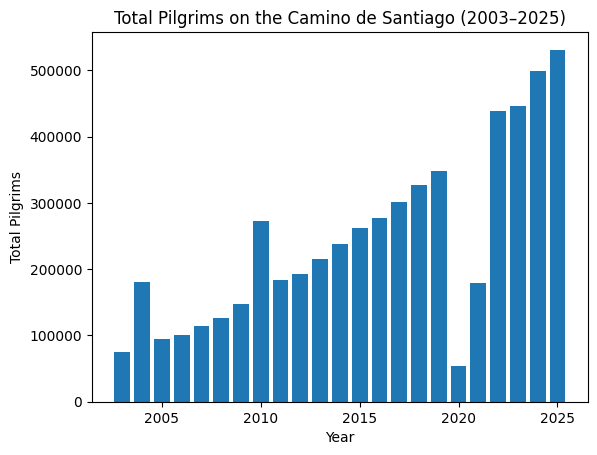
Total number of pilgrims per year from 2003 to 2025
Camino statistics show steady year-on-year growth. As can be seen, Holy Years always significantly increase the total number of pilgrims compared to previous years.
In 2017, the Camino surpassed 300,000 pilgrims for the first time, a figure that dropped dramatically during the COVID-19 year. The Camino began to recover and gained momentum again during the Holy Year 2021, although still far from 2017 figures. By 2022, the 2017 record was surpassed with more than 400,000 pilgrims, and in 2025 we surpassed half a million.
Camino de Santiago route statistics in recent years
The following table shows data for 2025, the previous five years, and for 2016 and 2010—Holy Years of the previous decade. Let’s take a closer look to analyze how the different Camino de Santiago routes have evolved.
| ROUTE | 2025 | 2024 | 2023 | 2022 ** | 2021 * | 2020 *** | 2016 ** | 2010 * |
|---|---|---|---|---|---|---|---|---|
| FRENCH WAY | 242,180 | 236,380 | 219,786 | 226,863 | 98,091 | 28,906 | 176,075 | 189,278 |
| PORTUGUESE WAY | 100,835 | 95,453 | 88,717 | 93,195 | 34,248 | 10,252 | 49,538 | 33,140 |
| PORTUGUESE COAST | 89,509 | 74,758 | 52,747 | 30,607 | 7,942 | 2,736 | 2,600 | 1,114 |
| ENGLISH WAY | 30,204 | 28,058 | 24,093 | 24,205 | 10,980 | 2,932 | 9,703 | 6,461 |
| PRIMITIVE WAY | 27,871 | 24,464 | 20,714 | 21,360 | 10,143 | 3,399 | 12,089 | 8,043 |
| NORTHERN WAY | 21,521 | 21,417 | 20,583 | 20,868 | 9,595 | 3,804 | 17,289 | 17,662 |
| VÍA DE LA PLATA | 8,836 | 9,028 | 7,964 | 10,631 | 4,046 | 1,125 | 9,067 | 14,252 |
| WINTER WAY | 2,758 | 2,870 | 2,022 | 2,352 | 932 | 406 | 287 | 139 |
| MUXÍA – FINISTERRE | 2,381 | 2,255 | 1,787 | 1,616 | 808 | 263 | 770 | 1,797 |
| OTHERS | 4,006 | 4,111 | 3,664 | 5,960 | 2,129 | 321 | 436 | 499 |
Growth of the Camino de Santiago
Camino statistics are clear. It is important to highlight the significance of the French Way, which is always the most traveled route. In second place, as usual, is the Portuguese Way, another very popular route.
Meanwhile, the Portuguese Coastal Way is experiencing significant growth in the number of pilgrims. This is due to its beauty, of course, and perhaps also to the international air connections offered by Porto Airport. We should also highlight the English Way, Finisterre and Muxía Way, Primitive Way, and Northern Way, which have also been growing in recent years. The Vía de la Plata shows a slight decline, and finally the Winter Way and other routes, officially recognized in recent years, are gradually attracting more pilgrims.
The Camino de Santiago statistics in recent years reflect a clear trend: the number of pilgrims has grown steadily, consolidating this route as one of the most important pilgrimages in the world. Despite moments of crisis, such as the impact of the pandemic in 2020, the Camino has shown remarkable resilience, reaching record numbers in recent years. With current figures and the growing popularity of the Camino, the future looks promising. Every year, more people discover the magic of this unique experience, contributing to the evolution and preservation of a tradition that remains alive after centuries. And you—have you still not walked the Camino de Santiago?