


The Camino de Santiago from Irún, the start of the Northern Way along the Basque coast. 149 kilometres through San Sebastián, Zarautz, Getaria and Markina to Bilbao, among surf beaches, fishing villages, txakoli and cliffs over the Cantabrian Sea.
You walk; we provide the logistics: accommodation, your pilgrim's credential, full documentation and travel insurance, from 671 €. And if you'd rather take on the Basque cliffs without any weight, add the daily luggage transfer.
The Northern Way from Irún to Bilbao is an itinerary organised by Viajes Camino de Santiago®.
Services
Included in all our routes
- Accommodation
9 days / 8 nights
- 9 days / 8 nights accommodation
- Complete documentation (Dossier and material for the Camino)
- On-the-road emergency telephone assistance
- Pilgrim's Credential
- Travel insurance
Optional
- Extra night
- Luggage transfer during the stages. (1 piece per person max 15 kgs)
- Breakfast
- MP (Breakfast and dinner)
- Cancellation Insurance
Accommodations
- Most popular
Private comfort (Guesthouses, rural houses and small hotels)
671 €
The perfect balance between charm and comfort. Guesthouses, B&Bs and country houses await you in the villages along the Camino with private rooms, private bathrooms, TV, and daily cleaning service. Simple and welcoming, they are the ideal place to truly rest and enjoy the peaceful rural essence that only the Camino can offer.
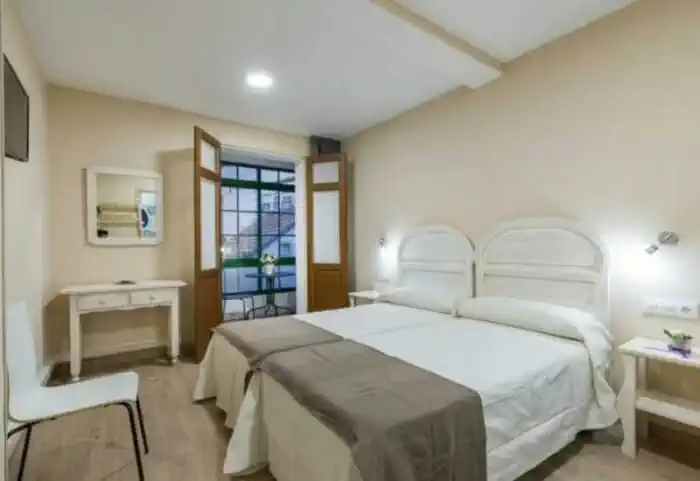
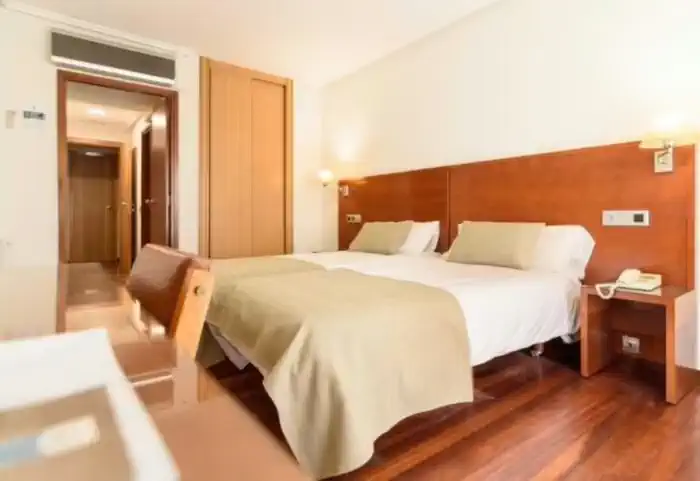
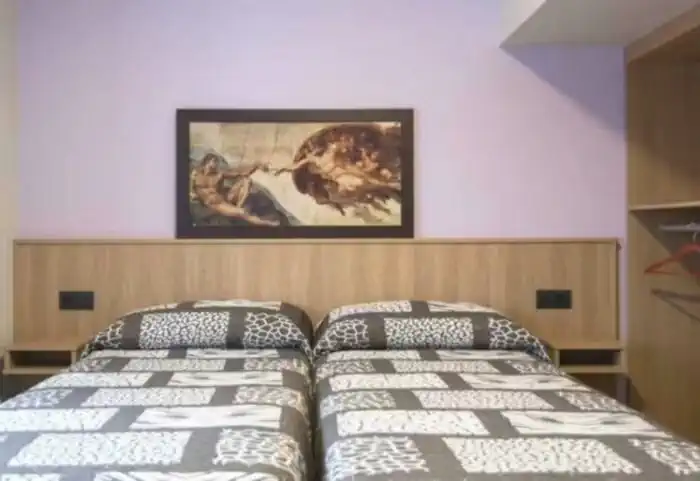
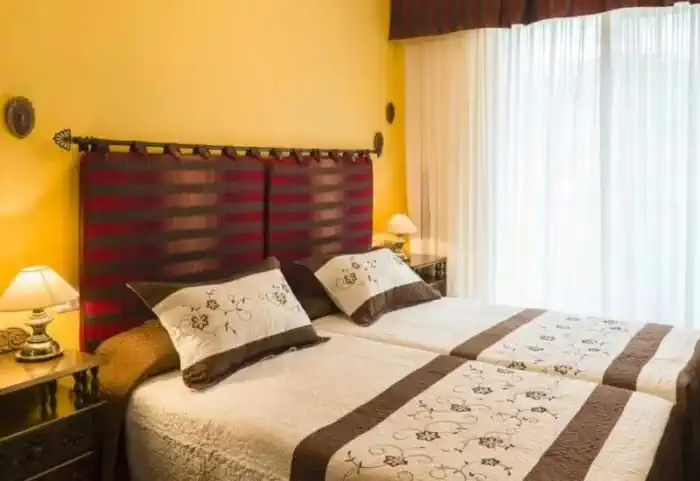
Photos


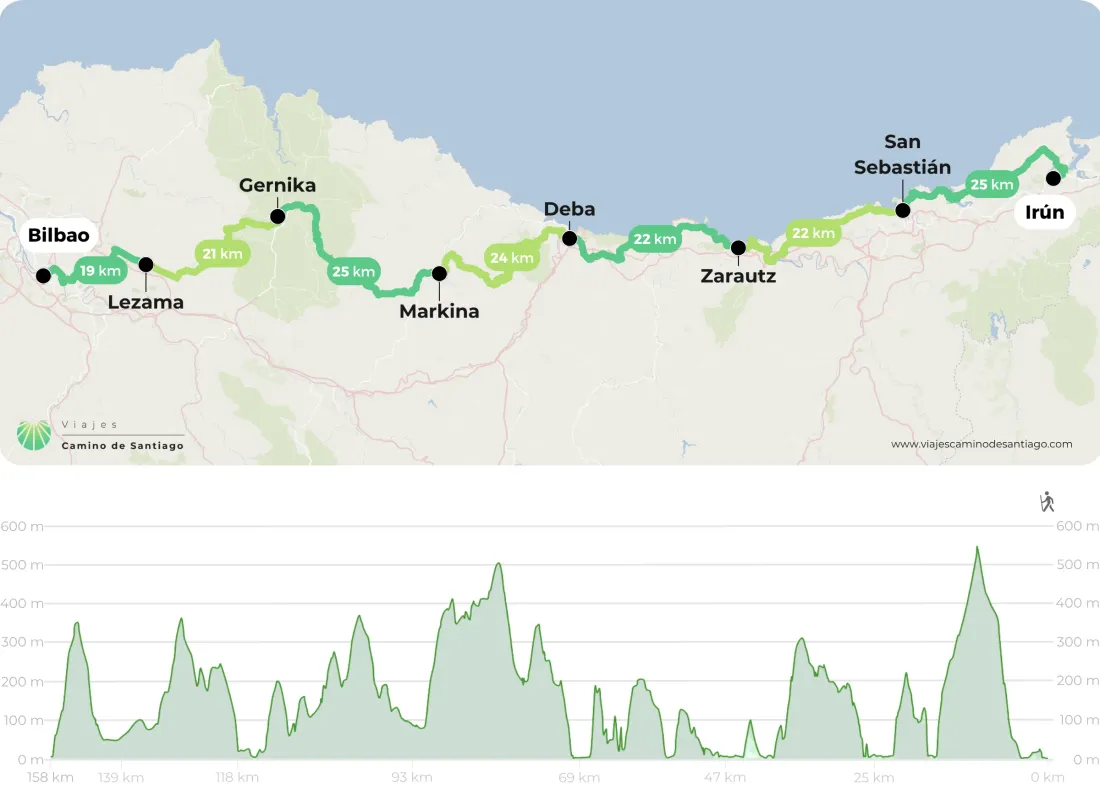
Map of the Northern Way from Irún to Bilbao
Stages
- day 1
Arrival at Irún
- day 2
Stage 1. Irún - San Sebastián (24.8 km)
The first stage and one of the most beautiful: you leave Irún towards the sanctuary of Guadalupe and walk along Mount Jaizkibel with the Bay of Biscay at your feet. You drop down to Pasai Donibane, cross the harbour mouth on a small launch to Pasai San Pedro and, over Mount Ulía, reach La Concha. San Sebastián is one of the most beautiful cities on the Cantabrian coast. La Concha forms an almost perfect bay between Mount Igueldo and Urgull, and the Parte Vieja packs in one of the highest densities of pintxos bars in the world. Climbing up to the Peine del Viento at sunset or crossing over to Santa Clara island never disappoint.
- day 3
Stage 2. San Sebastián - Zarautz (22.2 km)
You leave San Sebastián heading west, between beaches and hills. You climb Mount Igueldo in zigzags and follow the old Orio road, with the Cantabrian Sea always in the background, amid farmhouses and meadows. You pass through the seafaring town of Orio and, after some magnificent views of Getaria and its “mouse”, arrive in Zarautz, with its very long beach.
- day 4
Stage 3. Zarautz - Deba (21.8 km)
You can leave Zarautz along the seafront promenade, with a strategic stop in Getaria, birthplace of Balenciaga and of the navigator Elcano. The route continues towards Zumaia, with its flysch coastline, and climbs towards the Santa Klara farmhouse along local roads and dirt tracks, some quite steep, to Deba, back by the sea.
- day 5
Stage 4. Deba - Markina (24 km)
Today you say goodbye to the sea in Deba and head into the Basque interior. After climbing to the Calvario hermitage, a path leads you to Olatz, the gateway to Biscay, through some of the purest, most authentic rural scenery in the Basque Country. You cross Mount Arno along forest paths to Markina, home of Basque pelota. At the end, choose the newer route, which is in better condition.
- day 6
Stage 5. Markina - Gernika-Lumo (24.6 km)
A stage steeped in history. From Markina you pass through Bolibar, ancestral home of the forebears of the liberator Simón Bolívar, and the monastery of Zenarruza, a jewel of Biscayan Gothic. After climbing the slope of Mount Oiz, a long descent takes you to Munitibar and finally to Gernika, the town Picasso immortalised in his most famous painting.
- day 7
Stage 6. Gernika-Lumo - Lezama (21 km)
You leave Gernika skirting the Urdaibai reserve, with spectacular natural scenery. The day strings together climbs — Morga, Aretxabalagana — among hermitages, tracks and lovely forest paths, always well signposted. After Larrabezu, there's no way to get lost on the road to Lezama, where the stage ends at the gates of the Bilbao area.
- day 8
Stage 7. Lezama - Bilbao (11 km)
A short stage: from Lezama you pass through Zamudio and climb Monte Avril, where you first see Bilbao at your feet, before heading down into the city. Bilbao blends seafaring tradition and cutting-edge architecture like few other cities. The Casco Viejo and its Siete Calles bring together the cathedral of Santiago, pintxos bars and the Ribera market; along the estuary, the Guggenheim and the Abandoibarra promenade show the other side of the city. An unhurried txikiteo is the best plan.
- day 9
End of the trip
After your last night, you check out of your accommodation and your trip comes to an end.
Related Trips
 12 days / 11 nights
 11 days / 10 nights
 7 days / 6 nights
Frequently Asked Questions
-
Which are the most beautiful stages of the Northern Way?
Some of the most beautiful stages of the Camino del Norte are:- San Sebastian - Zarautz: Breathtaking coastal views and the promenade of Zarautz.
- Deba - Markina-Xemein: Green and mountainous landscapes with forests and meadows.
- Llanes - Ribadesella: Cliffs, beaches and hidden coves with a seafaring finish in Ribadesella.
- Ribadesella - Colunga: Contrast of mountains and sea, with Vega Beach standing out.
- Ribadeo - Lourenzá: Entrance to Galicia with landscapes of hills, forests and picturesque villages.
- Gijón - Avilés: Combines the Asturian coast with the rich architecture of Avilés.
-
What are the hardest stages of the Northern Way?
The hardest stages of the Northern Way are:- Irun - San Sebastian: Initial stage with constant ups and downs, especially on Mount Jaizkibel.
- Deba - Markina-Xemein: Mountainous terrain with narrow paths and the tough ascent of Mount Arno.
- Gernika - Lezama: Significant gradients and unpredictable weather in the Basque Country.
- Llanes - Ribadesella: Long coastal stage with rugged terrain and frequent changes in altitude.
- Ribadeo - Lourenzá: Entry into Galicia with demanding climbs, especially to O Fiouco mountain.
- Villaviciosa - Gijón: Long stage with the demanding climb to the Alto de la Cruz before descending towards Gijón.
-
I need to cancel my reservation.
You can cancel your trip free of charge up to 15 days before the start date, with no need to give any explanation.
- 15 days or more in advance → refund of 100 % of the amount paid, with no penalty. The refund is processed within a maximum of 7 days.
- Less than 15 days → Between 15 and 8 days before: 50 % of the total amount. 7 days or less → 100 % of the total amount.
- No-show → no right to a refund.
If you have taken out the Cancellation Insurance, you must inform us regardless of how many days' notice you give, but you have to handle the refund process with the insurer yourself.
Transfer of the booking: if you cannot travel, you can transfer it to another person at no cost; we only need you to let us know far enough in advance for us to arrange it. In that case, payments are settled directly between clients.
The client is responsible for any additional cost arising from the cancellation.
⚠️ IMPORTANT: every cancellation must be notified by email: info@viajescaminodesantiago.com (cancellations are not processed by phone).
👉 More info: Booking conditions.
-
What is luggage transport and how does it work?
Luggage transport is included in group trips, trips with a dog and VIP trips; on all other trips it is an optional service you can add when booking. With it you can enjoy the Camino de Santiago without the burden of carrying your luggage on your back, knowing that your suitcase will be waiting for you at your next accommodation upon your arrival. Along with your credential, you'll also receive stickers. Cover these stickers with the requested information and stick them in a visible place on your suitcase. Upon arrival at your accommodation, we suggest asking at the reception where you can leave your luggage. You'll need to leave your luggage at the designated spot early in the morning for our carrier to pick it up. This ensures that when you arrive at your next accommodation, your luggage will already be waiting for you. -
Should I start the Northern Way in Irún or in San Sebastián?
It depends on how many days you have. From Irún it's 7 stages and 149 km, with 8 nights' accommodation, and you experience the start of the Northern Way right on the French border. From San Sebastián it's 6 stages and 125 km, with 7 nights: you skip the first day and still reach Bilbao via Zarautz, Deba, Markina and Gernika. If you want to walk the Northern Way from kilometre zero, start in Irún.
-
Does the Northern Way from Irún to Bilbao qualify for the Compostela?
Not on its own. The Pilgrim's Office awards the Compostela to those who walk at least the last 100 km to Santiago, and this section ends in Bilbao. What you do get is stamps in your Pilgrim's Credential, which you can use to continue the Northern Way on another trip. To earn the Compostela you'll need to walk those last 100 km to Santiago, for example from Vilalba (118 km).
-
What is there to see in Irún before starting the Northern Way?
You arrive the day before, so you have the afternoon free in Irún. We recommend the Oiasso Roman museum and a look at Pheasant Island, a curious enclave on the border. It's a good time to rest, pack your rucksack and get in the right frame of mind: the next day your Northern Way sets off towards San Sebastián.
-
What is the first stage of the Northern Way, from Irún to San Sebastián, like?
It's 24.8 km between the coast and the mountains, with plenty of ups and downs from day one. The path runs mostly along tracks and through woodland and passes the Sanctuary of Our Lady of Guadalupe before dropping down to San Sebastián. You'll arrive ready for a reward: La Concha, the Old Town and its pintxos more than make up for it.
-
Are there places to eat on the Deba to Markina stage?
Very little: there are hardly any villages along the 24 km between Deba and Markina, so set off with water and food in your rucksack. This is the stage where you leave the sea behind and head into the Basque interior. You climb to the Calvario hermitage, enter Bizkaia at Olatz and cross Mount Arno on forest paths. Towards the end, take the newer route, which is in better condition.
-
What makes the Markina to Gernika stage special?
It's the stage with the most history on this section. You pass through Bolibar, the ancestral home of Simón Bolívar's family, and the Zenarruza monastery, a gem of Biscayan Gothic. After the slopes of Mount Oiz, a long descent takes you to Munitibar and on to Gernika, the town of Picasso's painting. It's 24.6 km.
-
Is the last stage, from Lezama to Bilbao, hard?
No: at 11 km it's the shortest and easiest stage of the trip, although there's one last effort up Mount Avril before dropping into Bilbao. The final kilometres cross the industrial outskirts, as usual when entering a big city. The afternoon is yours for the Old Town, the Seven Streets and the Guggenheim.
-
Can I continue the Northern Way from Bilbao to Santander?
Yes. It's the next section: 5 stages and 122 km via Portugalete, Castro Urdiales, Laredo and Noja to Santander, and we offer it as a trip of its own. You can do it straight after or on another getaway, picking up the Northern Way where you left off.
From Irún to Bilbao
From 671 €

Reviews
Ane Larrinaga Urrutia
Iker Zabala Arregi
Nerea Etxebarria Sola
Asier Lasa Mendieta
Maialen Uribe Zubia
Unai Mendizabal Garmendia
Leire Aranburu Ochoa
Xabier Kortazar Elorza
Itziar Soroa Landa
Mikel Eguiguren Aizpurua