


The origin of the Camino de Santiago
18 July, 2026
Explore the origin of the Camino de Santiago and how this historic pilgrimage route emerged around the discovery of the apostle's tomb. The article reviews its evolution, religious significance, and expansion across Europe, providing key context to understand its current importance.

When speaking of the history of the Camino de Santiago, it is essential to discuss the figure of Saint James the Apostle, whose life, preaching, martyrdom, and subsequent discovery of his tomb marked the birth of the Jacobean routes, which today are traveled by thousands of pilgrims each year. In this article, we will delve into the origin of the Camino de Santiago, the figure of the Apostle, his connection to Galicia, the discovery of his tomb, and the birth of the pilgrimage to Compostela.
 The Apostle James in the Portico of Glory
The life of Saint James the Apostle
James the Greater, also known as James, the son of Zebedee, was one of Jesus' closest disciples according to the Gospels. His family, dedicated to fishing in Galilee, consisted of his father Zebedee and his mother Salome, who is considered in some traditions to be the sister of the Virgin Mary; additionally, James had a younger brother, John, and both were called the "Boanerges" or "sons of Thunder", due to their impetuous characters. As for his origin, biblical sources do not specify his birthplace, but it is assumed that he came from Galilee, possibly a native of Bethsaida, a fishing village by the Sea of Tiberias (Sea of Galilee).
At the beginning of Jesus' preaching, James and his brother John were called to follow him while they were working with their father in fishing. They immediately left their boat and their father to join Jesus, becoming part of the first group of disciples along with Peter and Andrew. This encounter and their commitment to Jesus occurred around the year 28 A.D., when he called them "fishers of men," symbolizing their new mission.
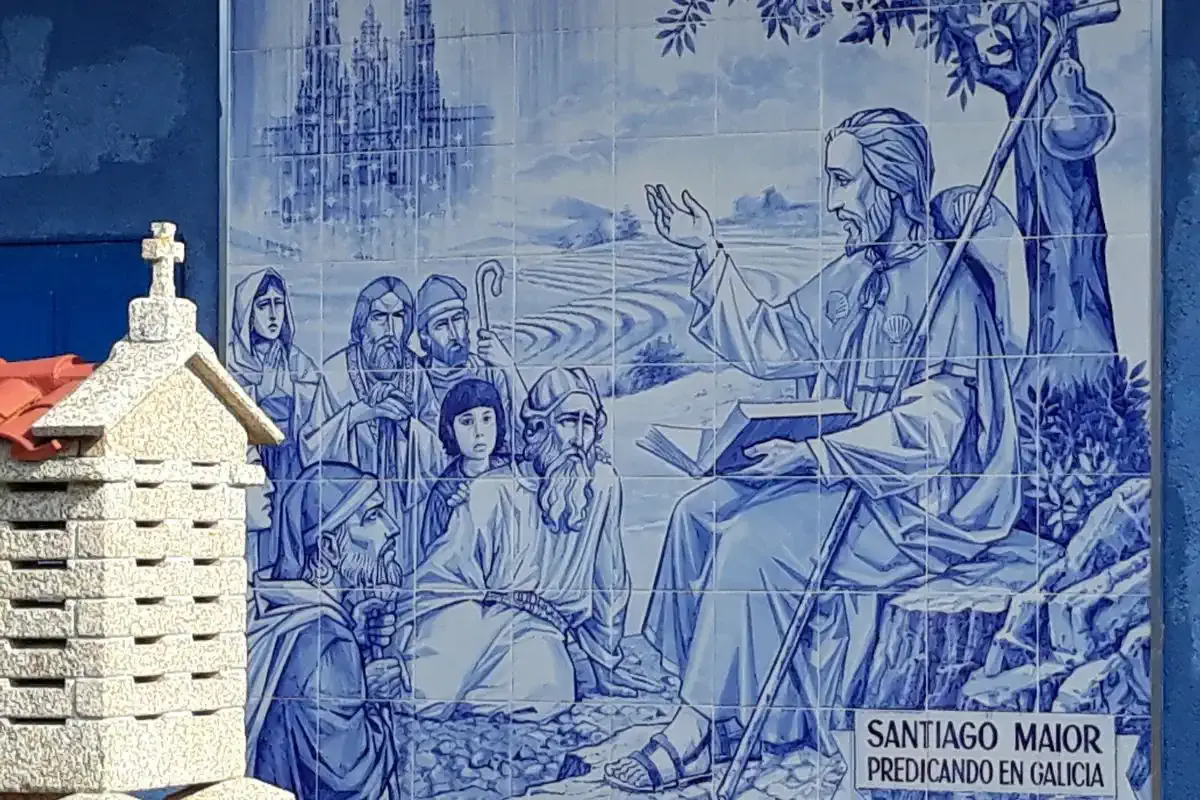 Saint James the Apostle preaching
His journey and preaching in Galicia
After the death of Jesus, Santiago was one of the first to preach his message, spreading it across various regions in Palestine and other places. Subsequently, responding to the mission he had to evangelize the westernmost part of the known world, Santiago arrived in Roman Hispania, where it is believed he brought the word of Jesus to the local pagan tribes.
Thus, in Galicia, where it was believed to be the "End of the World" or Finisterrae, he gathered a group of followers and faced the difficult task of evangelizing a pagan people. One of his stops, according to legend, was Santiaguiño do Monte, in the municipality of Padrón, a locality of the Portuguese Way closely linked to the Jacobean tradition, although it is also located in Muxía, around the Sanctuary of the Virxe da Barca.
After his mission in Galicia, Santiago returned to Palestine, where he continued preaching. He was arrested by order of Herod Agrippa I and martyred by decapitation in the year 44 AD, becoming the first apostle to be martyred for his faith.
 Holy Stones in Santiaguiño do Monte
The Traslatio, the Depositio and the Inventio
After the martyrdom of Santiago, his body was transported by his disciples, Teodoro and Atanasio, from Jerusalem to Galicia, in a journey and episode known as the Traslatio. Tradition holds that the body was placed in a stone boat that sailed without a rudder or sail, arriving at the shores of Galicia, specifically in Padrón. After searching for a burial place and enduring many hardships with the queen Lupa, the body of Santiago was deposited in the place we now know as Santiago de Compostela, an episode that tradition titles as Depositio.
The discovery of the tomb of Santiago
800 years later, in the 9th century, the discovery of the tomb of Santiago took place, an episode known as the Inventio, which marked a milestone in the origin of the Camino de Santiago. Legend has it that a hermit named Pelayo observed a field of bright stars over a hill; one theory, in fact, claims that this campus stellae ("field of stars" in Latin) is where the toponym "Compostela" comes from. Intrigued by this celestial vision, he headed to the site and discovered a marble tomb. Pelayo informed Bishop Teodomiro of Iria Flavia (Padrón), who in turn notified King Alfonso II of Asturias. He, from his court in Oviedo, decided to embark on a journey along what is now known as the Primitive Way to reach the recently discovered tomb in Compostela to certify the discovery; in fact, this monarch is known as the first pilgrim.
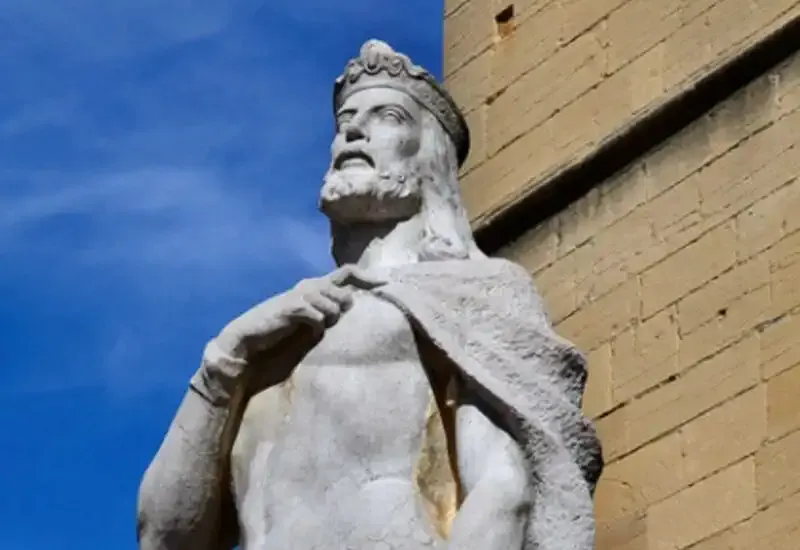 Alfonso II the Chaste, the first pilgrim in History
The origin of the Camino de Santiago
The discovery of the tomb of Santiago had a significant historical and political impact during the Christian "Reconquista". The possession of the relics of the Apostle represented a moral boost for the Kingdom of Asturias in the face of the Muslim presence on the peninsula, and promoted pilgrimage to his tomb as a way to seek his protection. At the same time, it would become a path of faith and penance and, subsequently, a way to gain indulgences. In this context, the veneration of Santiago became a unifying factor for European Christians.
The creation of the city of Santiago de Compostela
Thus, around the tomb of Santiago, a first church was built, which was replaced or rebuilt by others of increasing size. At the same time, monasteries such as that of San Martín Pinario, churches, houses, artisan workshops, walls, and other constructions began to be part of the new city of Santiago de Compostela. Finally, with the beginning of the construction of the current Romanesque cathedral at the end of the 11th century, the city became an important pilgrimage center, attracting thousands of people from all over Europe, primarily through the French Way.
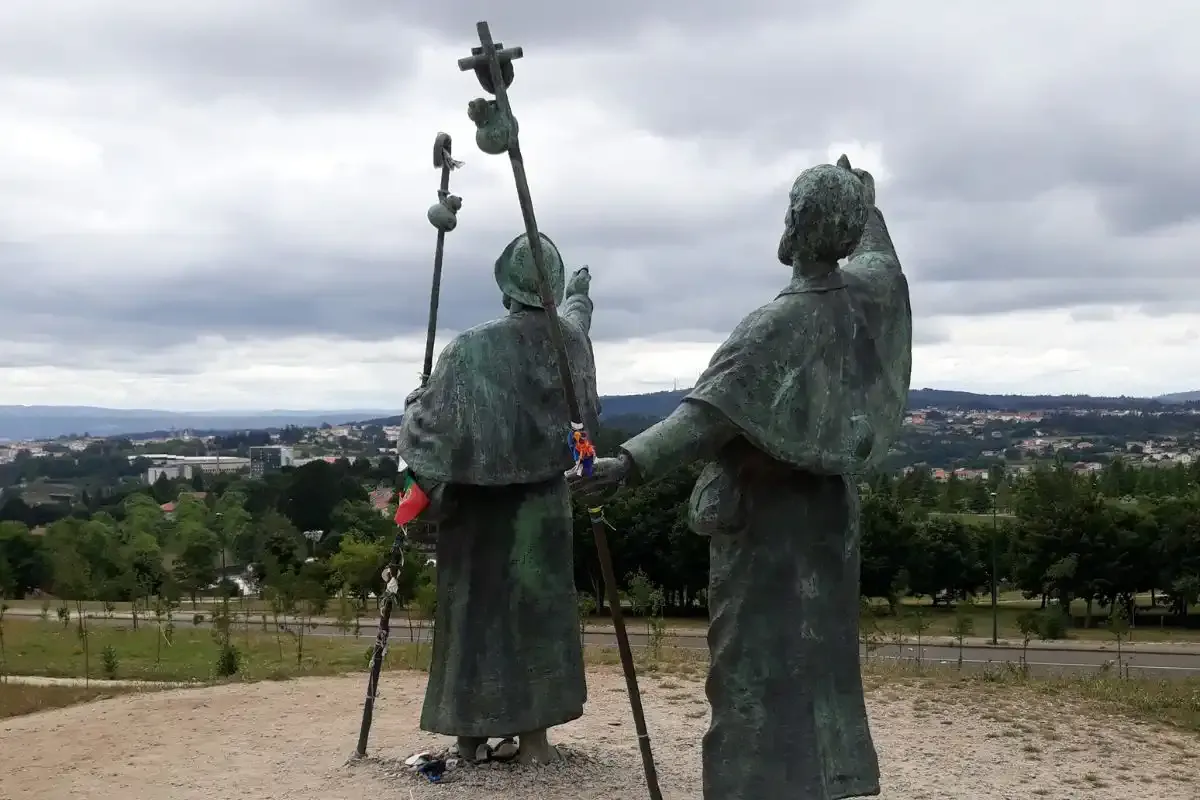 Statue of the pilgrims at Monte do Gozo, upon arriving in Santiago
Experience the history of the Camino de Santiago with us
If you have ever dreamed of walking the Camino de Santiago, this may be your moment. Because beyond whether the remains of the Apostle are really in the cathedral or not, what truly matters is everything the Camino has meant —and continues to mean— for thousands of people throughout the centuries: transformation, encounter, pause, meaning. And we would love to accompany you on this very special adventure: write to us and we will help you plan your route, with everything you need to experience the Camino with peace and authenticity.
The Camino is waiting for you… Are you ready to take the first step?