


Who was the first pilgrim precursor of the Camino de Santiago?
19 February, 2025
The first known pilgrim to undertake the Camino de Santiago was Apostle James. Tradition holds that it was the apostle who preached in the Iberian Peninsula and that after his death, his body was transported by boat to Galicia, where his tomb was discovered in the 9th century. This event marked the beginning of the rise of pilgrimage to Santiago de Compostela, turning the city into one of the most important pilgrimage destinations of medieval Christianity. Although a single "first pilgrim" cannot be identified, the discovery of James' tomb is what initiated the tradition of pilgrimage to his burial site.

As of today, Santiago de Compostela receives hundreds of thousands of pilgrims each year, even despite how the pandemic may have affected tourism and pilgrimage. But it was not always this way, as at many moments in history it was on the brink of disappearance. However, beyond statistics and numbers, one of the most common questions among our pilgrims is the following: who was the first pilgrim of the Camino de Santiago? Some say that the first pilgrim was Santiago himself, but that does not make much sense, as it is he who is sought in the pilgrimage.
There is no certain or concrete answer to this question, as there is much information based on legends, preconceived ideas, or traditions, but nothing tangible that exactly corroborates who it was. Below we present some of the hypotheses put forward by historians specializing in the Camino de Santiago.
King Alfonso II, the most widespread theory
José Miguel Andrade, an expert on the Camino and professor of Medieval History at the University of Santiago de Compostela, states that “tradition holds that Bishop Teodomiro informs King Alfonso II that the body of Santiago has been found, and the king comes on pilgrimage around the year 820, becoming the first pilgrim”, in order to corroborate this discovery by the prelate. This journey would have also given rise to the emergence of the first Camino, known as the Primitive Way from present-day Oviedo. This is because the Asturian capital was where the royal residence was located, yes, but a first problem arises, which is that there is no contemporary document to the events that validates this theory: neither regarding the undertaking of the route nor the starting point in case the journey was embarked upon, as this crossing is not mentioned until two and a half centuries later, in the Compostela of the 11th century.
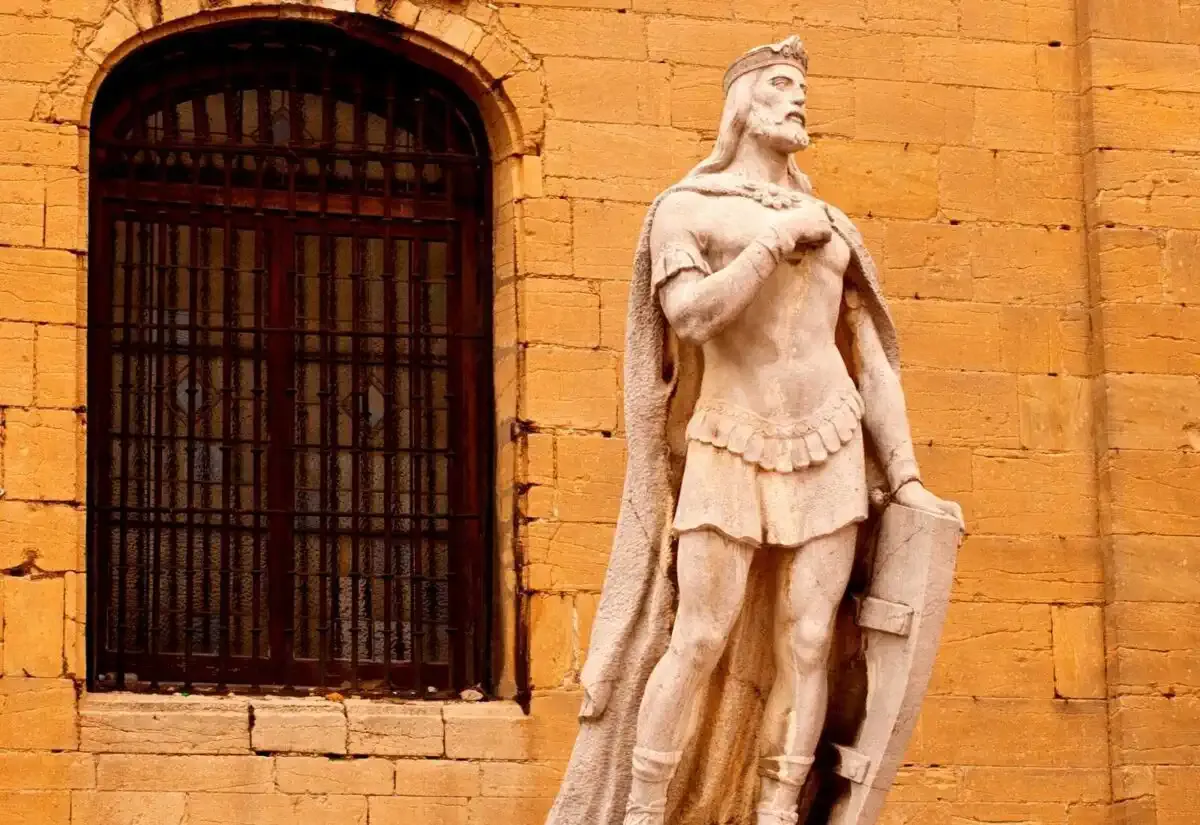
Statue of Alfonso II in Oviedo
Furthermore, if we take into account the life of a king at that time, nothing can assure us that the monarch, had he made a pilgrimage to Santiago de Compostela, would have done so from Oviedo and not from any other point in the kingdom. In fact, if this were true, it is most likely that the route taken was not the same as the one that, centuries later, was traced to connect Oviedo with Santiago de Compostela, since it is unlikely that such a direct journey on the map would have been made.
And why Alfonso II? It is important to note that the first documentary reference mentioning the church of Santiago de Compostela is a donation from Alfonso II himself, but this does not certify at all that he, and not someone else, was the first traveler to see the remains of the Apostle. “Tradition says that, but there is no documentary evidence to support it. Whether he was the first pilgrim or not is completely impossible to know,” states Andrade, placing great importance on documentary evidence.
A blind German, the first documented pilgrim evidence
The earliest evidence consists of a German cleric pilgrim who in the year 930 claims to have traveled to Santiago de Compostela. Perhaps less credible is what he writes in that document, as he narrates, after having returned home, how his journey to Compostela was and how, thanks to his pilgrimage, the Apostle Santiago cured his blindness. In this regard, the German historian Klaus Herbers asserts that at that time “Santiago was known in Germany as a center of pilgrimage”.
The literary pilgrimage of Bishop Godescalco of Le Puy
The story of Godescalco is a documented and curious one. He, a French bishop from Le Puy en Velay, where the current Via Podiense originates, pilgrimed in the year 951 to the Compostela See with a retinue of many pilgrims. On his way to Santiago, it is known that he passed through Pamplona and Logroño, where curiously he deviated about 15 kilometers south, heading to a new monastery in Albelda (La Rioja), a locality taken from the Muslims by Ordoño I, King of Asturias, in the year 924, just a few years earlier.
What was the reason? To request a copy of a manuscript by Saint Ildefonso, Bishop of Toledo from the 8th century about the Virgin, of which his diocese lacked, known for its Marian devotion and in search of Marian liturgical texts. The copy, which is now preserved in the National Library of France (Paris) along with the rest of its parts, is called Godescalco Manuscript, as noted by Roger Reynolds from the Pontifical Institute of Medieval Studies and a pilgrim to Santiago de Compostela on three occasions (most recently in time).
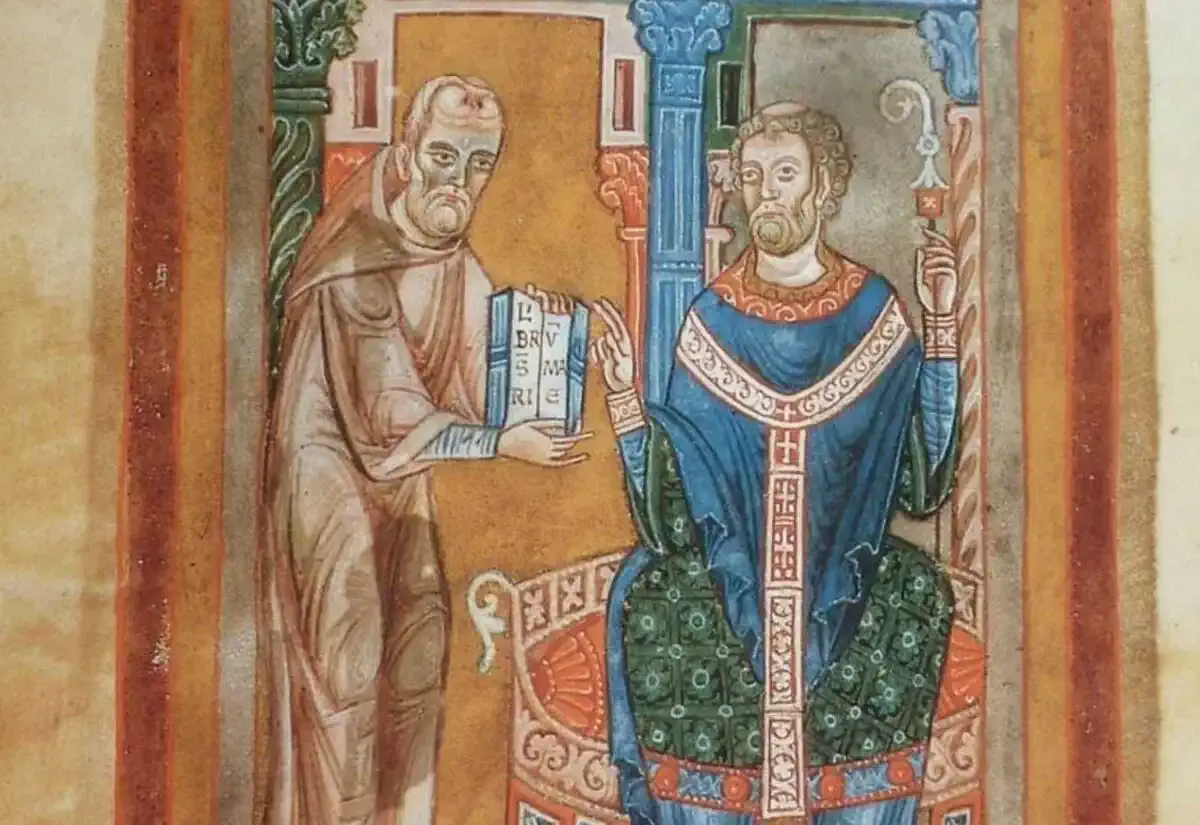
An image of Godescalco from Puy
And it is there, in the very prologue of the manuscript, where the record of that request and the evidence of his journey remains, as it states that he requests it on his way to Santiago, to collect it on the return, clearly demonstrating, this time indeed, the adventure. Therefore, we are faced with the first known pilgrim whose journey was documented at the moment he undertook it, which does not mean that he was the first pilgrim.
The good Godescalco claims that he was born on the day the Apostle ascended to heaven, July 25, when he himself was also appointed bishop. It seems he was very devoted to the Son of Thunder, and he took a nice souvenir from his visit to the Camino de Santiago.
Perhaps Charlemagne?
Special mention deserves the emperor Charlemagne. There is no record of him reaching the Compostela mitre, but his story is another of many in which documents (later) place him on the Way, in this case as its creator.
Why are such facts mentioned in the Calixtine Codex of the 12th century, three centuries after his death? Probably, and as was common at the time, with the intention of linking the discovery of the remains of the Apostle with the monarchy to give prestige to the finding. But it seems that the story is quite improbable.
We will continue investigating, but always with documentary certainties
The history of the Camino de Santiago and of the first pilgrims to the recently discovered Tomb of the Apostle in Compostela, such as the most widespread one, that of Alfonso II, “is a story that is written two and a half centuries after the event. It appears in chronicles and texts from Compostela in the 11th century. Based on that, we know nothing. We do not even know if Alfonso II ever went to Compostela”, states the French Adeline Rucquoi, a member of the Expert Committee of the Camino de Santiago.
With all this, we can conclude that it is difficult to know exactly who the first pilgrim of the Camino de Santiago was, as it is difficult to contrast certain sources. Is it likely that it was Alfonso II? Yes, but as likely as it is improbable, so researchers will need to be given room to continue working on clarifying one of the great doubts of Jacobean history. We will continue to pilgrimage through history to find the traces of those who began to forge the First European Cultural Itinerary, will you join us? And if you want to follow those footsteps on foot, calculate the price of your Camino here.