


10 Hidden Secrets to See in Santiago de Compostela
22 March, 2026
Discover the 10 hidden secrets to see in Santiago de Compostela beyond the classic tourist itineraries: from historic parks and curious streets of the old town to medieval symbols, facades with ancient marks, the oldest pharmacy in the city, and unique architectural details known only to those who explore the city thoroughly, ideal for travelers who want to see Compostela from a different perspective

Santiago de Compostela is a city full of magic, legends, and traditions, but it also hides secrets that not everyone knows. Beyond the Cathedral of Santiago and the Botafumeiro, the Plaza de la Quintana and the Shadow of the Pilgrim, the Plaza de Abastos and the Paseo de la Alameda, Santiago de Compostela conceals corners and details that every good guide should tell you about. Are you wondering what to see in Santiago de Compostela? In this tour, we invite you to discover those unique corners, those 10 hidden secrets of Santiago de Compostela designed for pilgrims of the Camino de Santiago and tourists to enjoy the city even more.

In the historic center of Santiago, as well as outside of it, you will find many hidden secrets
The Park of San Domingos de Bonaval and its ghost cemetery
We begin the route outside the walled perimeter of the historic center with the Bonaval park, a green space full of history and tranquility. It houses an ancient cemetery, which was moved here from its original location in Praza da Quintana in 1780, due to lack of space and perhaps for health reasons. It functioned as such until the 1960s, when it was closed and abandoned. In the 1990s, it was rehabilitated and transformed into the park we know today, integrating elements from the old convent of San Domingos.
Located next to the Museo do Pobo Galego and the Centro Galego de Arte Contemporánea, two of the main museums in the city, the park combines nature and history. Its paths wind between tall trees and ancient architectural remains, offering a unique atmosphere filled with details that connect with Santiago's past.
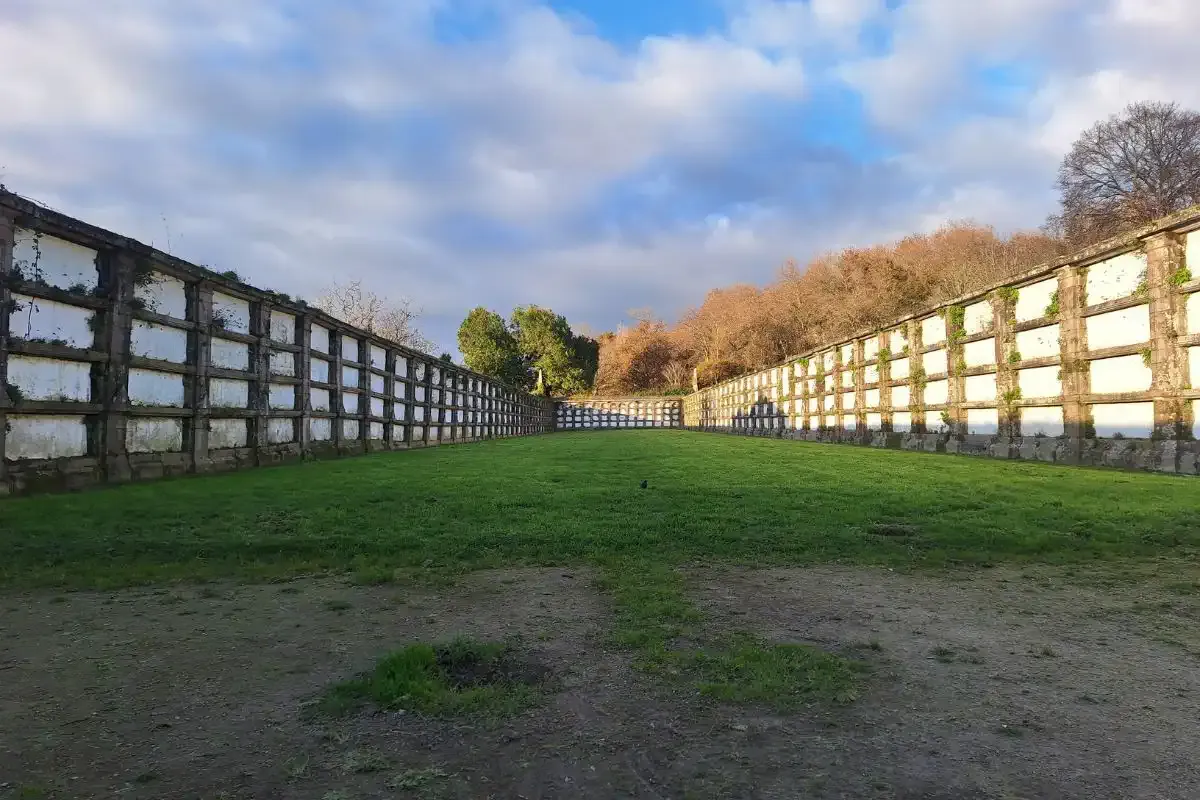
The Bonaval cemetery is a peaceful and beautiful place to stroll
Some Curious Streets of the Historic Center
The Rúa do Franco is the gastronomic heart of the historic center. In ancient times, this was where medieval tavern keepers and builders of the cathedral, known as "francos," settled. These could be free men, pilgrims who arrived through the Pyrenees, or citizens of a "frank nation." In modern times, this street became the epicenter of student nightlife with the legendary Paris-Dakar rally, a "pilgrimage" within the city through all the existing bars, from Paris to Dakar, where participants had to drink a chato of wine. Whoever arrived at the last bar in "good condition" won, and the prize was, more wine!
The Rúa Entrerúas, whose name literally means "between streets," is one of the narrowest in Santiago, with barely 90 centimeters in width. It connects Rúa do Vilar with Rúa Nova, and its narrowness makes it a draw for visitors. However, the Rúa Oliveira surpasses this record, with only 70 centimeters in width, earning the title of the narrowest street in the city. The Rúa Oliveira also houses a very curious corner: the alley known as Ruela Sae Se Podes (or Alley of "Sal Si Puedes").

If you are accompanied, when passing through the Rúa Entrerúas, you must walk in single file.
The Oldest Houses of Santiago de Compostela
The number 29 of Rúa Algalia de Abaixo is considered the oldest dwelling in the historic center. It dates back to the late 12th century and is located next to the now-disappeared San Roque gate, one of the 7 historical gates of the walls of Santiago. Its structure reflects typical medieval architecture, highlighting the projections on its façade, a common feature of constructions from that era. The upper floor is wider than the lower ones, creating overhangs that look directly towards the majestic Pazo de Amarante.
On Rúa Nova, there are two other medieval houses of great importance: the parish houses of Santa María Solomé. Built a century after the house on Algalia, these houses from the 13th century are an example of what Santiago was like in the Middle Ages.

The houses of Rúa Nova or Santa Solomé are in the process of restoration
The Property Marks
In the historic center of Santiago de Compostela, you can find symbols carved into the facades of many houses. These marks, used since the Middle Ages, identified the owners of the buildings and prevented confusion in the rental system. They emerged during the peak of the Camino de Santiago, when the city grew rapidly, and reflect the power of religious institutions, such as the Cabildo or the monasteries, which controlled much of the properties.
Among the most common marks are the scallop shell of the Cabildo of the Cathedral, the pine of the Monastery of San Martín Pinario, the five stars of the Universidade de Santiago, and the cross of the Hospital of the Catholic Monarchs. These marks, visible on lintels and walls, are a legacy of the urban and ecclesiastical history of Compostela that invites the curious to seek them out during their walks.

The scallop shell is one of the most abundant property marks
The Carved Board Games on the Stones
More than 200 baroque game boards, carved in stone, are distributed throughout the streets of Santiago. Dated to the 17th and 18th centuries, these engravings were used by locals to play the popular tic-tac-toe, especially during pilgrimages or while waiting for alms at the entrances of temples. Places like San Martińo Pinario and Santa Clara concentrate a large number of these boards, symbolizing the social inequalities of the time.
Although municipal ordinances restricted these games, locals continued to carve them in stone or perishable materials like wood to avoid penalties. Santiago boasts the largest collection of urban baroque boards in Spain, but their preservation is a challenge due to erosion and modern restorations. Exploring these streets to find them is to discover a fragment of life in historical Compostela.

In Santiago de Compostela, there is no room for boredom
Farmacia Bescansa, the oldest in the city
Farmacia Bescansa, founded in 1843 by Antonio Casares Rodríguez, is a living testament to the pharmaceutical tradition in Santiago de Compostela. Casares, considered the father of modern chemistry in Galicia, was the first dean of the Faculty of Pharmacy in the city. In 1917, Ricardo Bescansa Castilla, a descendant of Casares, founded Laboratorios Bescansa alongside the pharmacy. There, he developed innovative pharmaceutical products, consolidating the family's prestige in the pharmaceutical field.
Located in the old town of Santiago, the pharmacy retains its original structure, reminiscent of the old apothecaries of the 19th century. Although its appearance may go unnoticed, its interior is a historical gem. However, it is not intended as a tourist attraction, so it is best to enjoy it with respect and discretion.

The Bescansa pharmacy, in the cantón do Toural
The Gargoyles of Santiago de Compostela
In Santiago de Compostela, the gargoyles are much more than functional elements to divert water from the roofs. These sculpted figures, hidden in the heights, reflect a mix of art, sarcasm, and historical moments, but often go unnoticed by those who walk through the city.
Although their origin in the medieval period had a religious significance, representing beasts and figures with a moralistic purpose, the gargoyles of the Renaissance and Baroque styles were the result of the creativity and humor of the craftsmen. The stonemasons, working freely and giving free rein to their creative whims, added ironic or burlesque details in high places. Many figures include monstrous hybrids, classical myths, and caricatures of contemporary people. Some have funny or terrifying shapes, and searching for the most amusing ones can be a great game. It's like an urban safari of magical creatures!

Gargoyles "dialoguing" in San Martín Pinario
The Trapdoors of the Porticos
The trapdoors in the arcades of Rúa do Vilar and Rúa Nova are a unique element that for centuries formed part of the social life of Santiago. These openings allowed the inhabitants to observe passersby without being seen and, according to the writer Torrente Ballester, to criticize or comment on them from the privacy of their homes. They were also the setting for serenades described by Alejandro Pérez Lugín in "La Casa de la Troya".
In addition to this social function, the trapdoors had practical uses, such as collecting messages using baskets or attending to visitors without going to the door. Even in shops, they served for customers to take newspapers and leave money. Although many have disappeared, these trapdoors are a testament to the ingenuity and daily life of the city.

The trapdoors were very useful in the daily lives of the inhabitants
The Tree of Science and the Indecisive Students
In the heart of the historic center of Santiago de Compostela, between the colleges of Fonseca and San Xerome, stands the emblematic Tree of Science, a forged work integrated into the wall that combines history, tradition, and academia. Inspired by the eponymous work of Ramon Llull, written in the 13th century, this tree represents the different fields of knowledge as scrolls on branches that stem from a common trunk, symbolizing the unity and diversity of knowledge.
The Tree of Science is the epicenter of a curious tradition. According to this custom, those seeking vocational guidance to study at the University of Santiago must turn three times in front of the tree, turn their backs, and point to one of its branches. The chosen branch will indicate the scientific discipline they should follow. This ritual, which originally helped indecisive students decide their career, has evolved into a fun and magical experience for both locals and tourists. If you visit Santiago, do not miss the opportunity to participate in this unique ritual and discover what vocation might be written in your destiny.

It is not very hidden, but many pilgrims and tourists are unaware of its usefulness
The Largest Scallop Shell of Compostela: A Secret in Plain Sight
In the Plaza de Platería is the largest scallop shell in Santiago, a monumental structure designed by Domingo de Andrade in the 17th century. This architectural element connects the transept of the Cathedral with the first floor of the north wing of the cloister. According to legend, this shell is not only structural but symbolically supports the entire Cathedral, and removing it would imply its collapse.
Although it often goes unnoticed due to the magnificence of the Plaza de Platería, this shell is a detail that combines the spirituality of the Camino with Baroque architectural mastery. It is an essential stop for those wishing to discover the best-kept secrets of Compostela.

The facade of Platería is so beautiful that many do not notice the great hidden scallop shell.
Explore Santiago like an Adventurer
In summary: if you are looking for what to see in Santiago de Compostela beyond the typical, these 10 secrets include historic parks, hidden streets, medieval symbols, and unique curiosities that few visitors know. Indeed, Santiago de Compostela is full of secrets waiting to be discovered: every corner and every alley holds stories, legends, and traditions that will enrich your visit to Santiago de Compostela. Whether you are a tourist or a pilgrim on a Jacobean route, if you are wondering what to see in Santiago de Compostela, walk with your eyes wide open and let this city surprise you.
Comments (2)
David espinal botero
Jorge Severo Medina Martín
David espinal botero
Leave a comment