


The Camino de Santiago from Bilbao, from the Biscay estuary to the bay of Santander. 122 kilometres through Castro Urdiales, Laredo and Santoña to Santander, among marshes, vast beaches and the fishing towns of the Cantabrian Sea.
You walk; we provide the logistics: accommodation, your pilgrim's credential, full documentation and travel insurance, from 451 €. You decide whether your backpack comes with you or you add the daily luggage transfer.
The trip along the Northern Way from Bilbao to Santander is organised by Viajes Camino de Santiago®.
Services
Included in all our routes
- Accommodation
7 days / 6 nights
- 7 days / 6 nights accommodation
- Complete documentation (Dossier and material for the Camino)
- On-the-road emergency telephone assistance
- Pilgrim's Credential
- Travel insurance
Optional
- Extra night
- Luggage transfer during the stages. (1 piece per person max 15 kgs)
- Breakfast
- MP (Breakfast and dinner)
- Cancellation Insurance
Accommodations
- Most popular
Private comfort (Guesthouses, rural houses and small hotels)
451 €
The perfect balance between charm and comfort. Guesthouses, B&Bs and country houses await you in the villages along the Camino with private rooms, private bathrooms, TV, and daily cleaning service. Simple and welcoming, they are the ideal place to truly rest and enjoy the peaceful rural essence that only the Camino can offer.




Photos


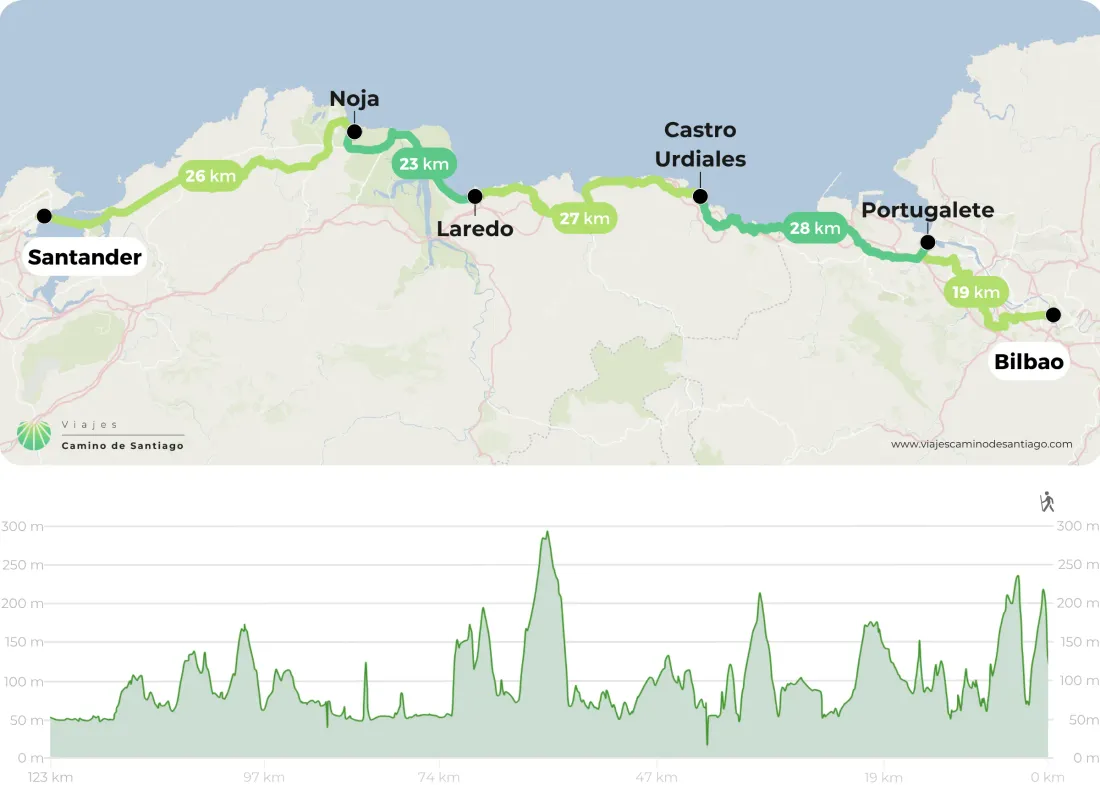
Map of the Northern Way from Bilbao to Santander
Stages
- day 1
Arrival at Bilbao
- day 2
Stage 1. Bilbao - Portugalete (19.2 km)
You leave Bilbao following the Nervión estuary towards Portugalete. The official route runs along the left bank, between Zorrotza and Barakaldo; don't skip this urban stretch — it holds history and architecture of the estuary. The great icon of the day is the Puente Bizkaia (the Puente Colgante), a World Heritage Site, already in Portugalete, where the stage ends.
- day 3
Stage 2. Portugalete - Castro Urdiales (27.6 km)
You leave Portugalete along the bidegorri (cycle path), leaving the Bilbao metropolitan area behind. After the beach of La Arena you reach Pobeña, where the best stretch of the day begins: the Paseo Itsaslur, a greenway following an old mining railway, with stunning views over the coast. You continue along paths to Castro Urdiales, already in Cantabria.
- day 4
Stage 3. Castro Urdiales - Laredo (26.6 km)
A day of cliffs. You leave Castro Urdiales, climbing towards Allendelagua, with the ruins of its Templar tower, and continue along wooded paths parallel to the imposing Cantabrian cliffs. You cross the Agüera river and choose between the inland route or the beautiful coastal path, both leading to Laredo and its huge Playa de La Salvé.
- day 5
Stage 4. Laredo - Noja (23 km)
You leave Laredo and its beach heading for Santoña, a seafaring town famous for its anchovies — many people cross the bay by boat, a beautiful little voyage. After that, the route turns rural and peaceful, skirting the marshes of Santoña, Victoria and Joyel, a refuge for thousands of birds. You finish in Noja, with its long beaches like Playa de Ris.
- day 6
Stage 5. Noja - Santander (26 km)
You leave Noja among marshes and beaches, pass through Castillo Siete Villas and Bareyo, with its Romanesque church of Santa María, and continue via Güemes and Galizano to Somo. The finish is unusual: you cross the bay by boat to the centre of Santander. Santander looks out over the Cantabrian Sea from a beautiful bay. The promenade along the first Sardinero beach, the Magdalena peninsula with its palace, and the Centro Botín right by the water sum up the city well. In the centre, the Esperanza market and the bars on Calle Peña Herbosa are a must-stop for rabas and a glass of wine.
- day 7
End of the trip
After your last night, you check out of your accommodation and your trip comes to an end.
Related Trips
 12 days / 11 nights
 9 days / 8 nights
 11 days / 10 nights
Frequently Asked Questions
-
Which Camino is harder: the Primitive or the Northern Way?
The Primitive Way is harder than the Northern Way because of its short but intense stages, with steep slopes and mountainous terrain. Although the Camino del Norte also presents challenges, it alternates mountainous sections with flatter stages along the coast. -
I need to cancel my reservation.
You can cancel your trip free of charge up to 15 days before the start date, with no need to give any explanation.
- 15 days or more in advance → refund of 100 % of the amount paid, with no penalty. The refund is processed within a maximum of 7 days.
- Less than 15 days → Between 15 and 8 days before: 50 % of the total amount. 7 days or less → 100 % of the total amount.
- No-show → no right to a refund.
If you have taken out the Cancellation Insurance, you must inform us regardless of how many days' notice you give, but you have to handle the refund process with the insurer yourself.
Transfer of the booking: if you cannot travel, you can transfer it to another person at no cost; we only need you to let us know far enough in advance for us to arrange it. In that case, payments are settled directly between clients.
The client is responsible for any additional cost arising from the cancellation.
⚠️ IMPORTANT: every cancellation must be notified by email: info@viajescaminodesantiago.com (cancellations are not processed by phone).
👉 More info: Booking conditions.
-
What is luggage transport and how does it work?
Luggage transport is included in group trips, trips with a dog and VIP trips; on all other trips it is an optional service you can add when booking. With it you can enjoy the Camino de Santiago without the burden of carrying your luggage on your back, knowing that your suitcase will be waiting for you at your next accommodation upon your arrival. Along with your credential, you'll also receive stickers. Cover these stickers with the requested information and stick them in a visible place on your suitcase. Upon arrival at your accommodation, we suggest asking at the reception where you can leave your luggage. You'll need to leave your luggage at the designated spot early in the morning for our carrier to pick it up. This ensures that when you arrive at your next accommodation, your luggage will already be waiting for you. -
What is there to see in Portugalete on the Northern Way from Bilbao?
The big icon is the Bizkaia Bridge, the transporter bridge over the Nervión estuary and a World Heritage Site. You arrive along the left bank of the estuary, through Zorrotza and Barakaldo: don't skip this urban stretch, it's full of history. In Portugalete itself, the Basilica of Santa María, the Salazar Tower, the Iron Pier and the old town are all worth a stroll.
-
Does the Northern Way from Bilbao to Santander qualify for the Compostela?
Not on its own. The Pilgrim's Office awards the Compostela to those who walk at least the last 100 km to Santiago, and this section ends in Santander. What you do get is stamps in your Pilgrim's Credential, which you can use to continue the Northern Way on another trip. To earn the Compostela you'll need to walk those last 100 km to Santiago, for example from Vilalba (118 km).
-
What is the Itsaslur Walk on the way to Castro Urdiales?
It's a greenway along the route of an old mining railway, and it's the best part of the 27.6 km Portugalete–Castro Urdiales stage. It starts past La Arena beach, at Pobeña, and offers stunning views of the coast. That day you enter Cantabria. In Castro, don't miss the castle-lighthouse, the church of Santa María de la Asunción and the medieval bridge.
-
Do you have to take a boat from Laredo to Santoña?
It's not compulsory, but it's the nicest option: many pilgrims cross the bay by boat from Laredo to Santoña, a short crossing that saves walking round the estuary. Check beforehand that it's running that day; if not, you go round the estuary on foot. Make the most of Santoña to try its anchovies before continuing through the marshes to Noja.
-
How do you reach Santander at the end of the Northern Way from Bilbao?
The usual way is to cross the bay by boat. The last stage leaves Noja with plenty of ups and downs via Arnuero and the Bareyo tide mill to Somo. From there, pilgrims usually take the launch across the bay, which drops you right in the centre of Santander, very close to the Pereda Gardens. Round off the day with some rabas (fried squid) on Calle Peña Herbosa.
-
Which is the hardest stage between Bilbao and Santander?
The toughest ones are hard because of distance, not altitude: Portugalete–Castro Urdiales (27.6 km) and Castro Urdiales–Laredo (26.6 km). The second has gentle ups and downs and never goes above 200 metres. After crossing the Agüera river you can choose the inland route or the prettier coastal path to La Salvé beach in Laredo.
From Bilbao to Santander
From 451 €

Reviews
Lucía Santisteban Correa
Nuria Cifuentes Rebolledo
Marcos Villalonga Paredes
Clara Mendoza Alcaide
David Escobar Lumbreras
Irene Salvatierra Nogales
Pablo Galiano Cerezo
Marta Vela Carrasco
Álvaro Benjumea Torrijos