


The Maritime Way of Muros and Noia
10 January, 2022
The Muros-Noia Ría Way is an official Jacobean route that combines maritime crossing and hiking in Galicia, linking historical tradition, navigation through the ría, and walking to Santiago de Compostela. It offers a distinct and less crowded experience, ideal for those seeking sea, nature, and heritage in their pilgrimage.

There are different ways to undertake the Camino de Santiago, with the most common being on foot and by bicycle. However, we have sometimes had the opportunity to see pilgrims on horseback and in wheelchairs. All these modalities are recognized by the Church and the Pilgrim Office of Santiago de Compostela, and, since 2019, the sailing modality is also official. Thus, setting sail and hoisting the sails, the Sea of Muros and Noia Way offers us a very special Jacobean route, a maritime path with historical justification that provides the possibility of having another perspective of the Jacobean ways.
How is there a Camino de Santiago by sea?
Indeed, and it is not a fabrication. If we go back to the time of the Second Crusade in the Holy Land, in the first half of the 12th century, there is historical evidence that many warriors and soldiers committed to the holy war came from northern Europe, and on their journey to the Holy Land they sailed along the coasts of Galicia. This was the case with the 200 ships from Great Britain, Burgundy, Flanders, and Germany that arrived in 1147 on the Galician coast. Before continuing their journey, they generally tended to make a stop in Galicia to pilgrimage to Santiago de Compostela and ask the Apostle Saint for help in their risky endeavor.
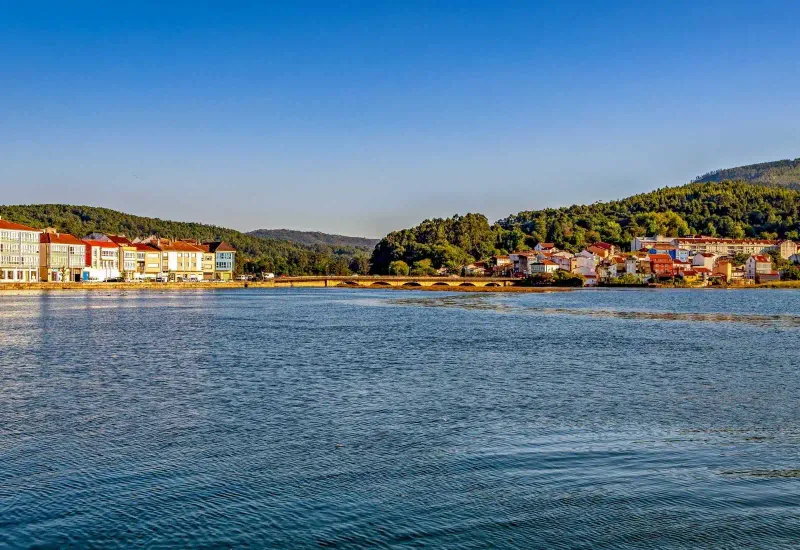
King Ferdinand II of León, whose tomb is in the Chapel of the Relics of the Catedral de Santiago de Compostela, granted the title of Portus Apostoli to the town of Noia, thus formalizing its Jacobean connection since the late 12th century. Later, in the 15th century, the famous Venetian navigator Pietro Querini opened a trade route with northern Europe, not without first docking in Muros to pilgrimage to Santiago de Compostela.
An amphibious path
The Maritime Way of Muros and Noia is a path different from the one you may already know, a blend of navigation and hiking. It involves making a maritime crossing of a minimum of ninety nautical miles and walking the last twelve kilometers from Bertamiráns (A Coruña) to Santiago de Compostela. This is an official route recognized by the Cathedral Chapter on December 15, 2020, prior to the Holy Year 2021, and it offers the possibility of obtaining the Compostela by stamping twice a day at the ports and in the places passed while walking, even with a digital pilgrim passport.
Stages
As good sea pilgrims that we are, we can recommend a division into five stages, in a mix of three days of navigation and two days of walking:
- Baiona – Sanxenxo (by sea)
- Sanxenxo – A Pobra do Caramiñal (by sea)
- A Pobra do Caramiñal – Noia (by sea)
- Noia – Bertamiráns (land, 28 km)
- Bertamiráns – Santiago de Compostela (land, 12 km)
You can consult the map and elevation profile from Noia on the official website, that is, the last two stages, which are on land. Let’s take a closer look at each one.
Stage 1: Baiona – Sanxenxo
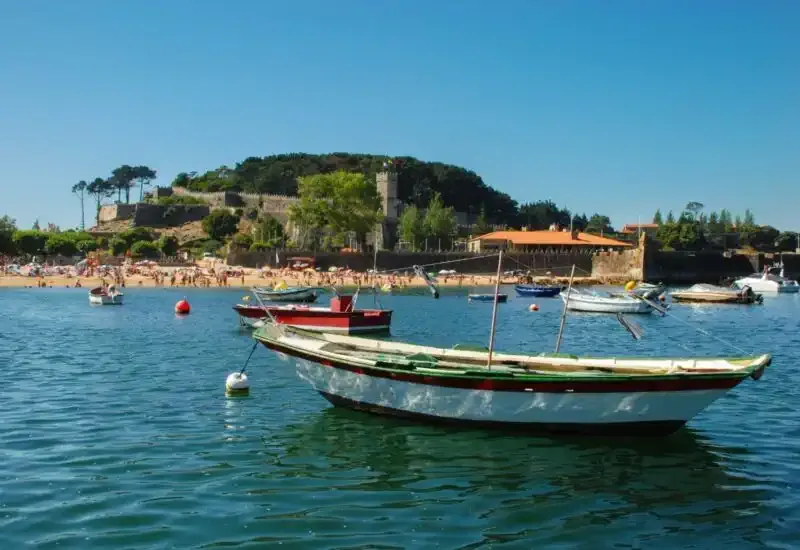
We depart from Baiona, a beautiful fishing village that has the privilege of being the first to learn of the news of the Discovery of America. Closely related to the sea, some of the sailors who survived Magellan and Elcano's circumnavigation hail from this village. We set sail and navigate through the mouth of the Ría de Vigo, to reach the Cíes Islands. There, we can anchor and enjoy the views, take a swim, or have a good meal on board. We continue and pass into the Ría de Pontevedra, with the island of Ons, to finally arrive at Sanxenxo and anchor or dock at its marina. In this village, we will have all kinds of services.
Stage 2: Sanxenxo – A Pobra do Caramiñal
We leave Sanxenxo, a very touristy town closely linked to recreational navigation, heading towards the beautiful, imposing, and Jacobean Arousa estuary. The island of Sálvora, the O Grove peninsula with its sandy front of A Lanzada beach, and a multitude of bateas await us, announcing a rich gastronomy of seafood. We can anchor in front of the paradisiacal island of Guidoiro Areoso, to eat and take a swim, and then we will dock in A Pobra do Caramiñal, where we can either anchor or dock at its port. In its urban center, we will find all kinds of services.
Stage 3: A Pobra do Caramiñal – Noia
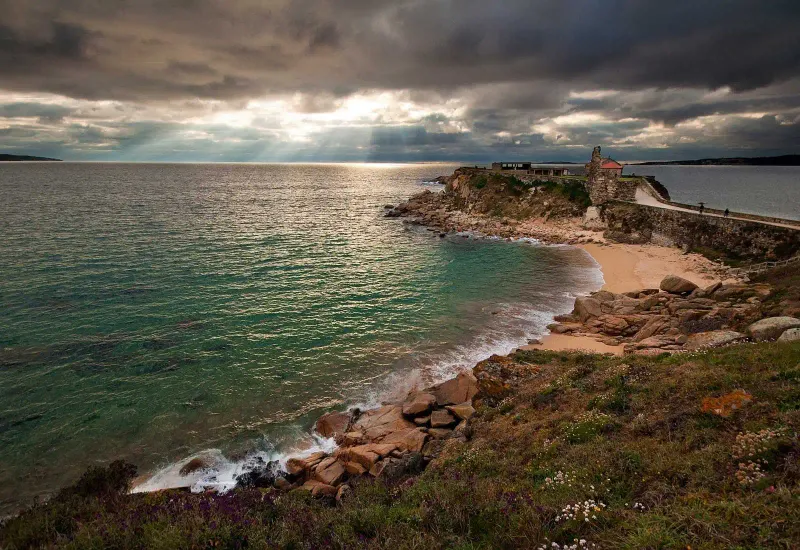
This last day of navigation will be the longest, and we will also sail many miles in open sea. During this crossing, we will enjoy the panoramic view of the Corrubedo dunes and its sandy beaches, before entering the ría of Muros and Noia. We can anchor in Muros to enjoy the views and eat peacefully, and then continue sailing towards our destination, Noia, which has all the services.
Stage 4: Noia – Bertamiráns
We begin our first stage walking, through approximately 28 kilometers that will take us to Bertamiráns. The first half of the stage will be uphill, reaching almost 500 meters above sea level. Then we will descend passing through different villages, and at the height of Brión, we will divert to Bertamiráns, which has all the services.
Stage 5: Bertamiráns – Santiago de Compostela
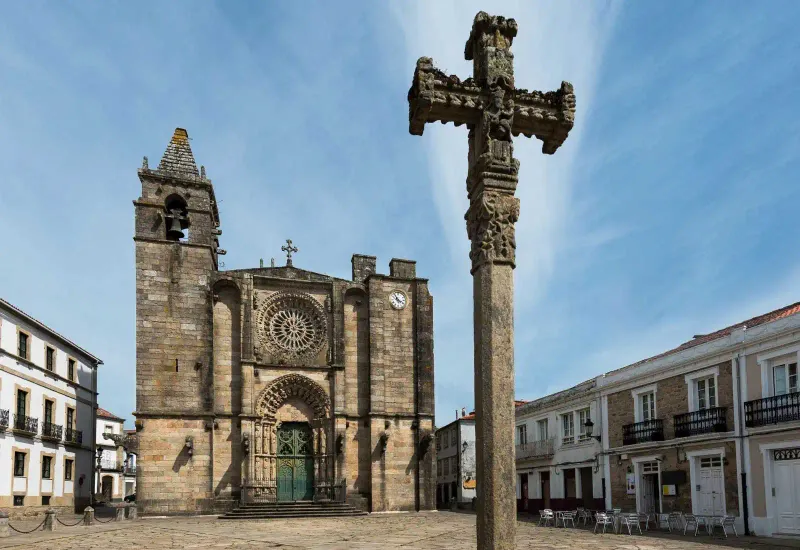
We have 12 kilometers left to reach Santiago de Compostela. It is a short distance, and it could be added to the previous stage, but it would make it too long. Thus, with this brief stage, we will arrive at a very good time in Santiago de Compostela and, who knows, attend the pilgrim's mass at 12:00 hours.
Things to consider on this different path
The crossing is not precisely short, as the ninety nautical miles would begin in the Ría de Vigo and pass through the rías of Pontevedra, Arousa, and finally Muros and Noia. It is also possible to arrive from the north, through the Cantabrian Sea; in fact, some refer to it as the English Way, given the origin of its pilgrims.
The boat can dock at the marinas or even anchor near the coast, but we recommend that you consult Ports of Galicia beforehand.
Just as it is not valid to travel by car while walking on land, but rather on foot, by bicycle, or on horseback, the maritime crossing must be done by sailboat and without a motor. You will not have blisters, although perhaps some seasickness, and we hope no capsizing.
Once in Noia, you would have 40 kilometers left to Santiago de Compostela, but just covering the 12 kilometers from Bertamiráns would be sufficient.
The Benefits of the Maritime Way
To begin with, the very experience of sailing. If you are not accustomed to navigating the seas, sailing along the coast of Galicia will be quite an adventure, and you may even pilgrim alongside dolphins, porpoises, and other marine animals.
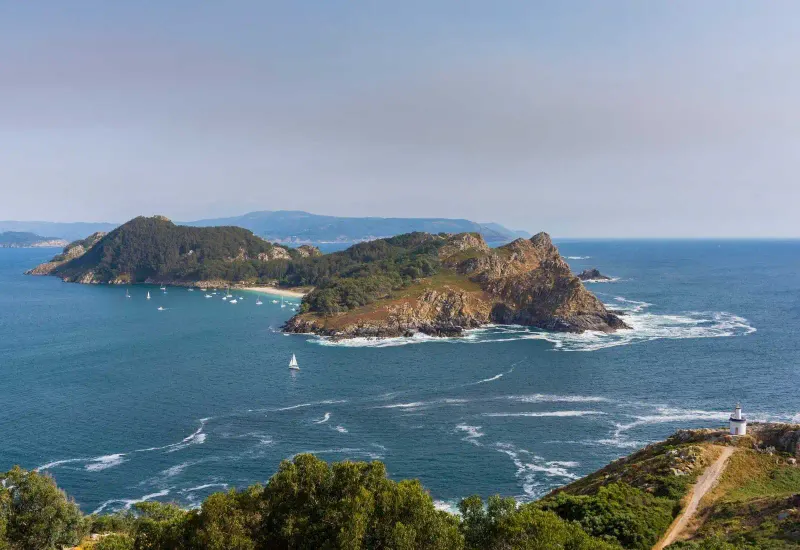
On the other hand, the coastal panoramas taken on board are impressive, and whether the sea is calm or rough, you will be able to capture beautiful snapshots for the memory. Following the Camino de Santiago Map, you can make stops at unique archipelagos such as the Cíes Islands, pilgrim cities like Pontevedra, fall in love with the grandeur of the Ría de Arousa, and have fun dodging its bateas to finally arrive at the wild Ría de Muros and Noia, with its historic ports.
An important detail
We are thinking that… perhaps you do not have a boat. Do not worry, you can always rent a boat with a captain who can take you to a good port and learn more about the coast and the sea of Galicia. We can help you with that, cabin boy.
Land in sight!