


What a teenager learns by walking the Camino de Santiago (and what they do not learn in school)
14 January, 2026
Reflection on what a teenager learns while walking the Camino de Santiago, addressing the lessons in resilience, autonomy, teamwork, and connection with other cultures and oneself, with examples of personal skills and values that are developed throughout the pilgrimage.

The Camino de Santiago has become one of those experiences that mark a before and after for any teenager. It is not just a trip: it is stepping out of the routine, living a real adventure, and discovering lessons that do not appear in any textbook. Although school teaches essential knowledge, there are lessons that can only be developed when you step out of your routine, face a real challenge, and interact with other people in a new environment. That is why more and more families are opting for proposals such as the Camino de Santiago for youth and summer camps for teenagers based on the Camino. It is not just "hiking": it is living an adventure, disconnecting from screens, getting to know oneself better, and returning home with memories that cannot fit in a photo.
A different summer: effort without grades, but with reward
In school, effort is ultimately measured by exam grades, attendance, behavior, and so on. On the Camino de Santiago, young people discover something completely different: effort is valuable in itself. There is no final exam, only the pride of arriving, overcoming stages, and seeing that each day they can do a little more. They realize that a report card is not necessary to feel proud of what they are capable of doing.
What do they really discover?
That moving forward step by step also counts, that not everything comes instantly, and that perseverance is a skill that can be trained. Over time, they understand that progress is not always noticeable in the moment, but it is when they look back. It is a practical way to develop a sense of patience and manage expectations without pressure. Moreover, they learn to set mini goals: "get to that village," "hold on for one more kilometer," "today, do not give up." These are small challenges that, without realizing it, work on their growth mindset.
And the best part: the reward is not a number on a piece of paper, but simple things like a hot shower after the stage, a group dinner full of laughter, or the satisfaction of saying "I thought I couldn't... and I could."
Responsible autonomy (but not alone)
One of the advantages of the Camino for teenagers is that it fosters autonomy within a safe environment. They do not travel alone: they are always accompanied by monitors, coordinators, and their own group. However, the journey leads them to take on small decisions and responsibilities that shape their personal development. It is like giving them freedom… but with a safety net.
Small decisions with a big impact
Organizing their backpack, managing their clothes, calculating the pace at which they can walk, or talking to the group when they need something. These are simple actions that, repeated over several days, reinforce their confidence and build enormous personal trust.
- They learn to pack their backpack for the next day without anyone reminding them.
- They decide what they really need… and what extra weight is not worth carrying.
- They organize with their peers to share sunscreen, snacks, water bottles, or band-aids.
All of this makes them return home more independent, with initiative, and with the feeling of "I can do it by myself," something that is invaluable at their age.
Living with other young people outside their circle
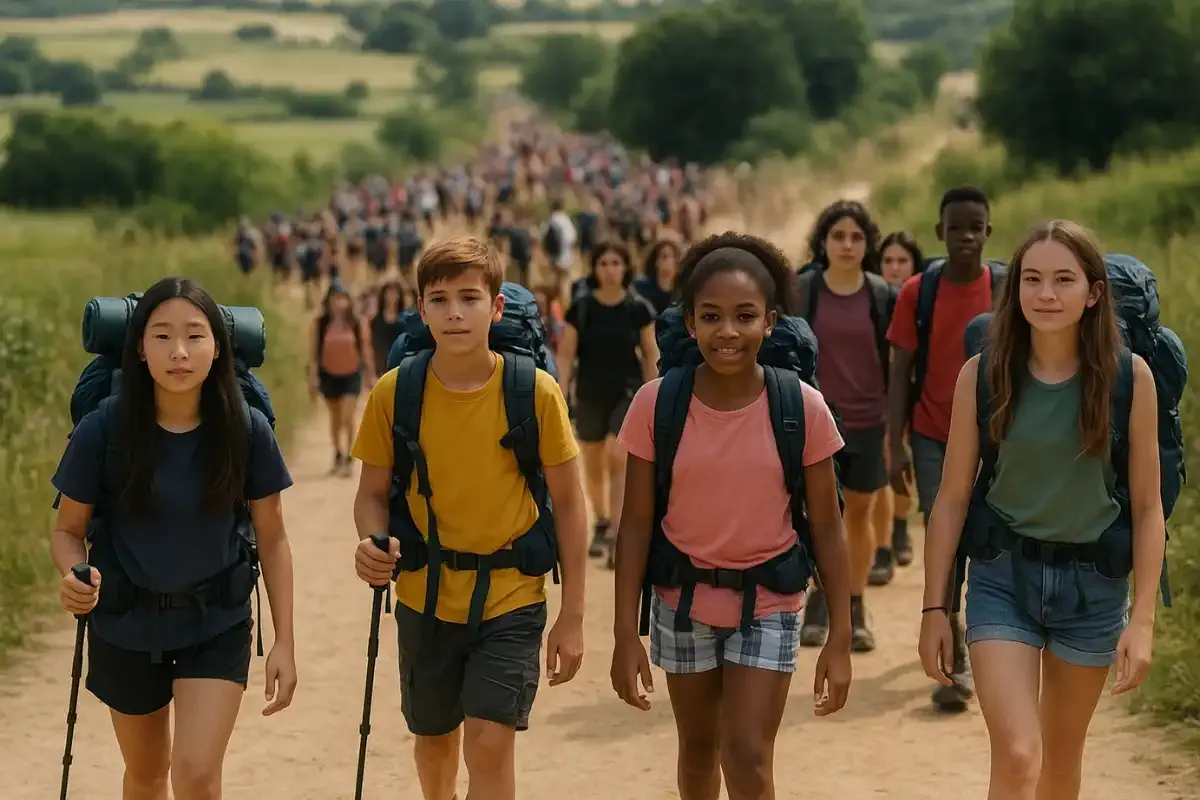
On the Camino, not everything revolves around the kilometers. Much of the learning comes from living with other teenagers who are not part of their usual environment. New friendships are formed, spontaneous conversations arise, and their perspective on life expands. They also learn to adapt to different paces and personalities: the one who walks faster, the one who needs to stop more, the shy one, the one who always tells jokes… and everyone finds their place.
A social laboratory in motion
Throughout the journey, they share challenges, breaks, anecdotes, and fun moments. This natural environment fosters empathy, respect, and social flexibility, key skills for their growth and a fundamental part of genuine values education. Moreover, they train in important things such as:
- Listening and being listened to within the group.
- Resolving small everyday conflicts without dramatizing.
- Supporting the peer who is having a bad day… and allowing themselves to be helped when it is their turn.
In the end, many return with new friends, eager to repeat the experience, and with the feeling of having been part of something special.
Managing fatigue, frustration, and difficult days
Not all stages are easy. There are long days, moments of low spirits, and stages where the legs feel heavier than expected. However, it is precisely in those moments that the most valuable learning emerges: recognizing limits, accepting fatigue, and moving forward by relying on the group. They discover that one cannot always go "full throttle" and that listening to the body is also a form of intelligence.
An emotional learning experience for young people
They discover that getting frustrated is not failing, that asking for help is part of the process, and that everyone has better and worse days. This type of emotional learning in adolescents is direct, real, and tremendously useful for their future.
With the support of the monitors, they learn to put words to what they feel: "I am tired," "I am frustrated to go slower," "today I was surprised by what I endured." This ability to express emotions and manage them, without self-judgment, becomes a tool they can later use in school, at home, and in any stage of their lives.
Connection with nature (and disconnection from the mobile)
Walking surrounded by nature helps to relax, concentrate, and disconnect from the fast pace of daily life. Many young people experience for the first time a silence that is not uncomfortable, but rather facilitates organizing thoughts. The combination of movement and natural surroundings fosters creativity, calmness, and emotional well-being.
The mobile phone does not disappear, but it does lose prominence. The focus shifts from notifications to face-to-face conversations, to landscapes, to shared group photos, and to moments that do not need to be posted on any network to be important.
A benefit that continues after the journey
Parents often notice clear changes upon their return: more responsibility, greater maturity, healthier relationships, and a calmer attitude towards daily challenges. For this reason, the Camino has established itself as one of the best educational summer experiences for adolescents.
Many repeat the following year or are encouraged to take new routes because they feel that "it has done them good." And not only on a physical level: sleeping better, managing course stress more effectively, appreciating the small things in daily life… are very positive side effects of this experience.
Want to know more?
If you are interested in discovering how the Camino de Santiago can transform a teenager's summer, you can visit our section dedicated to the Camino de Santiago for young people and teenagers. You can also explore our summer camps for teenagers based on the Camino de Santiago, where we explain how this experience is organized and why it marks a turning point.
If you are looking for something more than "just another summer," the Camino can be that turning point they remember for a lifetime.