


From the first stamp to the Compostela: instruction manual to obtain it with your pilgrim passport, the best souvenir of the summer
18 January, 2026
Summary on how to obtain and use the stamp of the pilgrim passport for the Compostela, explaining its importance for young pilgrims on the Camino de Santiago, where and when to stamp it, requirements to receive the Compostela, and practical tips to ensure valid records in shelters, churches, and official points.

In your summer camp experience on the Camino de Santiago, believe me, the first night in the shelter will take you a while to fall asleep. You will spend half the evening whispering in the bunks, creating your own world, until someone asks you to lower your voice. And you have a summer ahead that is unlike any other. A summer in which you come to pursue a goal physically, to walk kilometers with your feet to mentally connect with yourselves and your tribe. And to ensure that you do not forget a single second of this adventure, as good pilgrims of the Camino, you will carry the pilgrim passport in your pocket: take care of it, because when you go to collect the Compostela, that stained paper will be the only proof that everything you are going to experience was real.
What are the pilgrim passport and the Compostela for pilgrims?
To understand each other quickly: the pilgrim passport is your adventure passport, a foldable card that you must carry with you and fill with stamps to prove where you have been. The Compostela, on the other hand, is the goal: the official diploma in Latin that is given to you upon arriving in Santiago if you prove (with your pilgrim passport) that you have walked the last 100 kilometers of any official route of the Camino de Santiago, arriving in Santiago de Compostela.
Note this: speaking correctly (pro level)
Here is the advice that will distinguish you from the novices: it is called "Compostela," and "Compostelana" does not exist. The "compostelana" is, in any case, a lady born in Santiago. It is a small nuance, but it will make you seem like a veteran of the route and not someone who just got off the tourist bus.
And now you may wonder, "how do the pilgrim passport and the Compostela work? How do you obtain them?". Keep reading, as we have broken it down into three simple steps.
Step 1: Ritual of the first page
The Pilgrim's Passport can be obtained at churches, tourist offices, shelters, and many more places. At first, especially if you are a beginner, it can be intimidating: it is so white, so clean. Before taking the first step, you have to make it yours. Do not rush it.
Filling out the first page is signing a contract with yourself. Write your name, the date you start, and the starting place (we recommend putting a phone number, in case you forget it). It is not a bureaucratic procedure; it is the moment when you say "I am here." From that moment on, you are no longer a tourist; you are a pilgrim.
Step 2: Operation "The Stamp Hunt"
Forget about keeping it perfect. A pristine pilgrim passport at the end of the Camino is a pilgrim passport that has not lived. By the third day, that paper will have wrinkles and stains that tell your story. But, beware, there are two golden rules for this accordion of paper to have official value:
- To obtain the Compostela, you must have walked at least the last 100 kilometers to Santiago.
- You must stamp two stamps per day.
This is where the game begins. You have to fend for yourself and get your stamps. The first one usually comes from the shelter where you sleep or from the starting point in the morning. And the second? That’s where the adventure comes in. Look for it in a church lost in the middle of the forest, in that bar where you stopped for an Aquarius, or in a town hall. Each stamp is a temporary tattoo of your summer. There’s the beautiful and artistic stamp, and there’s the blurry stamp that was hurriedly put on you. All are valid. All count.
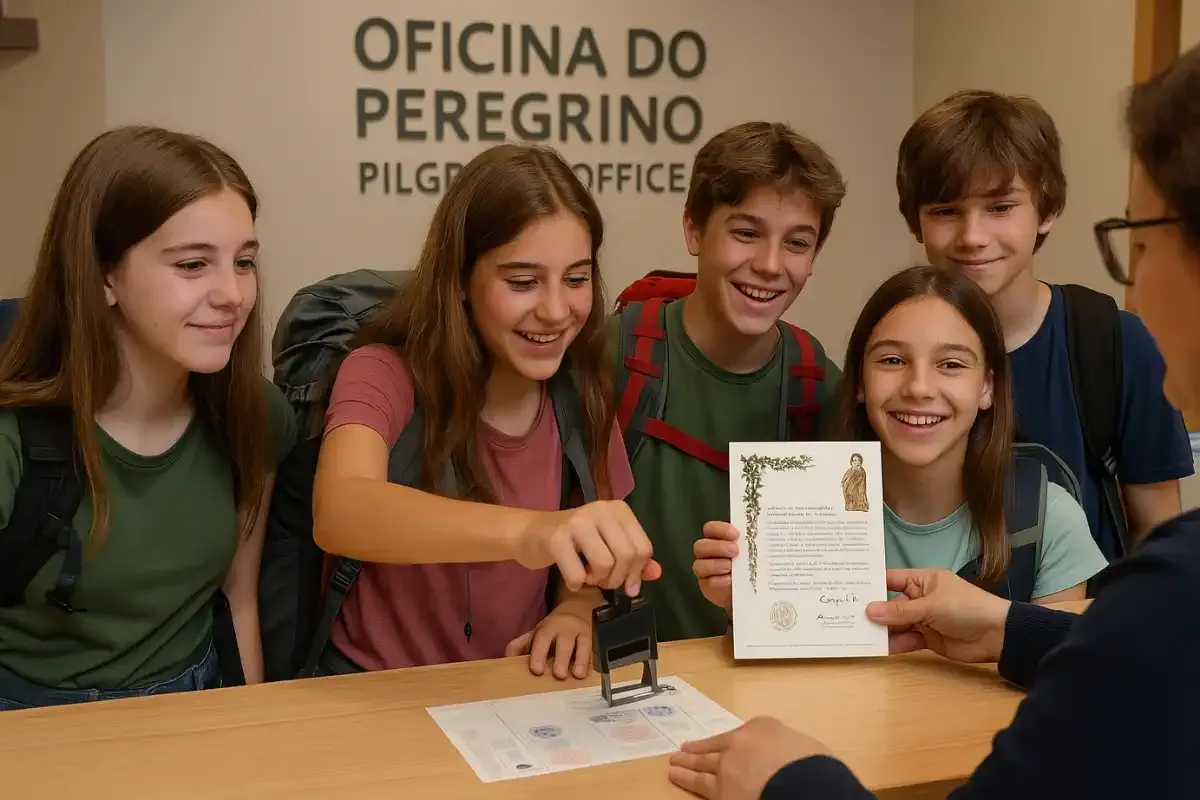
Step 3: Final Mission at the Pilgrim's Office
When you arrive at Monte del Gozo and see the towers of the cathedral, you will feel a strange mix. Joy, yes, but also that sensation that time stands still. But before you throw yourself on the ground in the Plaza del Obradoiro, there remains the final mission: to obtain the Compostela.
Thus, the steps you must follow to obtain the Compostela are:
- Head to the Pilgrim Reception Office and complete the mandatory registration: It is very close to the Cathedral, and there you can register (although, in reality, you can do it earlier by scanning the QR code on the pilgrim passport itself).
- Prepare your Pilgrim Passport: They need to see that the dates match and that you have your two daily stamps.
- Request the Compostela: If you have done the Camino for religious or spiritual reasons, you will receive one form, and if it is for tourist or sporting reasons, you will receive another.
The end is not a piece of paper, it is what you carry inside
Upon receiving your Compostela, you will feel the pride of having completed the mission. Perhaps you will remember "that night" when you took a long time to fall asleep, whispering until the early hours. But when you return home and store your pilgrim passport filled with stamps, you will understand that the true reward is not in Latin. The reward was every laugh, every early morning, and every step you took alongside your companions when you thought you could not go on. That accordion of paper is proof that, for a few days, you were free.