


At what age can a teenager undertake the Camino de Santiago?
15 January, 2026
Discover at what age a teenager can undertake the Camino de Santiago and what aspects to consider when planning the experience. The article addresses requirements, recommendations, and practical advice for young pilgrims to enjoy the journey safely and effectively.

In the midst of the digital age, where many teenagers are connected but rarely disconnect, the Camino de Santiago becomes an unexpected and powerful setting for growth. It is not just a historical route or a simple journey: it is a laboratory of autonomy, coexistence, and personal discovery. Therefore, when we talk about summer camps on the Camino, we do not think of just another school trip, but rather a space designed for the teenager to take a symbolic and practical step towards their own independence.
The summer camp on the Camino de Santiago thus arises not as a simple excursion, but as the perfect setting to cut the umbilical cord and allow autonomy to take its first steps. There, far from the comfort of home and the constant supervision of parents, the young person learns to manage their backpack, their energy, and their place within a group. It is in this environment, safe yet challenging, where the key question arises: at what age are they prepared to live such an experience?
The answer is not measured solely in completed years, but in emotional maturity, willingness, and the ability to coexist with others. Nevertheless, there is a clear boundary that marks a before and after in adolescence… and that boundary begins at 14 years old.
The boundary of 14 years: the beginning of autonomy
In the realm of itinerant summer camps, the cutoff age is usually set at 14 years. This is not a whimsical number. At this age, the teenager crosses an invisible line. Physically, they already have more than enough structure to endure the stages, but what is vital is that they begin to claim their space in the world, away from parental oversight.
In a camp, the dynamics are radically different from those of a family trip. Here, there is no father carrying the water bottle or a mother checking if the socks are dry. From the age of 14, the young person must manage their "square meter" of existence: their hygiene, their rest, and their gear. It is supervised autonomy, yes, but autonomy nonetheless.
14 is not the same as 17
Just as the landscape of a country changes from the coast to the mountains, adolescence is not a monolithic block. A 14-year-old does not experience the camp the same way as a 17-year-old, even though they walk the same path.
14–15 years: the need for belonging
For the youngest in the group, the camp is a refuge. At this age, separation from family can still cause some vertigo. They need a clear structure and monitors who act almost like older siblings.
- The group dynamic: They seek immediate acceptance from their peers. The Camino levels them: here it does not matter who is popular in school or who has the most expensive phone; what matters is who lends you a band-aid or who encourages you on the last hill.
- Guided rhythms: At this age, energy management is poor. They give their all in the first hour and are exhausted by the third. The monitors are key to setting the pace and teaching them to pace themselves.
16–17 years: The rehearsal for adult life
The veterans of adolescence arrive at the camp with a different mindset. Many see the Camino as an opportunity to disconnect from academic stress and connect with something more "real".
- Self-management: They are capable of understanding that their actions have immediate consequences (if you do not take care of your feet today, tomorrow you will not walk).
- Depth: While the 14-year-olds play, the 17-year-olds reflect. The conversations that arise while walking in the surroundings of the Camino are often of a maturity that would surprise their own parents.
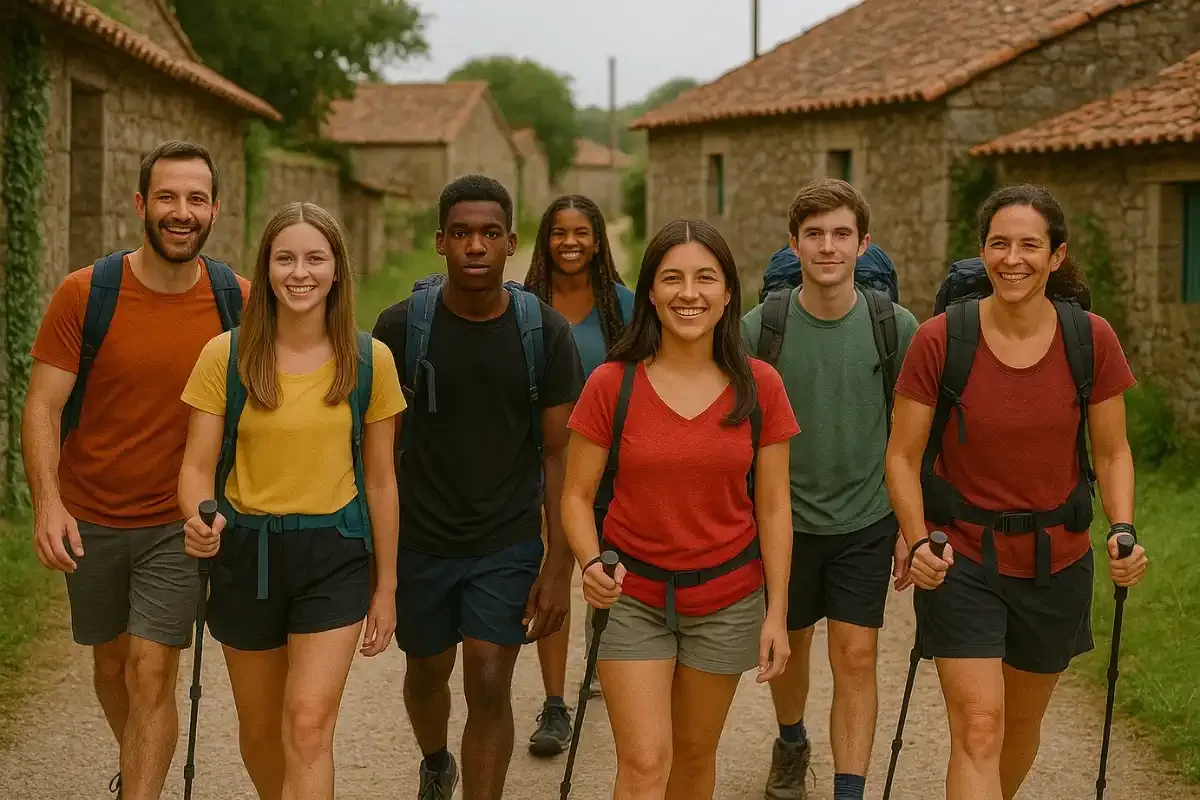
The "Camp" factor: Coexistence vs. Hiking
Many parents fear that their children are not physically prepared if they have never gone hiking. This is a miscalculation. In these camps, the physical challenge is secondary to the social challenge. What defines the success of the experience is not having the legs of an athlete, but the ability to adapt. In a camp on the Camino de Santiago, one lives 24 hours a day with other boys and girls who, at first, are strangers. They sleep in shelters, share meals, and fatigue. That desired companionship is forged in shared difficulty, far from the protection of home. When a young person, accustomed to comforts, discovers that they can be happy with just two changes of clothes and surrounded by new friends, something changes in their mind.
Signs that they are ready
Beyond age, how can you tell if your child will fit into this camp format?
- Willingness: The first sign is that they want to do the Camino de Santiago, and that they are not a reluctant pilgrim.
- Basic sociability: It is not necessary to be the life of the party, but they should be willing to open up to a new environment.
- Technological detachment: Although they will carry their mobile phone, its use is limited in the camps so that they lift their gaze from the screen and look at the landscape and their companions. If your child is able to survive a few hours without wifi without panicking, they are ready.
A safe environment to fly solo
The summer camp on the Camino de Santiago offers what sociologists call "controlled risk." For the teenager, it is an epic adventure, a break from routine, and a test of endurance away from home. For parents, it is the peace of mind knowing that this adventure takes place under the supervision of professionals, with measured logistics and assistance insurance.
It is perhaps the best way for them to discover that there is life beyond their neighborhood and their screen, and that they are capable of reaching a goal on their own.
If you are considering offering your child this opportunity for growth, we invite you to consult our section on Camino de Santiago for young people and teenagers, where we detail the available routes and dates. And to better understand the philosophy of our groups, visit the page on summer camps for teenagers based on the Camino de Santiago, where we explain how we transform walking into a school of life.