


Does your child not know how to use the washing machine? The Camino de Santiago as an intensive domestic survival camp
22 January, 2026
Guide to the Intensive Survival Camp on the Camino de Santiago for young people, with insights on physical training, essential skills, camp logistics, challenges, and practical learnings to strengthen endurance, teamwork, and confidence before embarking on the pilgrimage. Ideal for planning and making the most of the experience.

Let’s be honest: most of us spend the first 18 years of our children's lives obsessed with them learning English, robotics, and Mandarin Chinese. We worry that they know how to derive complex mathematical functions, but we forget a small detail: if tomorrow we let them loose in the middle of an empty kitchen, will they know how to survive without a delivery app?
Sometimes we look at our teenagers, so bright, so tech-savvy, and so capable of editing a viral video in ten seconds, and we realize that they live convinced that dry towels sprout from towel racks through spontaneous generation. And it’s not entirely their fault (well, not completely), accustomed to a society and, perhaps, a domestic environment with many comforts.
That’s why you should forget about the linguistic immersion course in Dublin this summer. What your child needs is a Reality Camp on the Camino de Santiago, a summer camp for young people where they will discover that autonomous living has its charm… and its challenges.
The Mystery of Dirty Laundry
The situation at home: In your child's ecosystem, dirty laundry follows a magical cycle in which it is dropped on the floor (or on a chair, known as "the laundry chair") and, through a process of domestic sorcery that they are unaware of, reappears folded and smelling of fabric softener in their drawer.
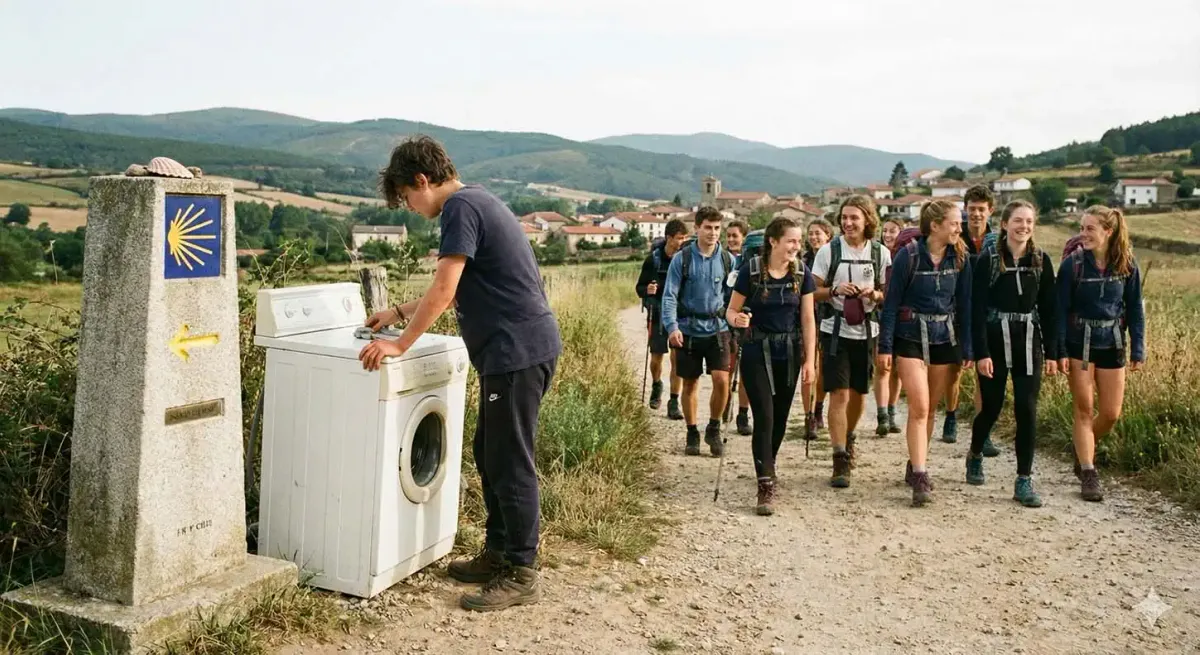
The reality check of the Camino: The peak moment arrives around the third day of pilgrimage. They run out of clean shirts. They open the backpack hoping that, by some magic, the backpack fairy has done its job, but… no. That shirt could evacuate a shelter by itself. There are washing machines in the shelters, of course, but here comes the real challenge: a teenager in front of a machine with more buttons than a game console controller. Either they learn to use it or, inevitably, they will have to wash by hand. And they will discover two universal truths: that stains do not disappear with a "click" like on a mobile phone and that some clothes, if not scrubbed well, will smell like humanity again even after spinning. That little domestic ritual, shared among laughter and improvised advice in the laundry room, is worth more than any theoretical class: they return knowing that clean clothes do not come about by spontaneous generation.
The disconnection from "Instatourism"
The situation at home: Family vacations often have a significant component of "photo for the gallery." Everyone smiling, the perfect ice cream, the idyllic beach. But we know that behind that photo is a father carrying the umbrella and a mother struggling with the sand. The teenager just puts on the California filter smile.
The reality check of the Camino: The Camino, as a summer camp experience, is the great aesthetic equalizer. Here, no outfit matters. At six in the morning, perhaps with horizontal Galician rain and a yellow plastic poncho that makes them look like a giant Minion, glamour disappears. And that is liberating. When you don’t have to look good for the photo, you relax. When there is no signal in the middle of the forest to upload the story, you start to truly look at the landscape. They will realize that no one cares about their brand of shoes, but whether they have band-aids to share. That fall of the "digital self" allows the "real self" to emerge, that really nice boy or girl you have at home who sometimes hides behind the screen.
Loneliness… accompanied
The situation at home: Many teenagers are terrified of silence. They need constant background noise: YouTube, Spotify, TikTok. But sometimes, the idea of being alone with their thoughts frightens them more than a horror movie.
The reality shock of the Camino: On the Camino, your child will have moments of silence while walking. And when they speak, it will not be via WhatsApp. They will be forced to interact with people outside their bubble: in addition to their fellow campers, a pilgrim from Iowa, a lady from South Korea, or a group of boys from France will enter the scene. Real people with fascinating stories. They will learn to listen without glancing at their phones. They will discover that they are capable of having an interesting conversation with strangers (yes, and practicing English or French!) and that, surprise, the world is full of kind people!
The return of the hero
Don't kid yourself, when your child returns, they will not start ironing shirts or cooking a tasting menu (although dreaming is free). They will probably throw their backpack in the hallway and raid the fridge. But there will be a subtle change. Perhaps a knowing glance when you put the laundry in. Perhaps an unexpected comment about how hard it is to "properly scrub" a t-shirt. They will have discovered that they have legs to go far, hands to take care of themselves, and that when everything fails (the Wi-Fi, the money, the comfort), they are capable of moving forward. And you, father or mother, will be able to smile thinking that, at least, they now know that socks do not wash themselves.
One way to encourage that metamorphosis into adulthood that you so desire for your son or daughter is to offer them an environment where they can make mistakes, learn, and overcome challenges without screens in between. To help you assess whether this experience aligns with what you are looking for, we have gathered several useful resources that you can explore in our section on the Caminos de Santiago for young people and teenagers, where we clarify the most common questions about safety, companionship, and the educational approach we apply at each stage.
If you would like to delve deeper into how everything is organized (departure dates, stages, logistics, camp operation, and more), we invite you to visit our page dedicated to the summer camps for teenagers based on the Camino de Santiago. There, you will discover why this model has established itself as a real alternative to traditional camps and what makes it one of the most valuable transformative experiences for our youth.
Because, in the end, the Camino not only shapes walkers: it shapes capable, autonomous individuals who are aware of everything they can achieve on their own.