


The Camino de Santiago from Tui at its most exclusive: you walk by day and rest by night in five-star hotels, Paradores Nacionales and charming pazos. 115 kilometres through Redondela, Pontevedra, Caldas de Reis and Padrón, with breakfasts included and transfers so comfort is never interrupted.
We orchestrate every high-end detail: luxury accommodation, daily luggage transfer, breakfasts, full documentation and travel insurance, from 1048 €.
The luxury Portuguese Way from Tui is an itinerary organised by Viajes Camino de Santiago®.
Services
Included in all our routes
- Accommodation
7 days / 6 nights
- 7 days / 6 nights accommodation
- Breakfast
- Complete documentation (Dossier and material for the Camino)
- Luggage transfer during the stages. (1 piece per person max 15 kgs)
- On-the-road emergency telephone assistance
- Pilgrim's Credential
- Travel insurance
Optional
- Supplements for dinners
- Supplement for single room
- Breakfast
- Cancellation Insurance
Accommodations


Photos
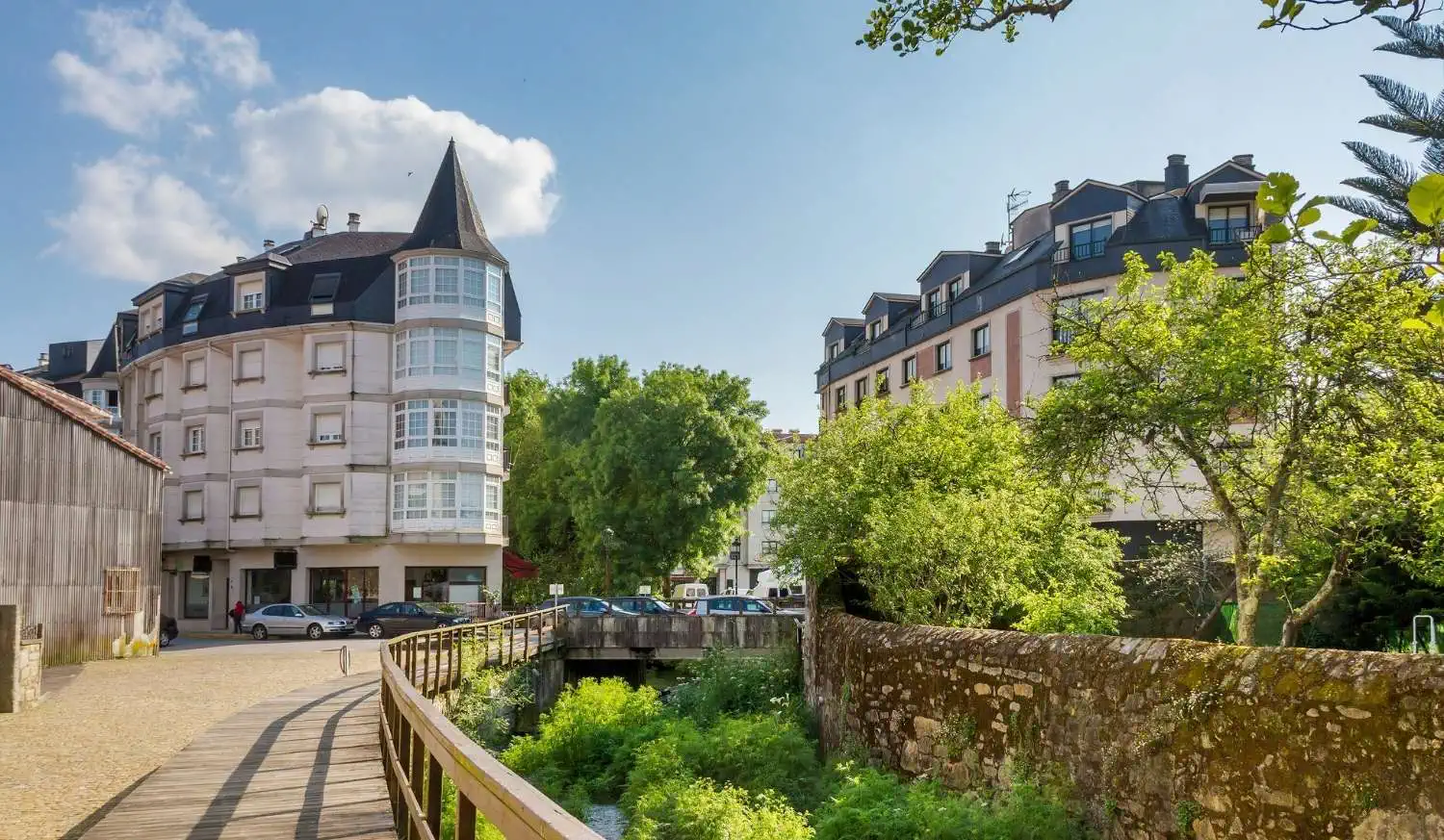
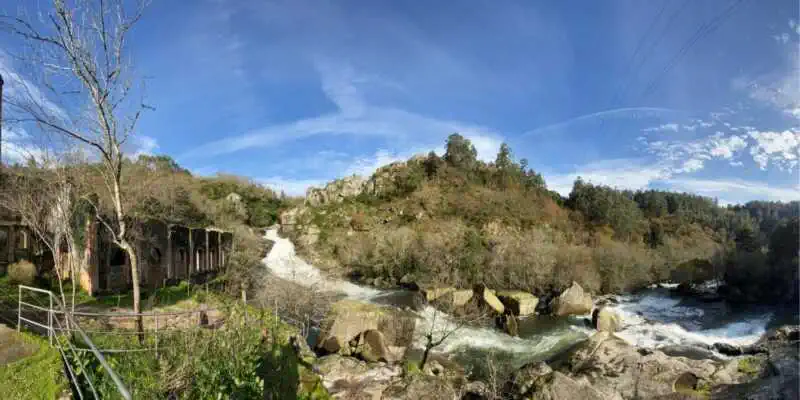


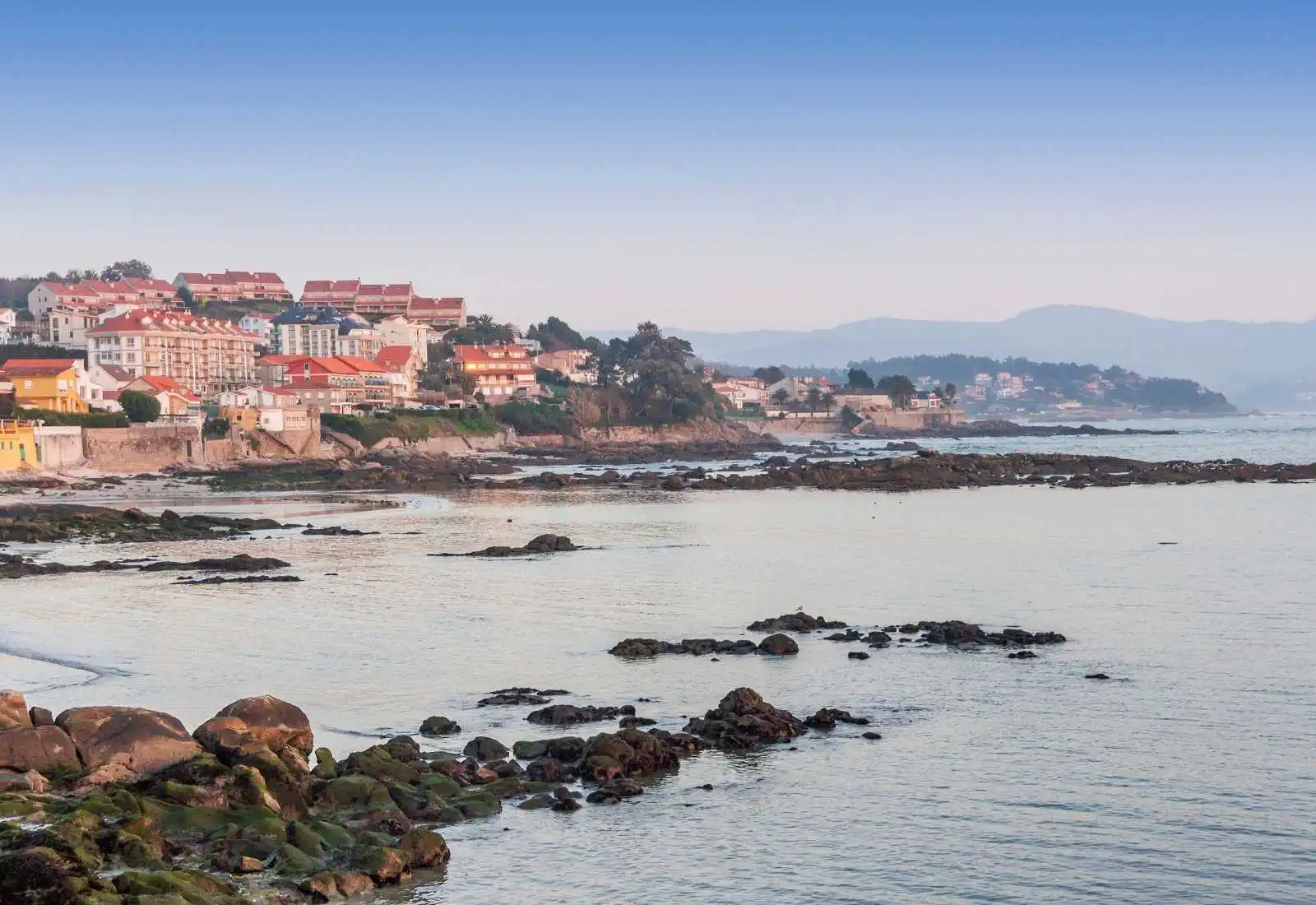
Map of the Portuguese Way VIP in luxury hotels
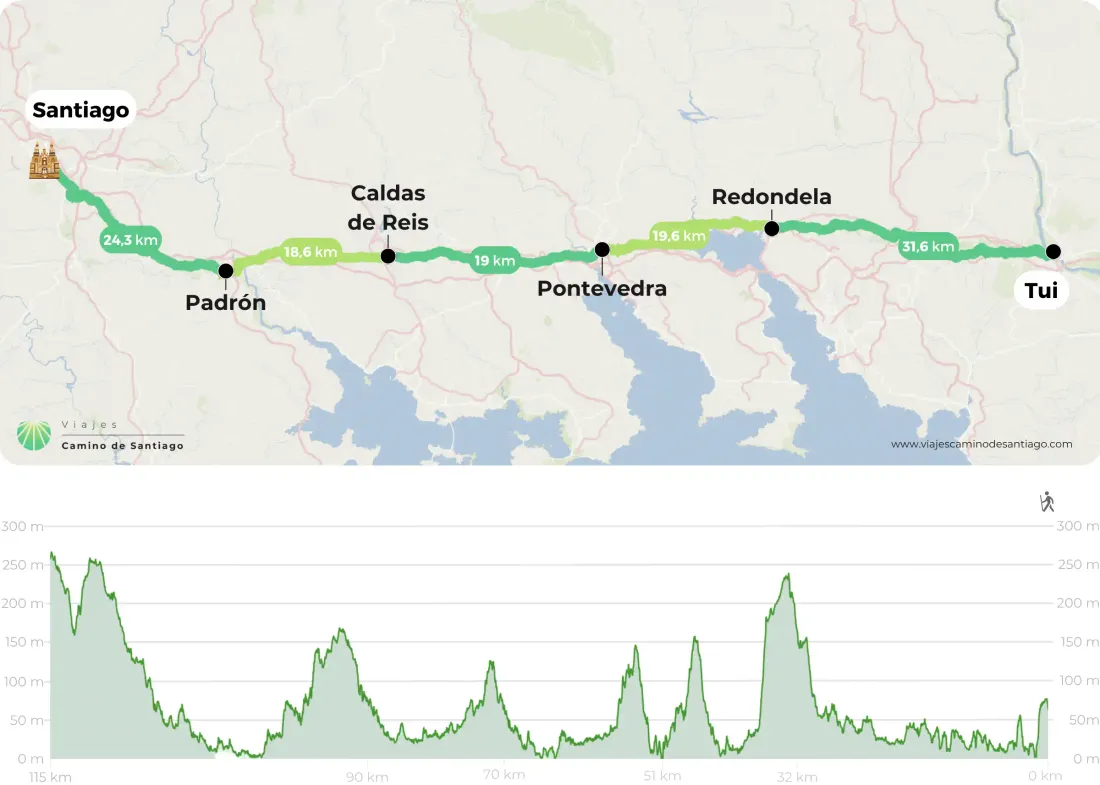
Stages
- day 1
Arrival at Tui
- day 2
Stage 1. Tui - Redondela (31.6 km)
Your first day as a pilgrim! You leave Tui through the natural area of As Gándaras e río Louro; we recommend this Louro route all the way to O Porriño, prettier than the one through the industrial estate. Then you face the toughest climb of the day, up to the chapel of Santiaguiño, in Mos. You finish in Redondela, with a very long history, the island of San Simón nearby and, with luck, a bit of beach time in Cesantes.
- day 3
Stage 2. Redondela - Pontevedra (19.6 km)
You head towards Arcade along the lovely Camiño Real de Cesantes and cross the imposing Ponte Sampaio, the site of the battle that drove the French troops out of Galicia. Then you walk the evocative Brea Vella da Canicouva, the old Roman road with its great slabs, past manor houses, granaries and stone crosses. You finish in Pontevedra, one of the most beautiful cities in Galicia, with its Church of the Peregrina as its symbol.
- day 4
Stage 3. Pontevedra - Caldas de Reis (21 km)
A gentle, pleasant stage. You leave Pontevedra through the Plaza de la Peregrina and cross the Puente do Burgo to head into a lovely rural setting, in the shade of centuries-old oaks. The small detour to the Barosa river waterfall is well worth it before reaching Caldas de Reis, a thermal town since ancient times: relax in its waters and follow its water route among waterfalls and mills.
- day 5
Stage 4. Caldas de Reis - Padrón (18.6 km)
The second-to-last day before Santiago. You leave Caldas de Reis along rural paths, pass through Valga and Pontecesures — the old "Port of Compostela" — and cross the river Ulla to enter Padrón. Here Jacobean legend hangs in the air: its church holds the Pedrón, where tradition says the boat carrying the Apostle's remains was moored. Try its famous peppers and turn in early: tomorrow, Santiago.
- day 6
Stage 5. Padrón - Santiago de Compostela (24.3 km)
Last day! Get up early and set off from Padrón soon: the excitement will make the kilometres fly by as you cross Iria Flavia and the last villages toward Compostela. And suddenly, the Plaza del Obradoiro and the Cathedral of Santiago right in front of you: you've completed your Camino Portuguese. Collect your Compostela at the Pilgrim's Office (Rúa Carretas) and don't miss the pilgrim's mass or the rest of the Galician capital.
- day 7
End of the trip
After your last night, you check out of your accommodation and your trip comes to an end.
Related Trips
 8 days / 7 nights
 7 days / 6 nights
 13 days / 12 nights
 13 days / 12 nights
 8 days / 7 nights
 7 days / 6 nights
Frequently Asked Questions
-
Is it necessary to book the luggage transfer in advance?
On group trips, trips with a dog and VIP trips luggage transport is included, so you don't need to book it. On all other trips it is an optional service: just request it when booking and we will leave it all arranged. And if during the Camino you need to add extra luggage, you can call us and we will arrange it without any problem. -
How busy is the Portuguese Way?
The Portuguese Way has become increasingly popular in recent years, positioning itself as the second most traveled route after the French Way. Although it does not reach the same level of traffic as the French route, it is still a busy option, especially from Porto or Tui. At these points, you will find a constant flow of pilgrims, especially during the high season (spring and summer). One of the reasons for its growing popularity is that it is an accessible route with less physically demanding stages. In addition, it offers excellent infrastructure for pilgrims, with numerous hostels, hotels and services at each stage. -
Which Camino is easier, the Portuguese or the French?
If you are wondering which route is easier between the Portuguese Way and the French Way, the answer depends on several factors. However, in general, the Portuguese Way is considered more accessible for most pilgrims. The Portuguese Way has flatter and gentler terrain, especially on its most popular stretch from Porto to Santiago de Compostela. The stages are less demanding and the climate is more moderate, an ideal option for those looking for a less physically challenging route. On the other hand, the French Way, although more famous and with a highly developed infrastructure, presents stages with greater unevenness, especially in the first sections that cross the Pyrenees and some mountainous areas in the provinces of León and Galicia. Although it is an incredibly popular route full of history, the physical effort is greater, so it requires better physical preparation. -
What are the most beautiful stages of the Portuguese Way?
Some stages of the Portuguese Way stand out for their natural beauty, historical richness and cultural significance. Below, I present a selection of the most beautiful stages of the Portuguese Way:- Tui - O Porriño
- Pontevedra - Caldas de Reis
- Valença do Minho - Tui
- Redondela - Pontevedra
- Caldas de Reis - Padrón
- Padrón - Santiago de Compostela
- Natural Landscapes: This stage crosses lush Galician forests, trails surrounded by vineyards and agricultural fields. The tranquility and greenery of the surroundings provide a comforting experience deeply connected to nature.
- Medieval Rivers and Bridges: Along the way, pilgrims cross crystalline rivers on ancient stone bridges, such as the famous Lérez River Bridge, which adds a historical and picturesque touch to the journey.
- Galician Villages: The route passes through small villages that preserve the traditional Galician essence, where pilgrims can enjoy the local hospitality and the rich gastronomy of the region.
- Hot Springs in Caldas de Reis: The stage ends in Caldas de Reis, known for its natural hot springs, which have attracted visitors since Roman times. It is the perfect place to relax after a day of walking.
-
Does the Portuguese Way from Tui entitle you to the Compostela?
Yes. From Tui to Santiago it is between 115 and 119 km depending on how the stages are split (115 km in 5 stages, 118 km in 6 and 119 km in short stages), more than the 100 km minimum on foot that the Pilgrim's Office requires for the Compostela. Tui is the equivalent of Sarria on the Portuguese Way: the most popular starting point that meets the requirement. -
Is dinner included on the VIP Portuguese Way?
No: the VIP trip includes breakfast, and dinners can be added as a supplement when you book. If you prefer to eat out on your own, the route makes it easy: oysters in Arcade, fish and Albariño in the squares of Pontevedra and peppers in Padrón.
-
What can you do in the afternoon in Caldas de Reis?
Caldas de Reis has been a spa town since ancient times, and water is the star. Relax in its waters, stroll through its botanical garden, follow its water trail past waterfalls and mills and then sit down at a terrace café. If you have energy to spare, before arriving it is worth a half-kilometre detour at Briallos to see the waterfalls of the river Barosa.
-
Where do you stay on the VIP Portuguese Way from Tui?
In five-star hotels, Paradores and charming Galician manor houses (pazos), among the most emblematic places to stay at each stop. You sleep in Tui, Redondela, Pontevedra, Caldas de Reis, Padrón and Santiago, with breakfast included, so you can truly rest after each stage.
-
How is the VIP Portuguese Way different from the Way from Tui in 5 stages?
The stages are the same: Tui–Redondela, Redondela–Pontevedra, Pontevedra–Caldas de Reis, Caldas de Reis–Padrón and Padrón–Santiago, 115 km in total. What changes is where you sleep and what is included. On the VIP trip you stay in five-star hotels, Paradores and manor houses, with breakfast, and daily luggage transfer is always included. On the standard version, luggage transfer and breakfast are optional.
-
Is the VIP Portuguese Way a good idea for a honeymoon or an anniversary?
Yes, it is one of the most original ways to celebrate. By day you walk the Portuguese Way from Tui, among vineyards, estuaries and medieval bridges, and at night you rest in Paradores, manor houses and five-star hotels. Arriving together at the Plaza del Obradoiro is an ending that is hard to forget.
-
What does the VIP option of the Camino include?
The VIP option accommodates you in five-star hotels, Paradores and charming pazos, with breakfast included, and it always includes the daily luggage transfer and telephone assistance throughout the route.
Portuguese Way VIP in luxury hotels
From 1048 €

Reviews
Guzman de L'Hotellerie
Gonzalo H
Asuncion
emanuel