


Egeria, the traveler who left us a unique account
26 January, 2026
Guide about Egeria, the traveler who left us a unique account of the Camino de Santiago, telling who this 4th-century nun was, how she described her pilgrimages to the Holy Land and Jacobean routes, what makes her chronicle special for the history of pilgrimage, and why she continues to inspire pilgrims from all over the world.

Imagine that today you are going on a trip and, instead of posting stories, you write a very long letter to your friends telling them everything: the journey, what you eat, whom you meet, what surprises you, what moves you… Well, that is what Egeria did hundreds of years ago, at the dawn of the Middle Ages. Egeria (also mentioned in sources such as Etheria or Aetheria) was a Christian woman from the Roman Empire who wrote an account of her pilgrimage to the Holy Land in the 4th century. Her text is known as Itinerarium Egeriae or Peregrinatio and, although it has come down to us incomplete, it is a gem: it is written in the first person, with the eyes of a real traveler, one who observes, asks, and notes.
And where was she from? Here comes the first "eye": we cannot affirm it 100%. She is often presented as Hispano-Roman and an origin in ancient Gallaecia (northwest of the Peninsula) has been defended, but there is academic debate about her identity and origin. What is clear is that her account is one of the oldest and most valuable testimonies of a Christian traveler detailing her experience. And a precious detail: the text seems to be addressed to a group of women "at home," a kind of "circle" of friends or spiritual companions, whom Egeria addresses with affectionate formulas typical of the time. In other words: she travels… but writes to share.
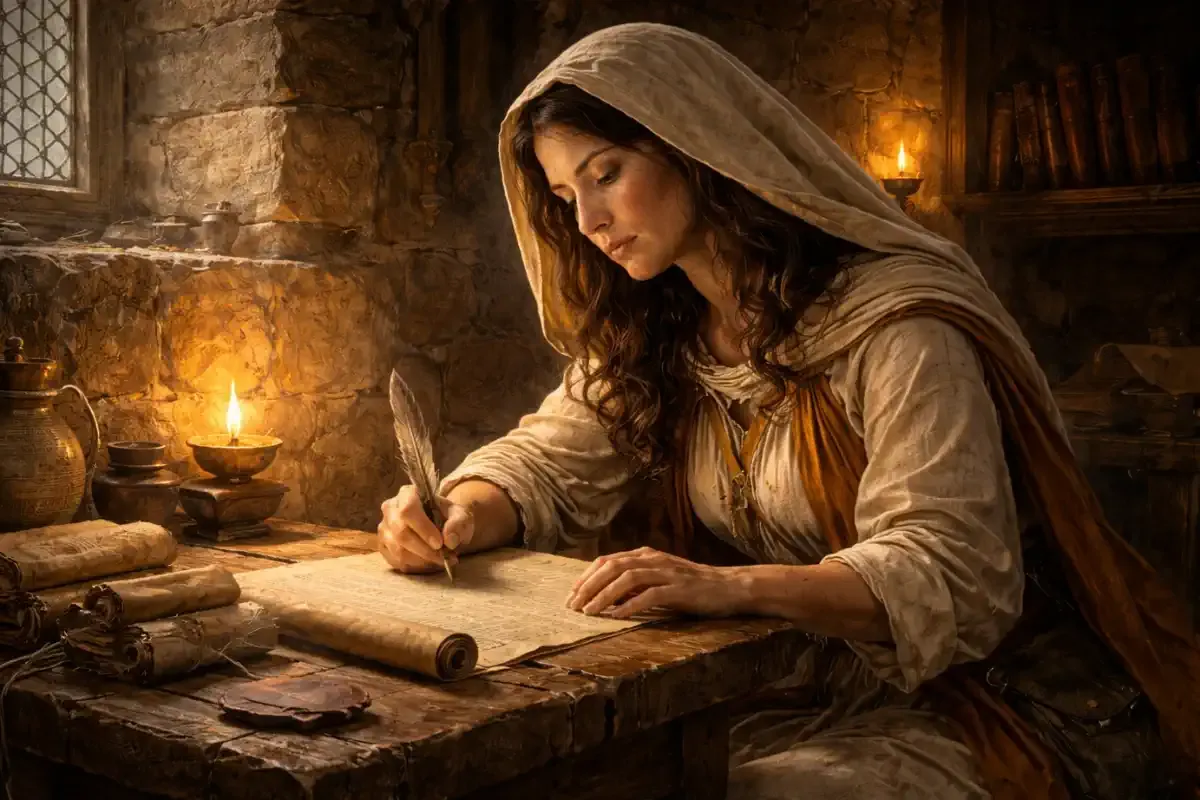
Egeria wrote her account during her journey
A huge journey in sandals: what she traveled (and how a pilgrim moved)
When we read "pilgrimage" today, we think of backpacks, boots, and stamps. Egeria, on the other hand, traveled in a world without Google Maps, without online reservations, and without "send me the location." And yet, she embarked on a gigantic adventure. Her route (according to what has been preserved from the text) passes through places that today sound like a history book and, at the same time, an epic movie: Mount Sinai, Jerusalem, Mount Nebo, the area of the Sea of Galilee… she even mentions stops in what today would be part of Syria and Turkey.
Moreover, it was not a quick "there and back" trip. Egeria spent around three years in Jerusalem, using the city as a base to take excursions to various sacred places. And how did one travel back then? With a lot of human logistics: Roman routes, escorts in some areas, hospices, Christian communities that welcomed pilgrims… and, above all, with patience. A lot. The kind of patience that makes you think: "well… if she could cross half the world 'dry', I can climb that slope of the Camino without drama."
Here, something very "travel-related" also fits: sometimes the journey is not determined so much by the "where" as by the "with whom," because the company changes the experience completely. Egeria, in her style, also shows that she does not travel like a robot: she converses, asks questions, marvels, relies on people. A journey is a map… but it is also a bunch of encounters.
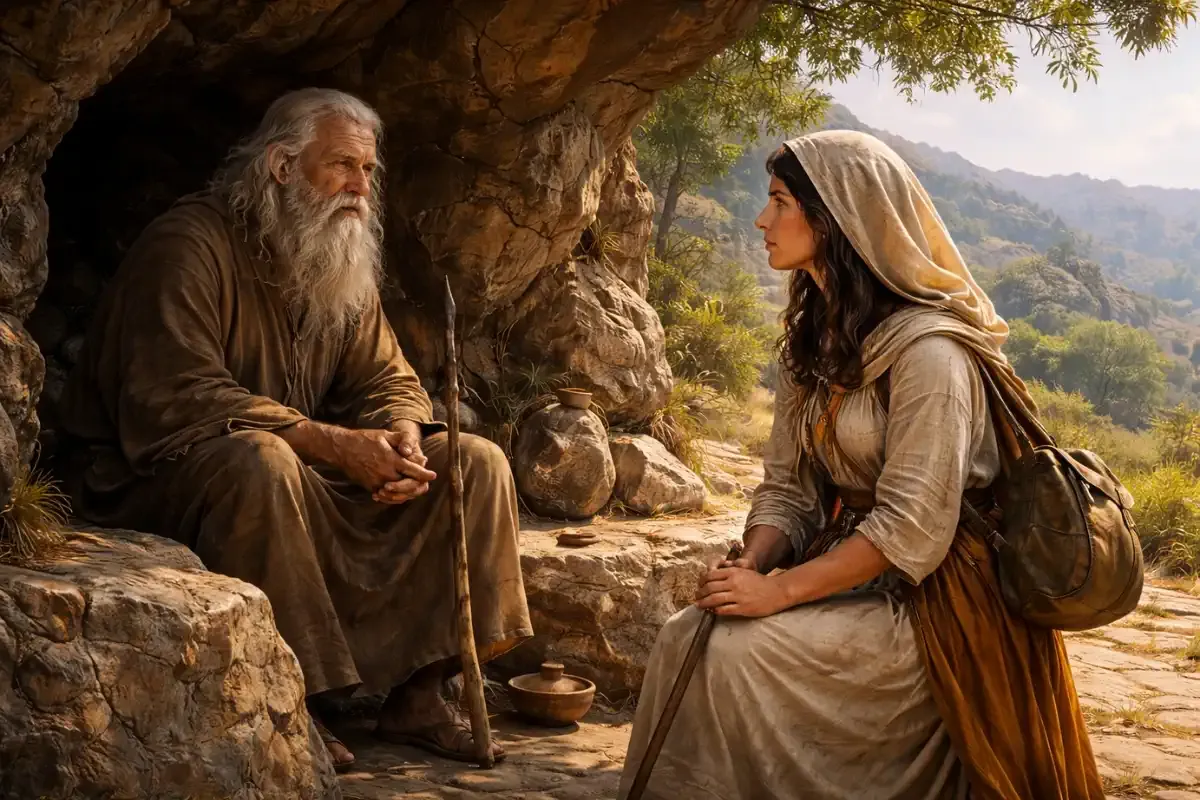
Egeria had the habit of visiting hermits and anchorites
The "diary" that is not a diary: what she wrote and why it is so engaging
Although it is often called a "diary," what Egeria wrote resembles more of a travel chronicle in the form of a letter, told from within. And that is what makes it so modern: it does not sound like a cold document, but like someone who is telling you: "You won't believe what I saw today!"
In the first preserved part (the "route" part), Egeria describes journeys and visits to places that she identifies with biblical stories. It is not just "here is a mountain": it is "here this happened," "here they remember that," "here they told us such a tradition." And then comes one of the most famous and valuable parts: her descriptions of the liturgy in Jerusalem, especially celebrations like Holy Week and Easter. Why is it important? Because it tells us how those ceremonies were experienced in the 4th century, with details of schedules, routes, songs, and customs. It is like finding an old video… but written.
The fun part is that, although Egeria talks about religious matters, she does so with a super "traveler's" perspective: she observes how the city functions, how people organize themselves, what they do at each moment. She is not writing a thesis; she is recounting an experience. And that, for historians, is gold. One of the ingredients that makes a story travel well (on paper or on screen) is the idea of remembering why you are telling what you are telling, what moved you to start. Egeria seems to write just from there: from the emotion of living something she wants to share.
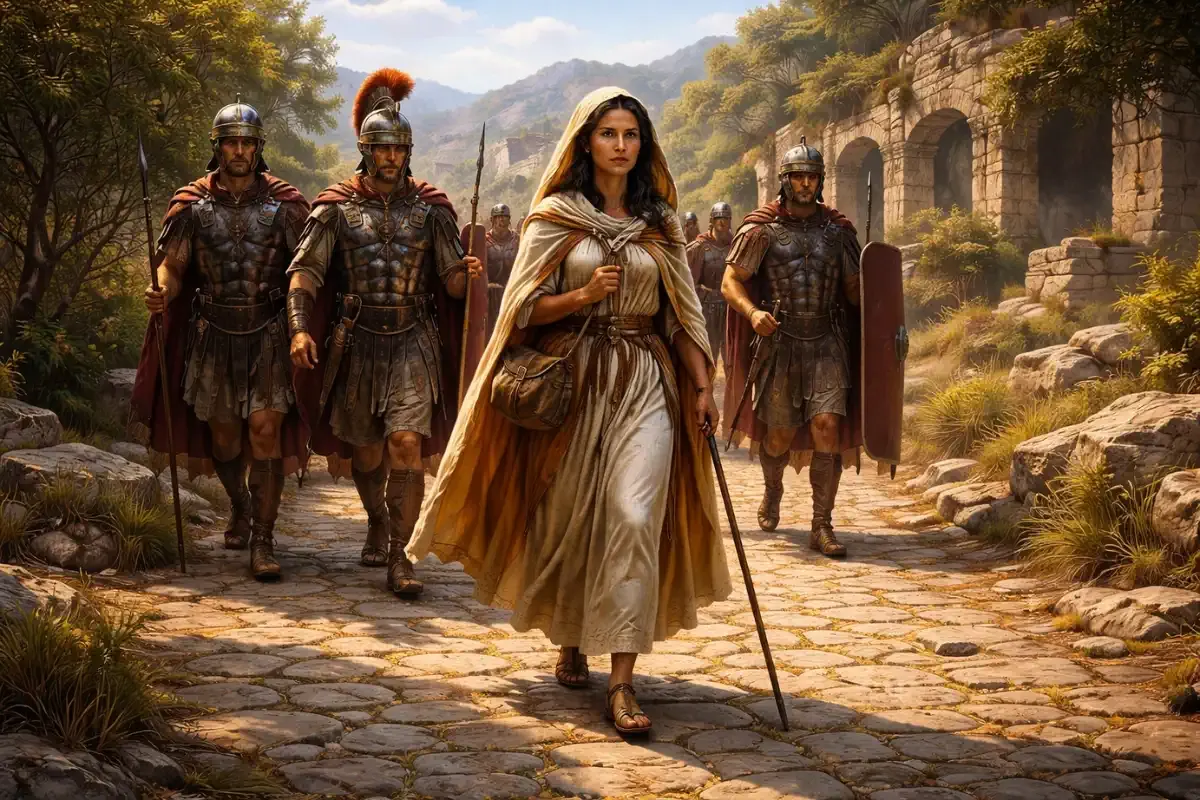
Egeria walking escorted by Roman soldiers, which makes us think she was a woman of high class
How did her story survive? The lost manuscript, the discovery, and the late "Eureka!"
Egeria wrote in the 4th century, but her text did not reach us in an original kept in a box with a ribbon. None of that. What is preserved from the Itinerarium came to us thanks to a medieval copy: the so-called Codex Aretinus, an 11th-century manuscript (copied in the vicinity of Monte Cassino, according to scholarly tradition).
In 1884, an Italian scholar named Gian Francesco Gamurrini found that codex in a library in Arezzo (Italy). So, for centuries the text was there, quietly waiting for someone to recognize it. Is it complete? No. The beginning and the end are missing, and there are gaps (lacunae) in several parts. But even so, what remains is enough to understand Egeria's voice and the dimension of her journey.
And what about the name? That is also interesting: since the preserved manuscript did not come with a clear "cover" saying "Hello, I am Egeria," there was confusion for a time. Part of the identification was related to a later letter (attributed to Valerio del Bierzo) that mentions a female pilgrim, and that is why variants of the name appear according to manuscripts. Result: today we talk about Egeria, Etheria, or Aetheria… and they possibly refer to the same person.
Why Egeria's journey is a milestone in history
The journey of Egeria is not just an ancient adventure: it is a true historical milestone. Her account, the Itinerarium Egeriae, is one of the oldest travel testimonies we have written by a person from Hispania, and moreover, by a woman. This makes it something extremely rare and invaluable: a female voice from the 4th century recounting in the first person what she sees, what she experiences, and what she feels while traversing the world.
Egeria provides something very close: the perspective of a real traveler. She describes paths, stages, stops, local traditions, and religious celebrations with a level of detail that today allows us to glimpse what it was like to pilgrimage in the late Roman Empire. Thanks to her, we know how people traveled, how pilgrimages were organized, and how the great sacred places were experienced during that time.
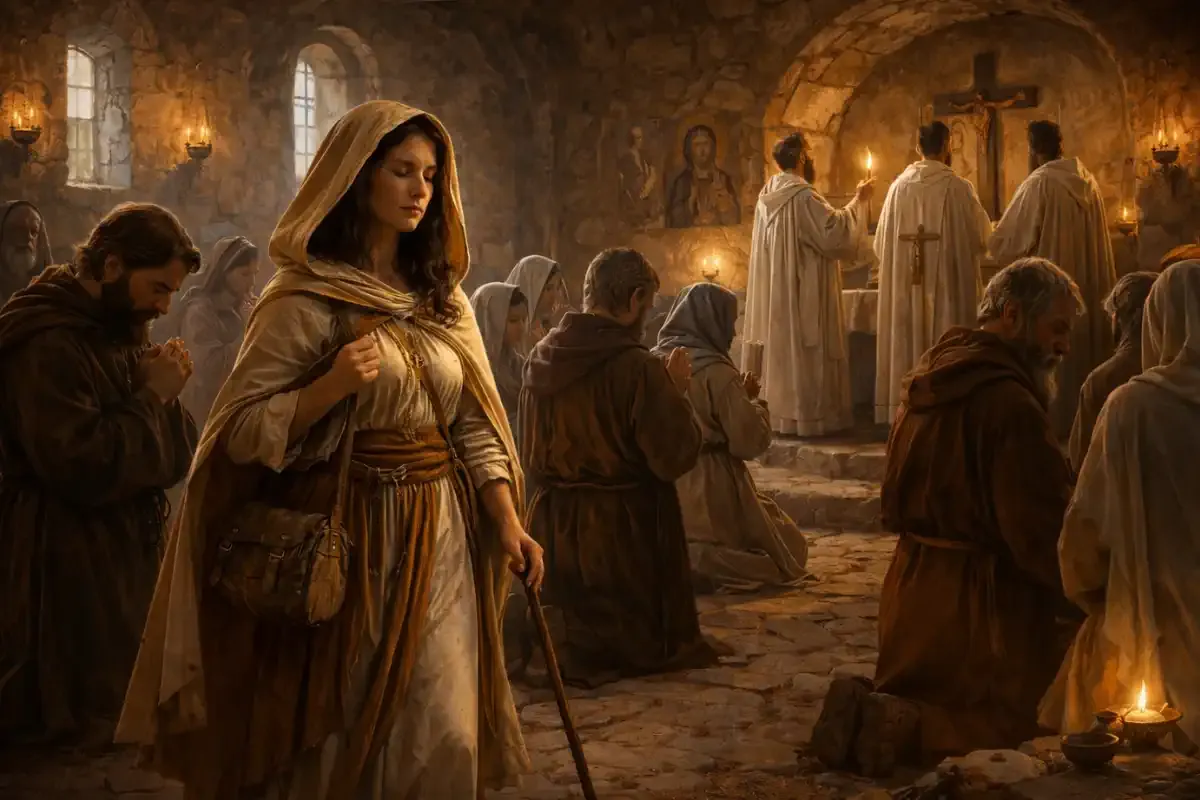
Egeria describes the Christian liturgy of her time very well in the places she visited
And here comes an interesting fact to put it into perspective: although today we associate the word "pilgrimage" with the Camino de Santiago, Egeria did not undertake the Way… simply because it did not yet exist! Her pilgrimage was to the Holy Land and other holy places in the Christian East. In fact, it was almost 500 years before the Camino de Santiago as we know it was born, when the great Jacobean story began in Galicia.
That is why Egeria is so important: because she left us, centuries before Compostela existed as a pilgrimage destination, a living proof that there were already people walking with purpose, traveling to seek something more than just a place. And the best part is that someone had the brilliant idea to write it down, a total milestone in travel literature. Thanks to her, today we not only imagine what that world was like: we see it through the eyes of a traveler.
There are people who walk to reach a place. And there are people who walk to tell about it. Egeria did both. And, fortunately, we can still read her (even if it is in bits) and smile thinking: the first great traveler did not need filters. Just eyes, legs… and the desire to share it with her friends.