


The sculptures of the Camino de Santiago
30 May, 2026
Walk the sculptural art of the Camino de Santiago and discover the works dedicated to the pilgrims that dot the different Jacobean routes, from classic pieces to more recent sculptures that pay tribute to their figure and enrich the cultural experience of the pilgrimage.

The Camino de Santiago and its different routes would not exist without the pilgrims who travel to Santiago de Compostela, as they are the ones who give meaning to the Jacobean event as its protagonists. On the various paths, you will find flesh-and-blood pilgrims like yourself, but also many sculptures that, as a tribute to their figure, are erected at some emblematic points of the Jacobean routes. In this article, we will learn more about some of the main sculptures, some more recent than others, that you will encounter while pilgrimaging to Compostela.
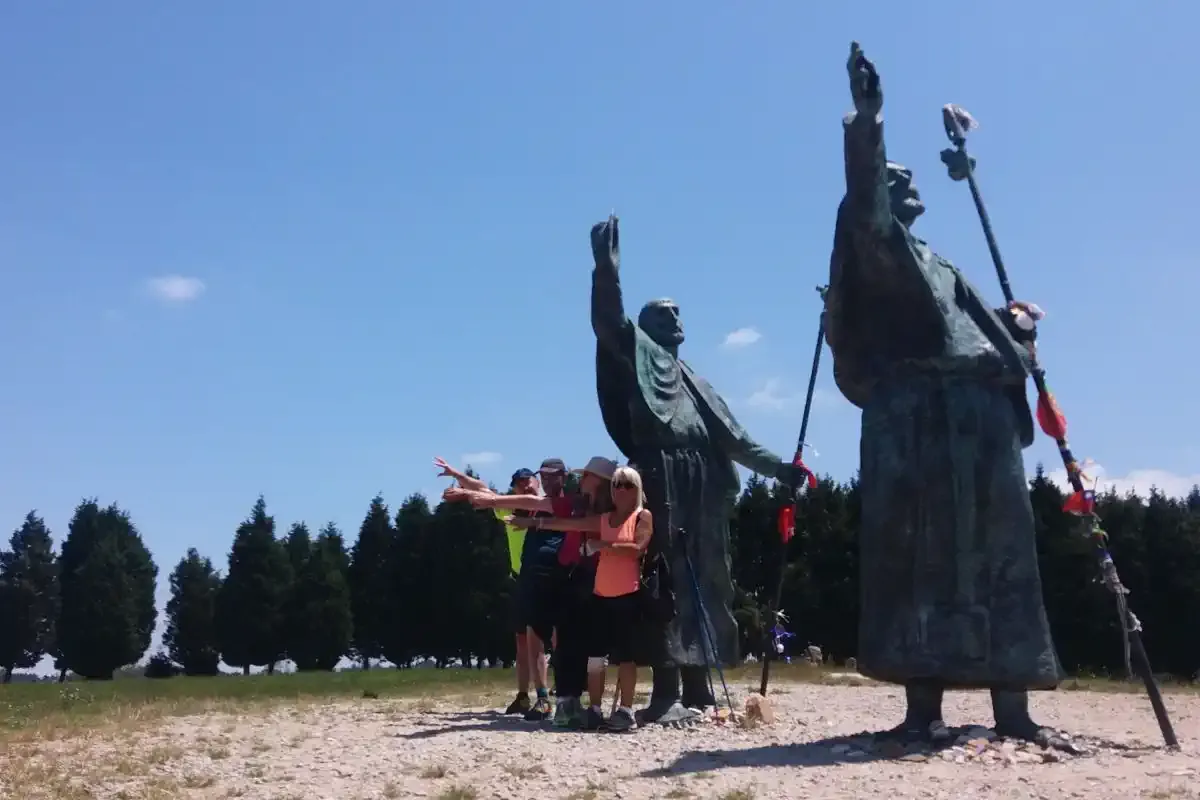
Pilgrims of the Northern Way at Monte do Gozo reaching their destination
Sculptures on the French Way
We head to Roncesvalles, at the beginning of the French Way in Spain, where you can contemplate the sculpture called "Estela del Camino". Located in the gardens of the Royal Collegiate Church of Roncesvalles, it is a work made of corten steel by the Navarrese sculptor Faustino Aizkorbe, inaugurated on May 31, 2013. It is an abstract work due to its spiral shape, which represents the movement involved in the pilgrim's journey. Furthermore, the irregularities of the spiral ribbon speak to all those experiences, both good and bad, that we can encounter during the pilgrimage, and even the irregularities of the terrain that the pilgrim faces along the way. Different notches in the ribbon represent the stages that gradually lead the pilgrim to the center, to Santiago de Compostela, an empty vertex that each one will fill during their pilgrim experience.
"Where the path of the wind crosses with that of the stars". Thus reads the monument we encounter as we advance towards Santiago de Compostela, a mythical sculptural ensemble on the Camino de Santiago, the Monument of Alto del Perdón, erected at over 900 meters above sea level. There are several sheet metal figures representing pilgrims from different eras, accompanied by horses, mules, and even dogs. Installed in 1996, it is the work of Vicente Galbete, and from here you have one of the most important panoramas of the French Way.
Further ahead, in Santo Domingo de la Calzada, you can visit a curious sculpture, "Tools of the Pilgrim", located at number 31 on Mayor Street. In it, we see the set of elements that identify the pilgrim and are necessary for their journey, such as a pair of boots, a backpack, a walking stick, the scallop shell, and even a bicycle, also paying tribute to the "bicigrinos". In the same town, you can find the most classic Monument to the Pilgrim, in front of the Parador of the town, a work created in 1971 by the sculptor Vicente Ochoa.
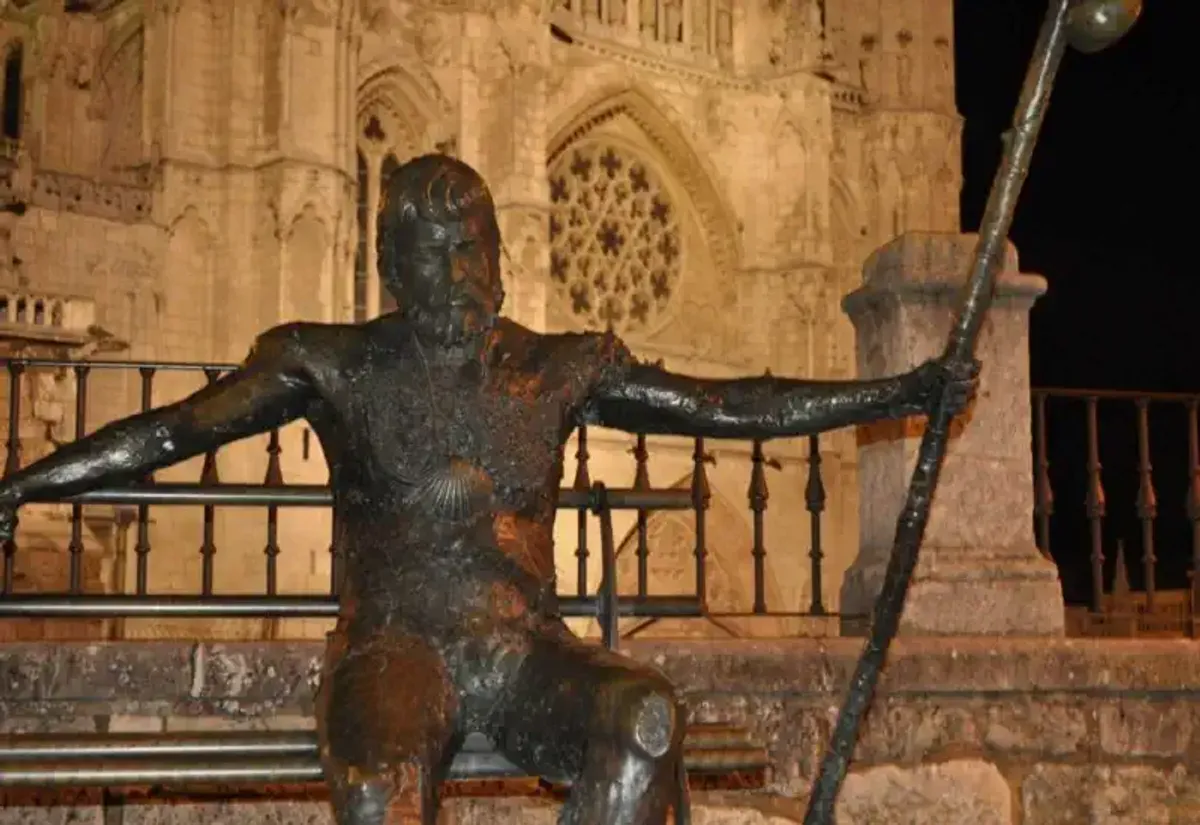
The sculpture of the pilgrim in Burgos
We continue walking and in the square of King San Fernando in Burgos, at the foot of the cathedral, you can find a beautiful statue of a pilgrim in bronze. Created by the Burgos sculptor Teodoro Antonio Ruiz, it represents a pilgrim resting, as he is sitting on a bench with the cathedral behind him. A good tourist attraction, as you can take a photo sitting next to him with the beautiful panorama of the square and the Burgos cathedral. Very close by, on Fernán González Street, you can find another sculpture representing a pilgrim taking care of his feet, in a classic scene of any self-respecting pilgrim.
We continue our pilgrimage, and at the Castle Gate of Mansilla de las Mulas, we will find another Monument to the Pilgrim, a stone cross where, at its feet, we can see three pilgrims resting. In this sculpture, created by the sculptor Ángel Muñiz in 1998, the presence of a young female pilgrim stands out, something that is not often seen in these monuments.
Once in León, it is important to highlight the Monument to the Pilgrim located at the cross of the majestic San Marcos square, created by the sculptor Martín Vázquez de Acuña and inaugurated in 1998. Resting barefoot at the base of the cross, the pilgrim appears perhaps asleep, or perhaps reflecting.
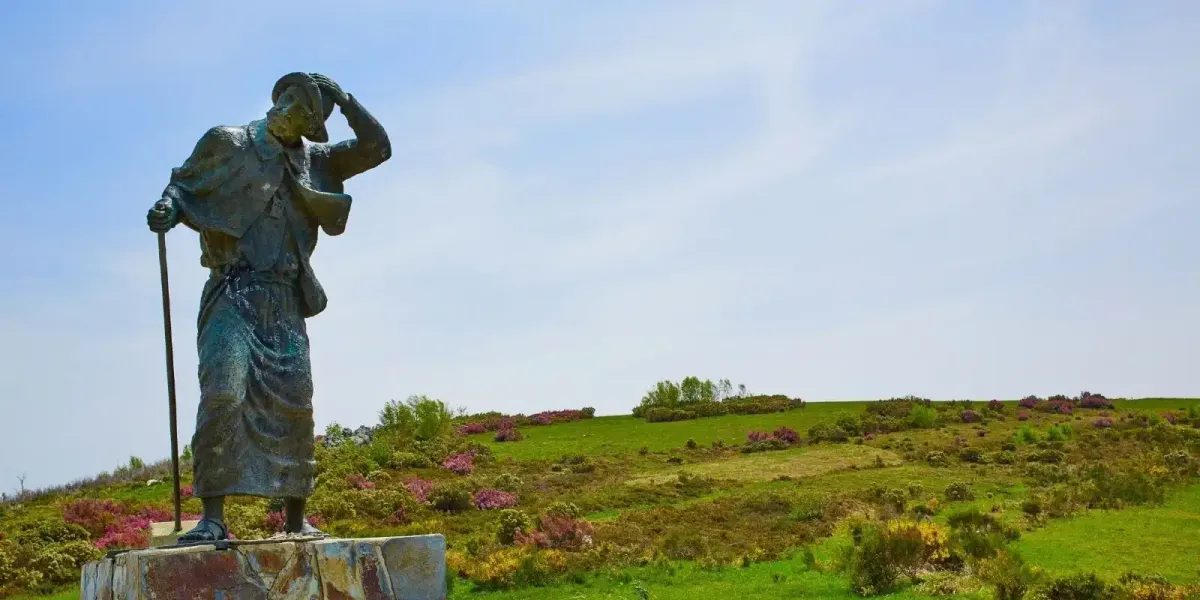
Alto de San Roque
Now in Galicia, at the Alto de San Roque, after passing O Cebreiro, we find the Monument to the Pilgrim, at 1,270 meters above sea level. It is the work of the Galician sculptor José María Acuña, installed here in 1993, on the occasion of the Holy Year. It depicts a pilgrim walking who must hold onto his hat, due to the strong winds that can often be found here.
Finally, common to both the Northern Way and the Primitive Way, located at Monte do Gozo, just five kilometers from Santiago de Compostela, we find an iconic image, the Monument to the Pilgrims. It features two pilgrims who, upon the first sight of the towers of the Cathedral of Santiago, express their joy at the imminent arrival. Like them, every pilgrim feels the same, and it is an iconic place to take photographs. Installed in the Holy Year of 1993, it is the work of the Galician sculptor José María Acuña.
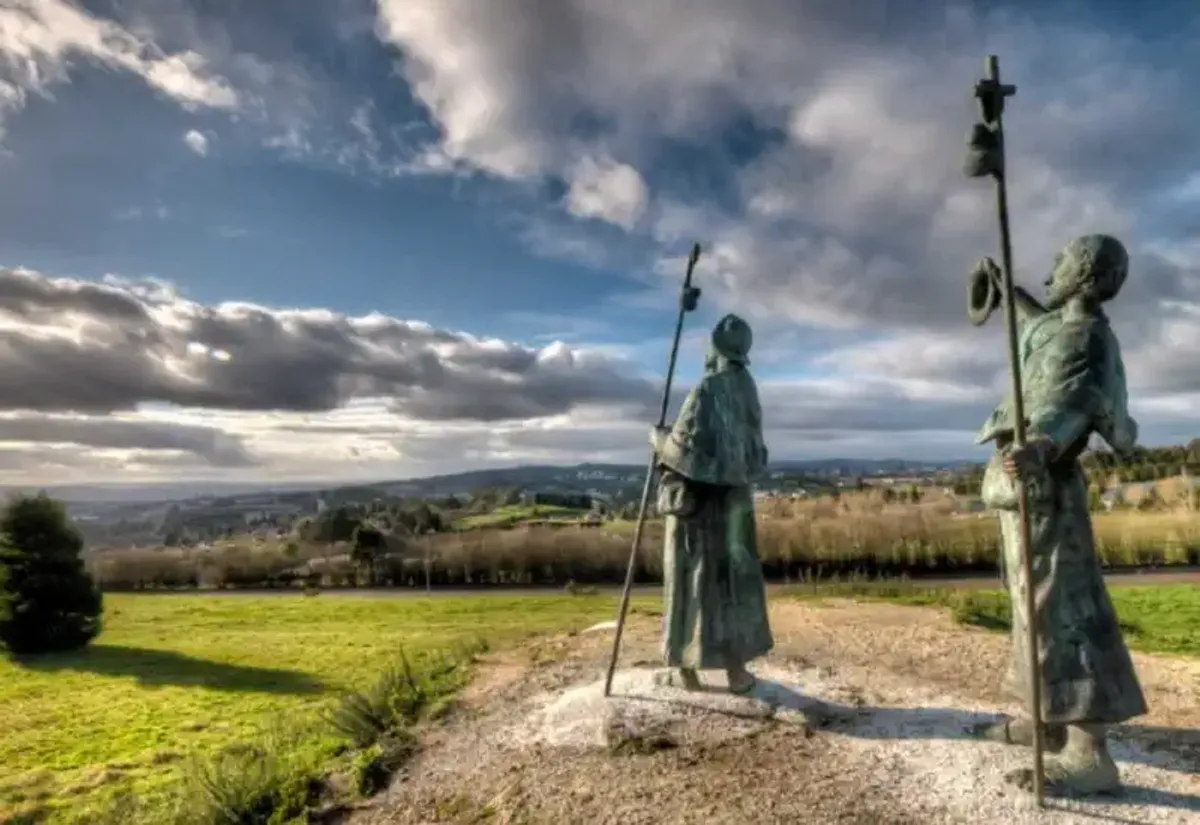
The sculptures of the Camino de Santiago at Monte do Gozo
Sculptures on the Portuguese Way
On the Portuguese Way, at the entrance of Tui, there is a sculpture created by the local artist Juan Vázquez, depicting a pilgrim resting beside a fountain with a scallop shell. At the exit of the city, next to the Roman bridge over the Louro River or Ponte da Veiga, we find a stone sculpture with the silhouette of a pilgrim hollowed out inside, including a walking stick.
Further along, in the next stage, we encounter a recent sculpture, rather a stone slab, shaped like a pilgrim. At the entrance of Redondela, under a viaduct, created by the students of the "Redondela Vila Bela II" Employment Workshop in 2019, this monument is where pilgrims make a mandatory stop to take photos "inside" this artwork. Additionally, it features a map of the Portuguese route in Galicia.
Sculptures on the Primitive Way
On the first of the ways to Santiago, the Primitive Way from Oviedo, it is important to highlight a monument that pays tribute to all pilgrims but, in particular, to the one considered the first pilgrim in History: it is the Monument to Alfonso II "the Chaste". Located next to the Cathedral of Oviedo, it is the work of sculptor Victor Hevia, made of stone in 1942. The city of Oviedo gifted a copy of this sculpture to the city of Santiago de Compostela in 1965, which we can see next to the Faculty of Geography and History in the city of Compostela.
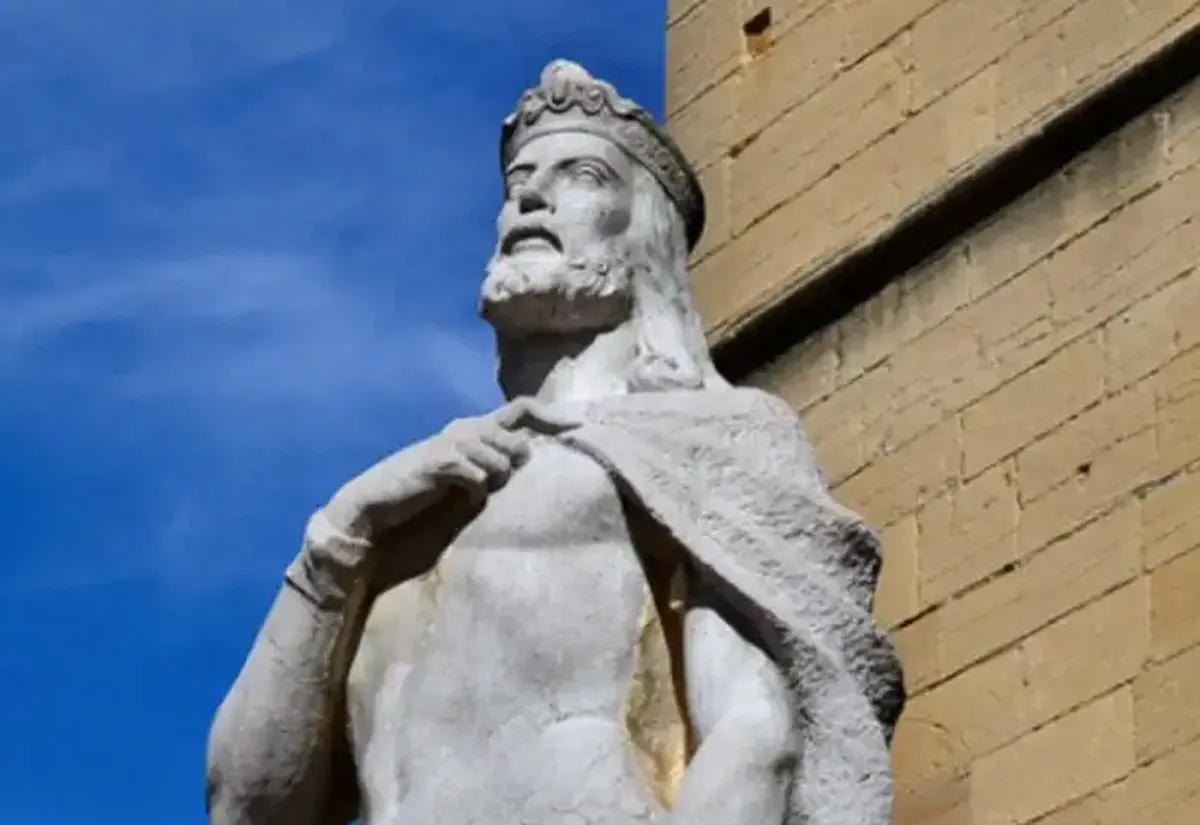
Alfonso II "the Chaste"
Sculptures on the English Way
On the English Way, in the place of Ardemil, we can see a curious and surreal set of sculptures in which, in addition to paying tribute to the pilgrims with a granite sculpture of the Apostle Santiago the Pilgrim, there is a giant dinosaur that we sometimes find devouring a girl, like King Kong. An arch with two tractors and other pieces with different figures make this place a must-stop for surprised pilgrims.
As you can see, there are many sculptural works that we can see on the different routes to Santiago de Compostela, especially on the French Way. These are sculptures that pay homage to us as pilgrims, in addition to giving us beautiful images and snapshots that will allow us to remember our pilgrim adventure forever. If you know of any more, please help us in our particular inventory and comment below what other sculptures you know. And if you are not familiar with these, we invite you to admire them while walking the Camino de Santiago.