


Priscillian and Santiago de Compostela: history, legend, and an uncomfortable question
27 March, 2026
The historical theory suggesting that the remains in the cathedral of Santiago could belong to Priscillian, a bishop from the 4th century, raises a debate about the true occupant of the tomb. Although there is no conclusive evidence, this hypothesis invites reflection on the history and legend of the Camino.

There is a moment of profound emotion upon arriving at the Cathedral of Santiago de Compostela that almost all pilgrims share. It does not matter which route is chosen or the reasons for undertaking the Camino de Santiago; that magical instant occurs when entering the temple, looking up, and wondering about the mystery that rests beneath the High Altar. Although tradition asserts that the tomb of the Apostle Santiago is located there, there exists a fascinating historical theory suggesting that the remains could belong to Priscillian, the controversial bishop of the 4th century. What is the truth behind this debate regarding the true occupant of the Compostela sepulcher?
In this article, we explore this historical theory and analyze the validity of the debate about the remains of the Cathedral of Santiago de Compostela. As explained in this article about whether the apostle is really buried in the cathedral, medieval tradition solidified the belief in the apostolic tomb, but the historical debate regarding the remains has never completely disappeared. It is not about questioning beliefs, but about understanding that the Camino is also made up of stories. And some of them invite us to look at Santiago with greater depth.
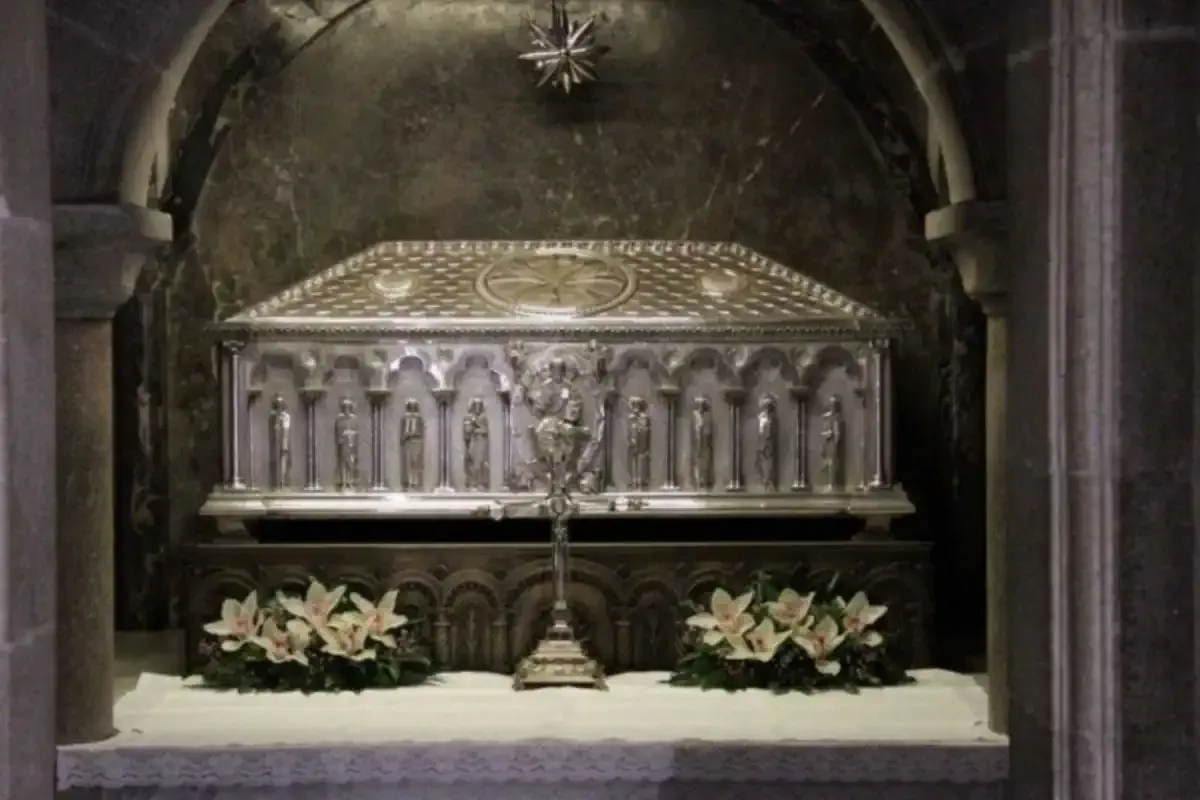
Tomb of the Apostle Santiago
Who was Priscillian and why does he continue to arouse curiosity
Priscillian was a historical figure who lived in the 4th century, in Roman Hispania, during a time when Christianity was beginning to consolidate as a structure of power within the Empire. He became bishop of Ávila and advocated for an austere life, based on fasting, simplicity, and intense spirituality.
This earned him followers… and also enemies. His ideas, in a Church undergoing organization and doctrinal control, were considered dangerous.
Accused of heresy, he was tried and executed in Trier in the year 385, becoming the first Christian executed for heresy by civil authorities. His death did not end his influence. On the contrary: for some he was a heretic, but for others a martyr. His movement had a strong presence in the northwestern peninsula, especially in Galicia, which makes his figure inevitably linked to the territory through which the Camino de Santiago now runs.
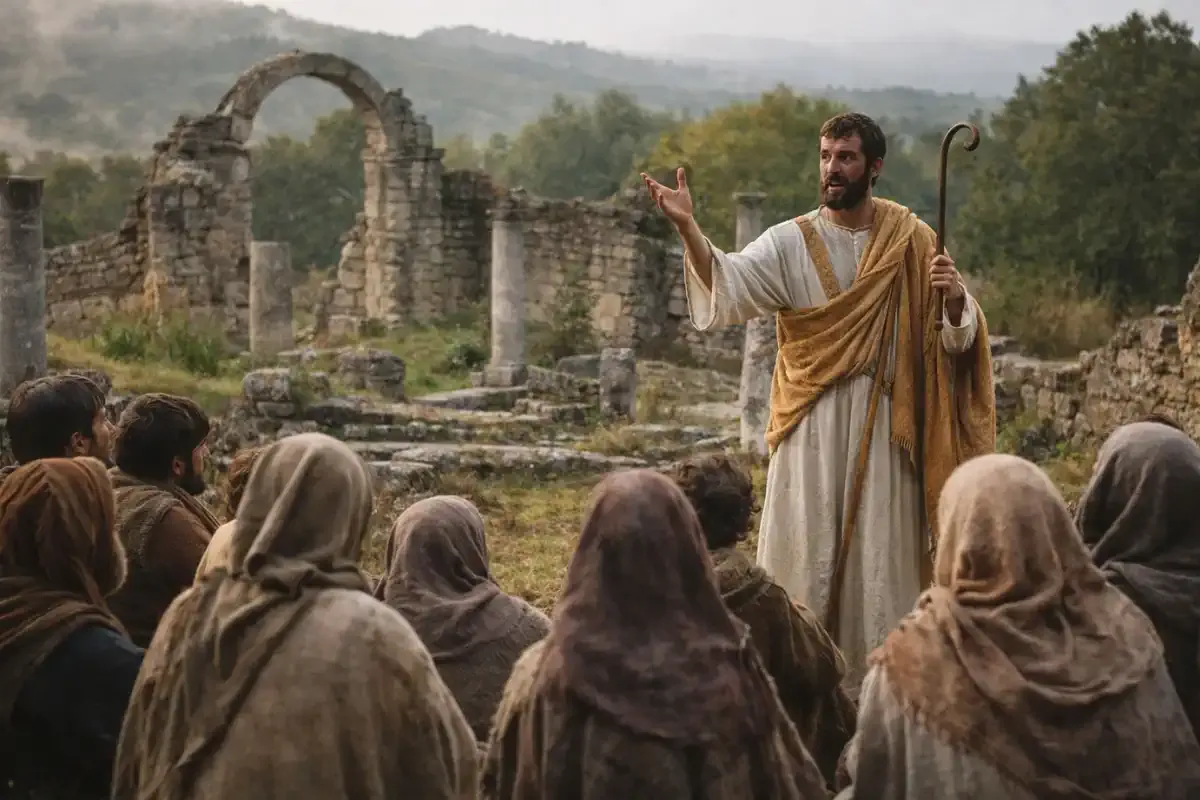
Priscillian preaching in Galicia
In that same historical context of the 4th century, we also find figures such as Egeria, a contemporary of Priscillian and probably also originally from ancient Gallaecia. Her famous journey to the Holy Land, one of the earliest preserved accounts of pilgrimage, reflects the intense spiritual life of this era and helps to better understand the religious environment in which movements like Priscillianism emerged.
The theory that connects him to Santiago de Compostela
The Jacobean tradition asserts that Santiago the Greater was buried in Compostela after being transferred from Jerusalem in the 1st century, in the episode known as the Traslatio. Centuries later, in the 9th century, during the reign of Alfonso II of Asturias, the discovery of his tomb is situated, giving rise to the cult and pilgrimage; in fact, this Asturian king is considered the first pilgrim in history. However, some historians have proposed an alternative hypothesis: that the remains venerated in the cathedral may not belong to the apostle, but to Priscillian.
According to this theory, after his execution, his followers would have transported his body from Trier to Galicia. In a region where his doctrine had a strong foothold, that cult could have evolved over time, being reinterpreted centuries later in an apostolic context.
It is a powerful idea from a narrative standpoint: the story of a persecuted bishop, some remains transported, and a cult that, over the centuries, ends up becoming one of the largest pilgrimage centers in the world. But it is important to make one thing clear: there is no conclusive evidence to confirm this theory. It is an interesting hypothesis, but not proven.
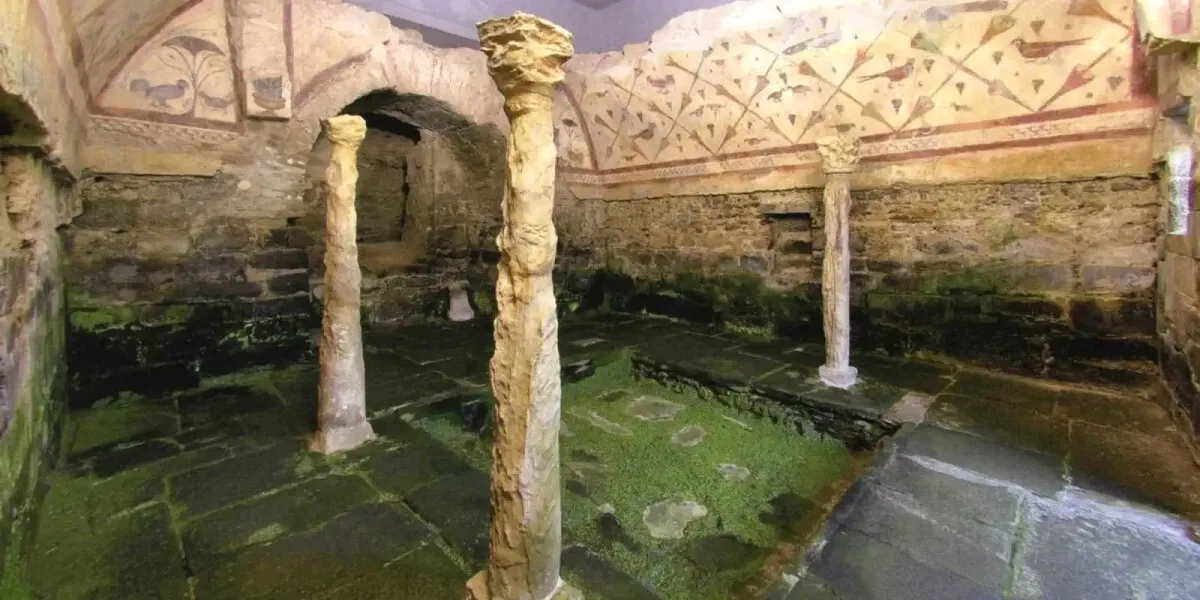
Santa Eulalia de Bóveda
Other hypotheses
However, the hypothesis linking Priscillian to Compostela is not the only one that has emerged over time. Some researchers have also proposed other possible burial sites in Galicia, especially in the province of Lugo. Among them, Santa Eulalia de Bóveda stands out, near the Primitive Way, an enigmatic monument from the late Roman period that has been interpreted by some authors as a possible space of worship or even a mausoleum related to Priscillianism. The area around A Ermida, in Quiroga, where the well-known Crismón of Quiroga appeared, a Christian piece from the 4th–5th centuries that has been linked by some researchers to this movement, has also been noted.
However, it is worth insisting that none of these hypotheses have conclusive evidence. The lack of clear archaeological evidence and the scarcity of documentary sources mean that the final fate of Priscillian's remains remains, to this day, an open mystery.
Tradition, history, and respect
This topic requires balance. For millions of people, the sepulcher of Santiago is not just a historical debate, but a place of faith, tradition, and personal significance. The Compostela tradition has built an immense cultural and spiritual heritage over more than a thousand years. At the same time, history raises questions, and both can coexist.
In fact, that coexistence is part of the Camino itself. It is not just a physical route, but a space where certainties, doubts, and personal experiences intersect.
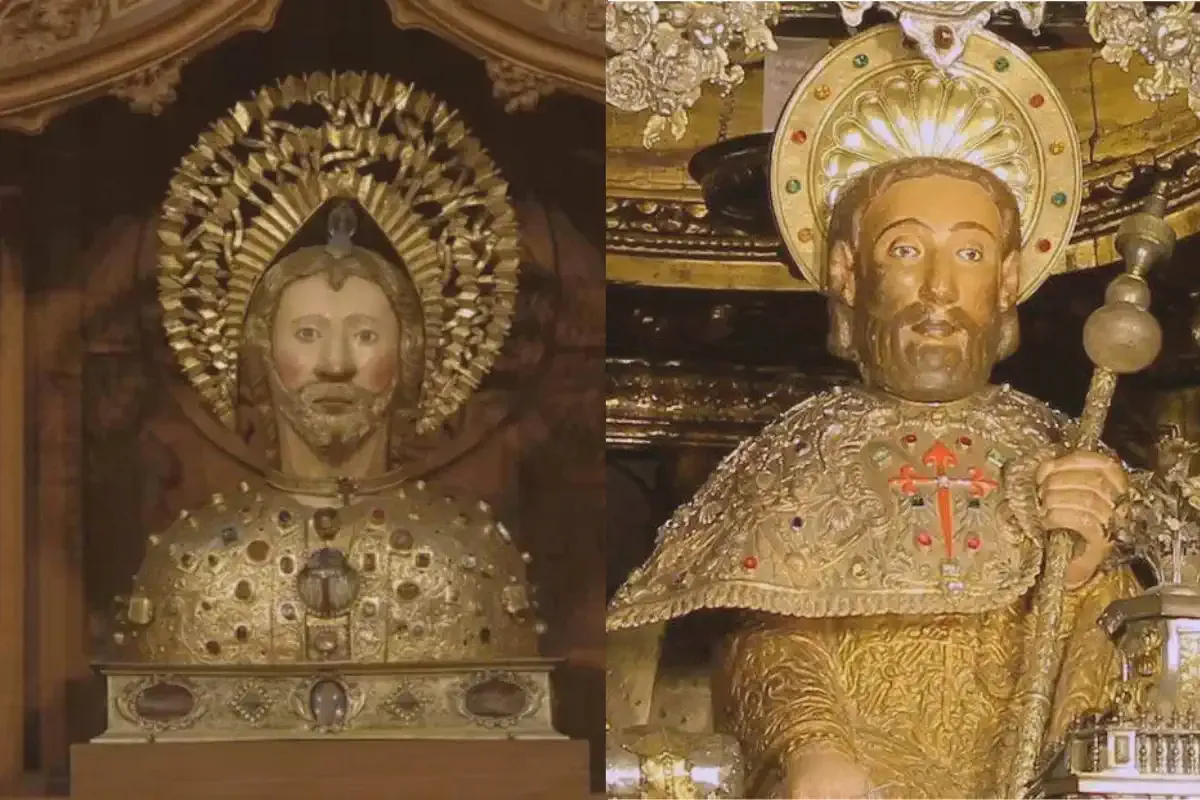
The two Santiagos
An even broader mystery than it seems
The debate is not limited to Santiago or Priscillian. In this article about the remains of the two Santiagos, another interesting question is raised: the possible confusion between Santiago the Greater and Santiago the Lesser, whose remains are also present in the cathedral according to tradition. This does not confirm any specific theory, but it does highlight something important: the history of ancient relics is complex. It is filled with transmissions, reinterpretations, and, at times, uncertainty. And the older the narrative, the more difficult it is to have absolute certainties.
To better understand these issues, a good option is to turn to books. In this selection of books about the Camino de Santiago, you will find works that delve into the history, relics, and figures like Priscillian. Reading does not replace the Camino, but enriches it: it allows one to arrive in Santiago with more context, more questions, and a more complete perspective.
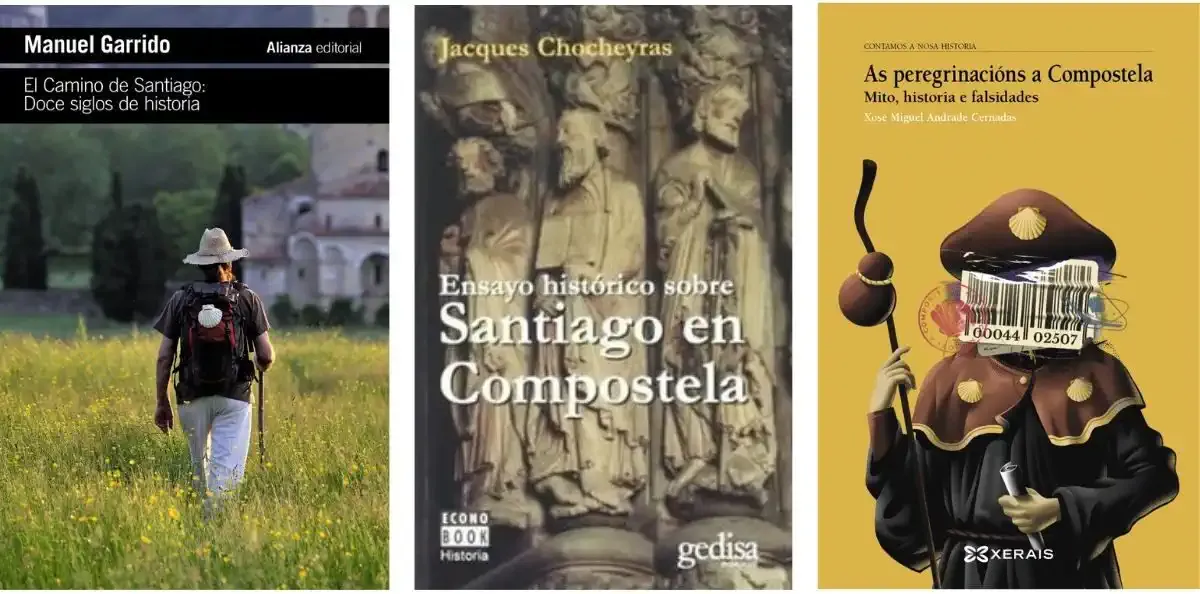
The historical essays on the Camino de Santiago investigate its lights and shadows
In summary
What can be stated with certainty today:
- Tradition holds that the apostle Santiago is buried in the cathedral of Compostela.
- There is a historical theory linking the remains to Priscillian, a 4th-century bishop.
- There is no conclusive evidence to confirm this alternative hypothesis.
- The value of the Camino de Santiago goes beyond this historical debate.
A question that remains open
Is the apostle Santiago buried in the cathedral? Tradition says yes. Could it be Priscillian? It is a hypothesis that has generated debate, but without definitive proof. Perhaps the most interesting aspect is not finding a closed answer, but accepting that Compostela is a place where history, legend, and question coexist.
In the end, when a pilgrim enters the cathedral, what matters is not just who is buried there. What matters is what has been experienced on the Camino, what one leaves behind, and what one carries with them. And perhaps that is why Santiago de Compostela remains special. Because it is not just a destination: it is a place that each pilgrim interprets in their own way.