


The Camino de Santiago from Ourense, the final stretch of the Vía de la Plata through southern Galicia. 109 kilometres through Cea, Lalín and Bandeira to the Obradoiro, among Ribeiro vineyards, monasteries and the gentle hills of inland Galicia.
You walk; we provide the logistics: accommodation, your pilgrim's credential, full documentation and travel insurance, from 490 €. On the Vía de la Plata the stages are long and villages are scarce: you can add the daily luggage transfer and walk light.
The itinerary of the Vía de la Plata to Santiago from Ourense is organised by Viajes Camino de Santiago®.
Services
Included in all our routes
- Accommodation
7 days / 6 nights
- 7 days / 6 nights accommodation
- Complete documentation (Dossier and material for the Camino)
- On-the-road emergency telephone assistance
- Pilgrim's Credential
- Travel insurance
Optional
- Extra night
- Luggage transfer during the stages. (1 piece per person max 15 kgs)
- Supplement for single room
- Breakfast
- MP (Breakfast and dinner)
- Cancellation Insurance
Accommodations
- Most popular
Private comfort (Guesthouses, rural houses and small hotels)
490 €
The perfect balance between charm and comfort. Guesthouses, B&Bs and country houses await you in the villages along the Camino with private rooms, private bathrooms, TV, and daily cleaning service. Simple and welcoming, they are the ideal place to truly rest and enjoy the peaceful rural essence that only the Camino can offer.
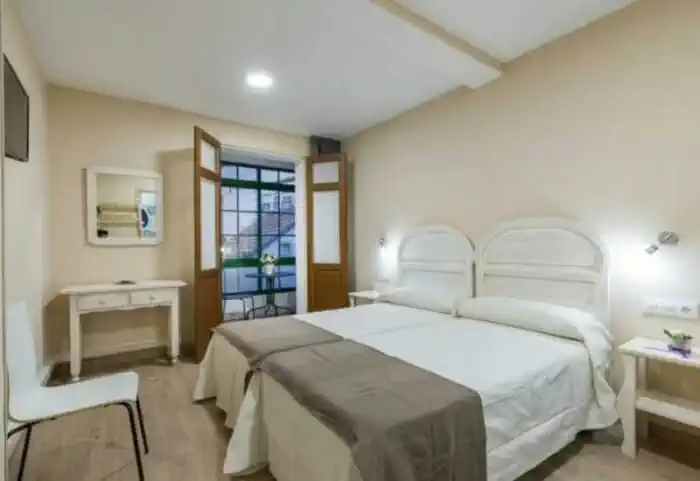
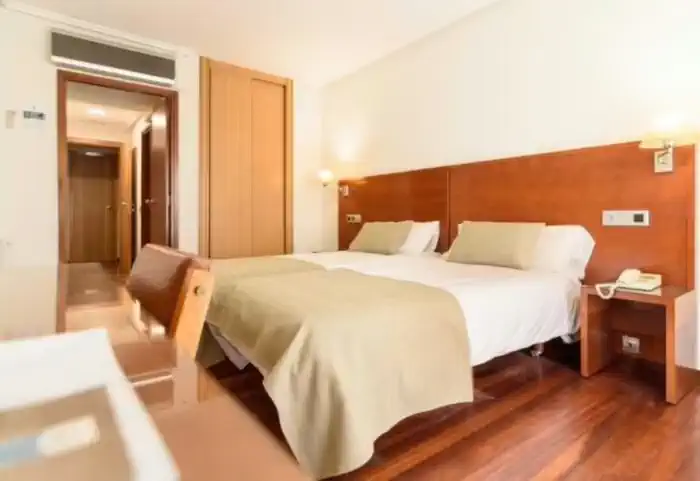
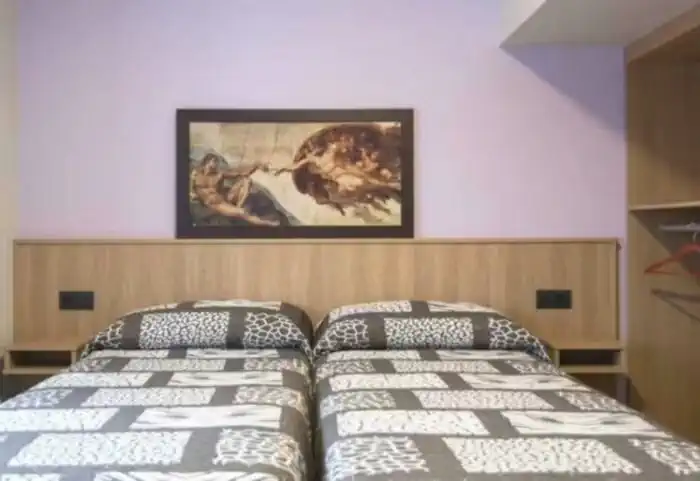
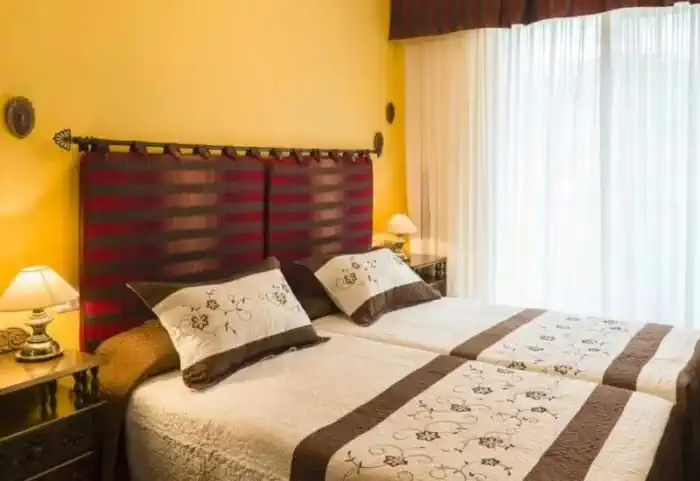
Photos


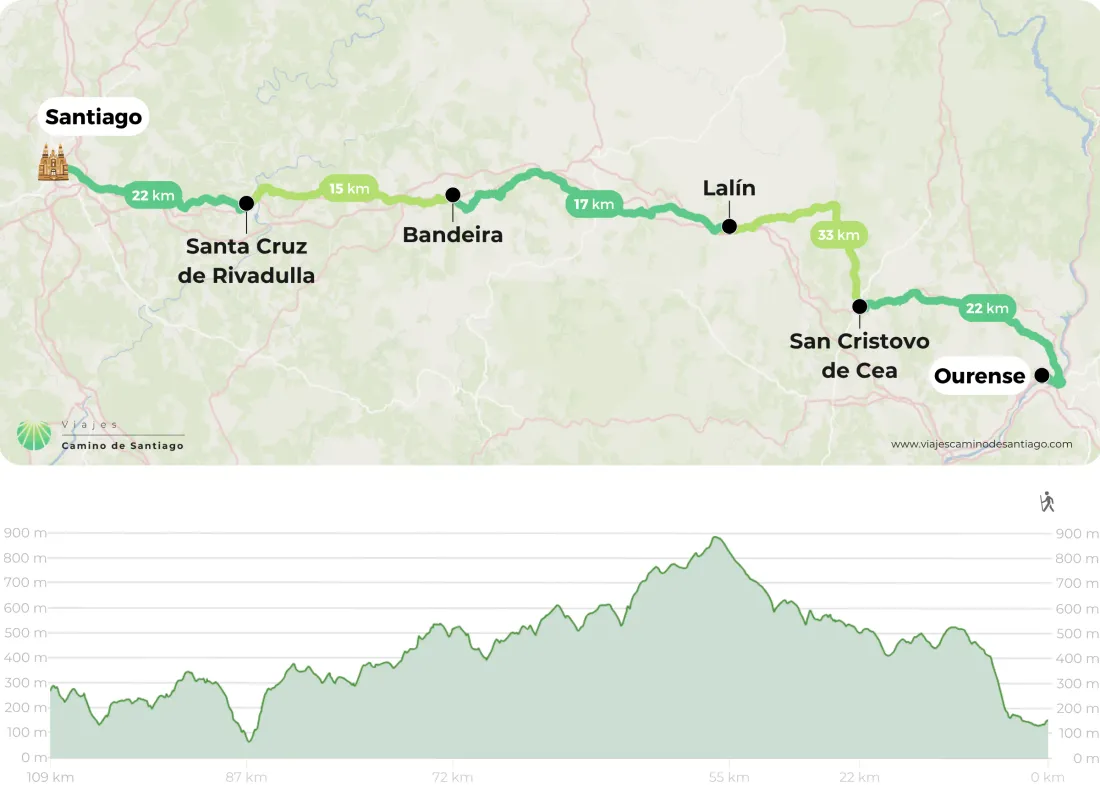
Map of the Camino Sanabrés from Ourense (Vía de la Plata)
Stages
- day 1
Arrival at Ourense
- day 2
Stage 1. Ourense - Cea (22 km)
You set off from Ourense, leaving the Miño valley behind to climb into the Galician interior. Through oak woods, vineyards and small hamlets, the day's walk brings you to Cea, home of the famous Pan de Cea, the first bread in Spain to earn Protected Geographical Indication status. Very close by stands the monumental Oseira monastery. A good place to rest before the queen stage.
- day 3
Stage 2. Cea - Lalín (32.8 km)
The longest and most demanding stage of the route, but also one of the most beautiful. It's well worth taking the variant that passes by the Oseira monastery, the "Galician Escorial," even if it adds a few kilometres — its grandeur is stunning. From there, natural paths through parishes and hamlets lead you to Lalín. And here's an order: don't leave without trying its cocido, considered one of the best in Galicia.
- day 4
Stage 3. Lalín - Bandeira (17 km)
You leave Lalín along the pleasant riverside walk by the Pontiñas river and continue through a stretch rich in monuments: the medieval bridge of Taboada and the Romanesque church of Santiago de Taboada, where you can stamp your credencial. Past the Pazo de Trasfontao and Silleda, you cross the Toxa river to reach Bandeira. It's the perfect place to try the traditional Galician empanada, the star dish of the area.
- day 5
Stage 4. Bandeira - Santa Cruz de Rivadulla (15 km)
A short, peaceful stage through Galicia's green interior. From Bandeira, through woods, hamlets and gentle paths, you leave the Silleda countryside behind as you draw closer to the Ulla valley. The day ends in Santa Cruz de Rivadulla, famous for its Pazo de Ortigueira and its spectacular gardens of camellias and centuries-old oaks. Santiago is now just one step away: tomorrow, the finish line.
- day 6
Stage 5. Santa Cruz de Rivadulla - Santiago de Compostela (22 km)
Last day! Set off early to make the most of Santiago. The first kilometres run beneath leafy woodland to Lestedo, where you can detour to the legendary Pico Sacro, with sweeping views over the whole region. The Camino enters the city through the Sar neighbourhood, crosses its Roman bridge and climbs to the old town through the Arch of Mazarelos. Savour every last step until your triumphant arrival at Obradoiro Square. You're in Santiago!
- day 7
End of the trip
After your last night, you check out of your accommodation and your trip comes to an end.
Related Trips
 7 days / 6 nights
 7 days / 6 nights
 7 days / 6 nights
Frequently Asked Questions
-
I need to cancel my reservation.
You can cancel your trip free of charge up to 15 days before the start date, with no need to give any explanation.
- 15 days or more in advance → refund of 100 % of the amount paid, with no penalty. The refund is processed within a maximum of 7 days.
- Less than 15 days → Between 15 and 8 days before: 50 % of the total amount. 7 days or less → 100 % of the total amount.
- No-show → no right to a refund.
If you have taken out the Cancellation Insurance, you must inform us regardless of how many days' notice you give, but you have to handle the refund process with the insurer yourself.
Transfer of the booking: if you cannot travel, you can transfer it to another person at no cost; we only need you to let us know far enough in advance for us to arrange it. In that case, payments are settled directly between clients.
The client is responsible for any additional cost arising from the cancellation.
⚠️ IMPORTANT: every cancellation must be notified by email: info@viajescaminodesantiago.com (cancellations are not processed by phone).
👉 More info: Booking conditions.
-
What is luggage transport and how does it work?
Luggage transport is included in group trips, trips with a dog and VIP trips; on all other trips it is an optional service you can add when booking. With it you can enjoy the Camino de Santiago without the burden of carrying your luggage on your back, knowing that your suitcase will be waiting for you at your next accommodation upon your arrival. Along with your credential, you'll also receive stickers. Cover these stickers with the requested information and stick them in a visible place on your suitcase. Upon arrival at your accommodation, we suggest asking at the reception where you can leave your luggage. You'll need to leave your luggage at the designated spot early in the morning for our carrier to pick it up. This ensures that when you arrive at your next accommodation, your luggage will already be waiting for you. -
How do you get to Ourense to start the Camino?
Ourense has a high-speed rail station (AVE) on the Madrid–Ourense–Santiago–A Coruña line, plus bus connections from Santiago and other Galician cities.
-
Why start the Vía de la Plata from Ourense?
Because it is the final stretch of the complete Vía de la Plata (Seville–Santiago, about 1,000 km), allowing you to walk its last 109 km and reach Santiago without needing weeks on the road.
-
Does the Camino from Ourense qualify you for the Compostela?
Yes. The Vía de la Plata stretch from Ourense covers about 109 km to Santiago, above the minimum of 100 km on foot that the Pilgrim's Office requires to obtain the Compostela.
-
How many stages does the Camino from Ourense to Santiago have?
There are 5 stages and 109 km through Cea, Lalín, Bandeira and Santa Cruz de Rivadulla to the Obradoiro, across the gentle hills of inland Galicia.
-
Is the Vía de la Plata from Ourense the same as the Sanabrian Way?
On this section, yes: from Ourense you walk the final part of the Sanabrian Way, which is how the Vía de la Plata reaches Galicia. It's the last 109 km to Santiago, via Cea, Lalín, Bandeira and Santa Cruz de Rivadulla. That's why you'll see it advertised under both names. It's a quiet, little-travelled and surprising Camino.
-
What should I see in Ourense before starting the Camino?
You arrive the day before, so make the most of it. Visit the cathedral and its Portico of Paradise, a tribute to the Portico of Glory in Santiago, the convent of San Francisco and the lively historic centre. And do what many pilgrims do in Ourense: relax your legs in one of its thermal pools by the Miño before setting off.
-
Is the detour to Oseira monastery worth it?
Yes, it's our recommendation. On the Cea to Lalín stage, the longest of the trip at 32.8 km, you can take the variant past the monastery of Santa María de Oseira, the «Galician Escorial». It adds a few kilometres to an already long day, but its grandeur makes up for it. Set off early with a sandwich made with Cea bread.
-
What should I eat on the Vía de la Plata from Ourense?
Each stage has its own dish. In Cea, its bread, the first in Spain with Protected Geographical Indication. In Lalín, its cocido (hearty stew), considered one of the best in Galicia: don't leave without trying it. In Bandeira, Galician empanada, the area's star dish.
-
What is the Pazo de Santa Cruz de Rivadulla?
It's the pazo (Galician manor house) that makes the end of the fourth stage famous, a short and easy one (15 km from Bandeira). It's also known as the Pazo de Ortigueira and is renowned for its gardens of camellias and centuries-old oaks. Before you arrive you cross the old bridge over the river Ulla, passing from the province of Pontevedra into A Coruña.
-
Is it worth climbing the Pico Sacro on the last stage?
If you have time, yes. After a few kilometres of woodland from Santa Cruz de Rivadulla you reach Lestedo, where the detour to the Pico Sacro starts, with views over the whole area. Then the Camino enters Santiago through the Sar district, crosses its Roman bridge and climbs through the Mazarelos Arch to the Obradoiro. It's 22 km: set off early.
From Ourense (Vía de la Plata)
From 490 €

Reviews
MArta Sánchez
Javi Torres