


The Camino de Santiago at your own pace, with no physical demands: the same arrival in Santiago but in gentle, short days. 111 kilometres well spread out across inland Galicia —Sarria, Portomarín, Palas de Rei and Arzúa—, to savour each stretch calmly, ideal if it's your first time or you prefer to walk unhurried.
You enjoy the walk; we sort out the rest: accommodation every night, your pilgrim's credential, full documentation and travel insurance, from 443 €. With stages this gentle already, adding the daily luggage transfer turns them into a stroll.
The French Way in short days is an itinerary organised by Viajes Camino de Santiago®.
Services
Included in all our routes
- Accommodation
12 days / 11 nights
- Complete documentation (Dossier and material for the Camino)
- On-the-road emergency telephone assistance
- Pilgrim's Credential
- Travel insurance
Optional
- Luggage transfer during the stages. (1 piece per person max 15 kgs)
- Transfer from Santiago to Sarria
- Supplement for single room
- Extra night in Santiago de Compostela
- Breakfast
- MP (Breakfast and dinner)
- Transfer from airport to Sarria
- Cancellation Insurance
Accommodations
- Most popular
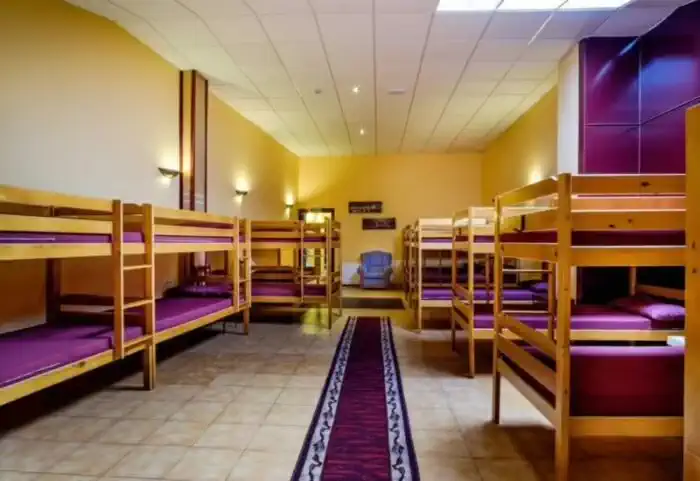
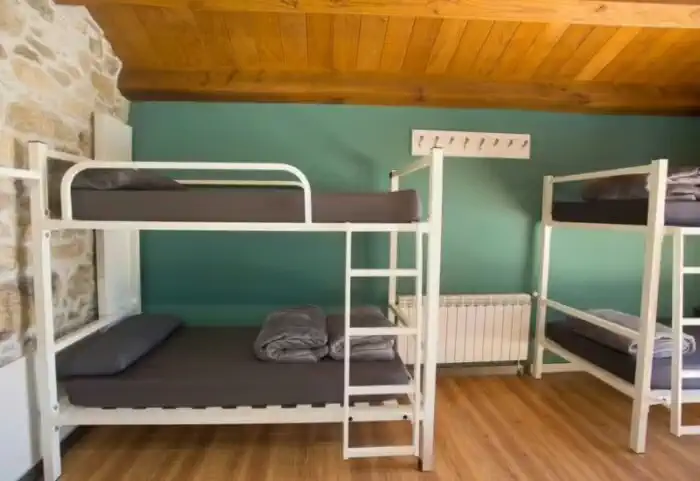
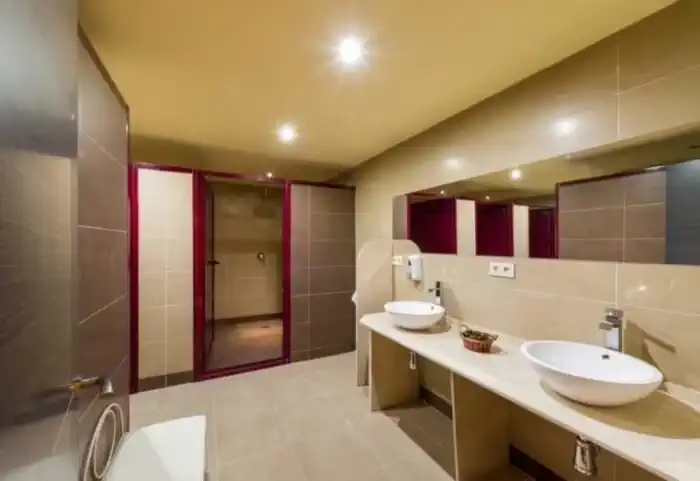
Basic accommodation (Private hostels)
443 €
The most authentic accommodation on the Camino. Hostels are the ideal option for those traveling on a tight budget, solo pilgrims, or anyone who wants to experience the Camino de Santiago in its purest form. They are the perfect place to socialize, share stages, and connect with fellow walkers along this ancient route.
- Most popular
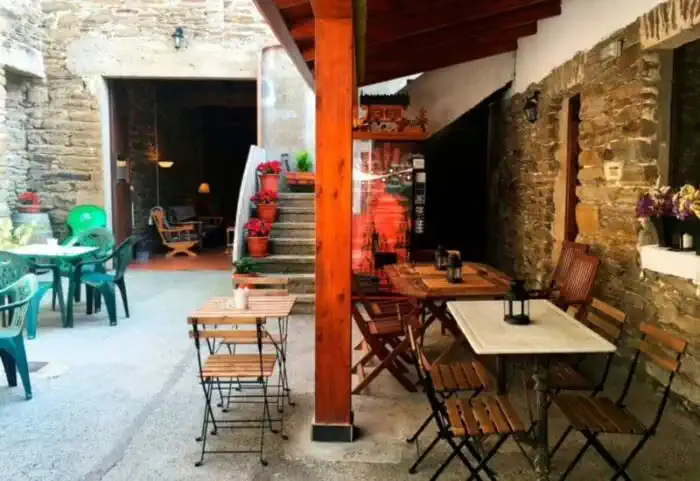
Private comfort (Guesthouses, rural houses and small hotels)
814 €
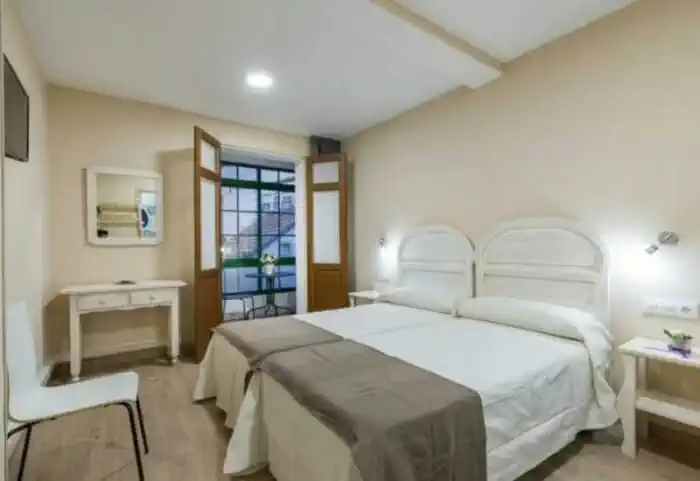
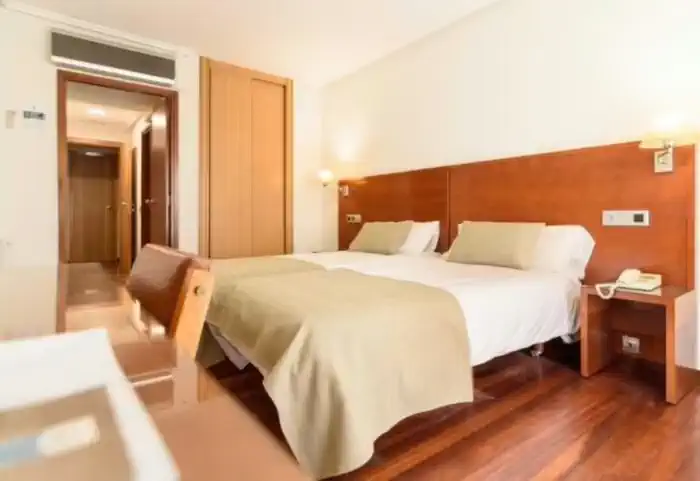
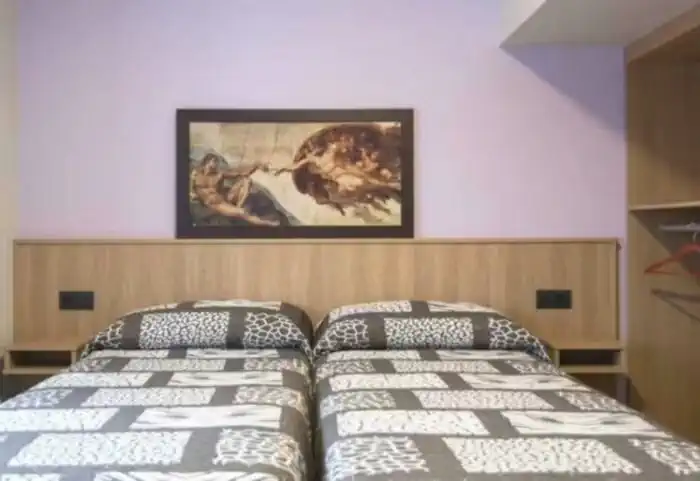
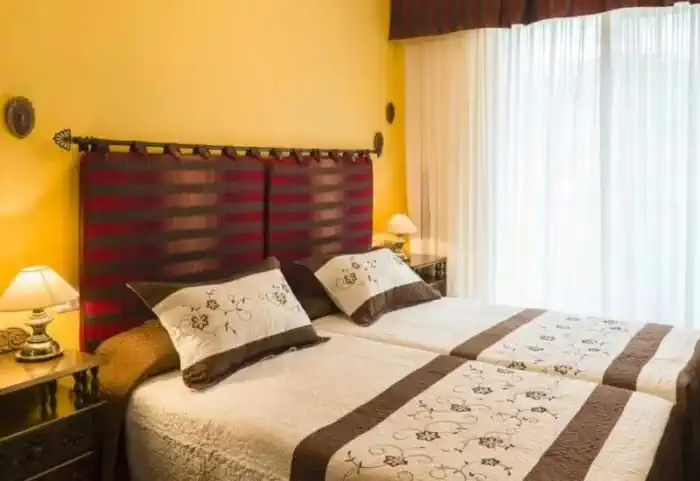
The perfect balance between charm and comfort. Guesthouses, B&Bs and country houses await you in the villages along the Camino with private rooms, private bathrooms, TV, and daily cleaning service. Simple and welcoming, they are the ideal place to truly rest and enjoy the peaceful rural essence that only the Camino can offer.
Photos


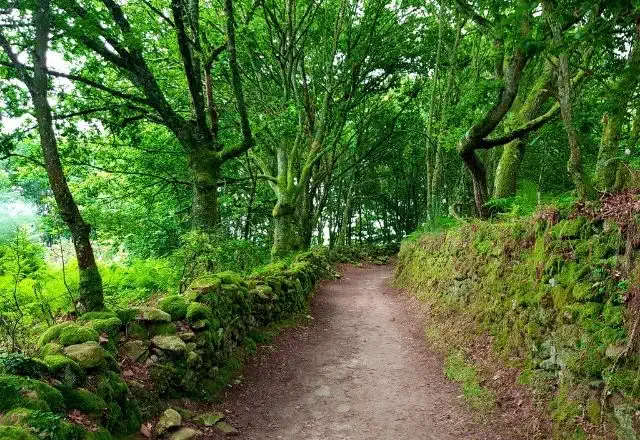
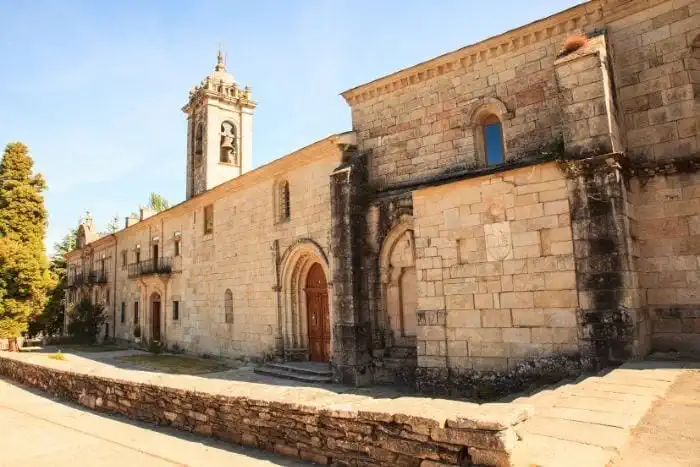
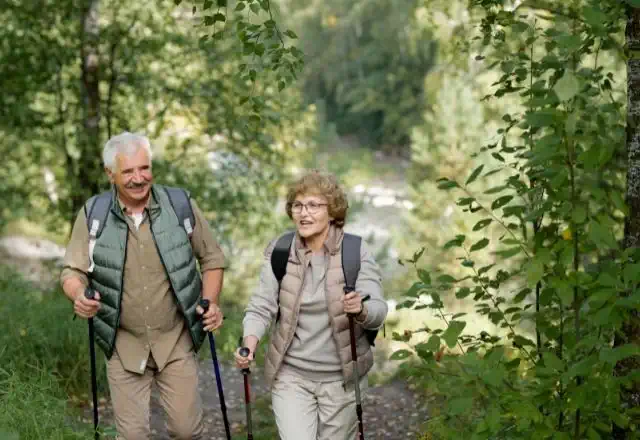
Map of the French Way in short stages
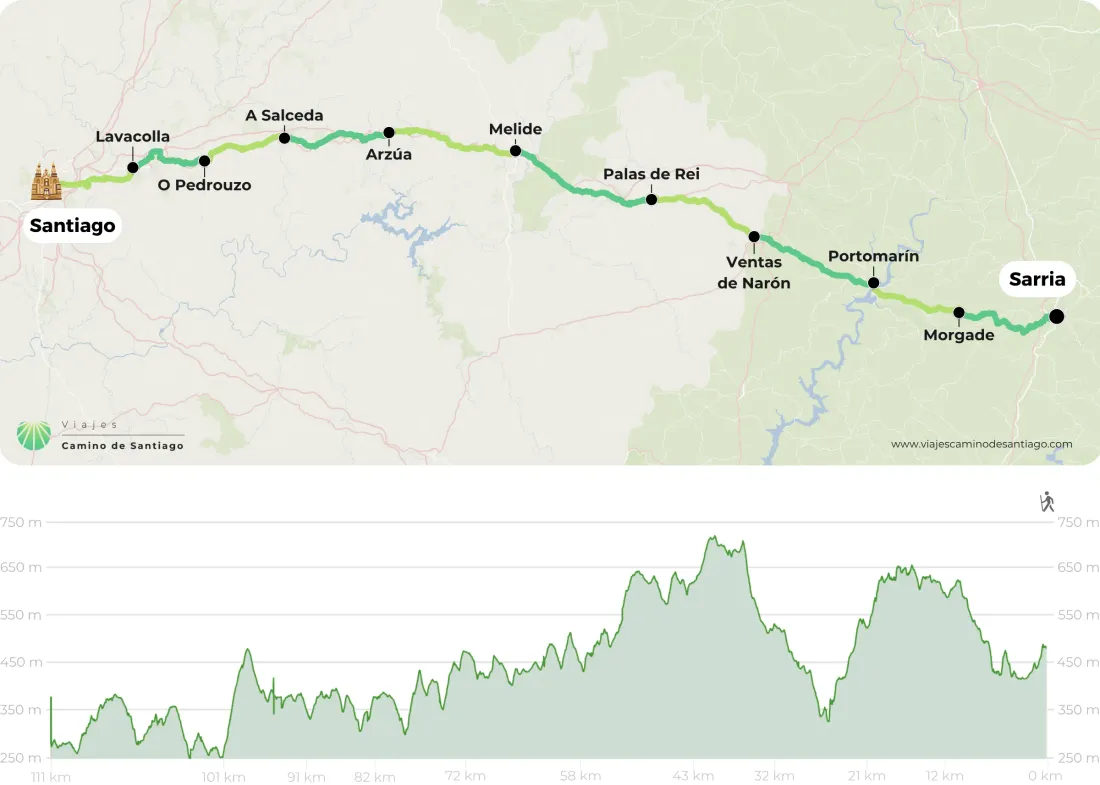
Stages
- day 1
Arrival at Sarria
- day 2
Stage 1. Sarria - Morgade (12 km)
The first stage from Sarria in short-stage mode, along paths and rural tracks full of life. Withdraw cash before setting off: there are no ATMs until Portomarín. You cross the Pequeno river over the medieval bridge of Áspera and reach the pretty Romanesque church of Barbadelo. The day ends in Morgade, beside the most photographed landmark of the Camino: the 100-kilometre marker to Santiago.
- day 3
Stage 2. Morgade - Portomarín (9 km)
A very short, very green stage. Shortly after setting off you reach Ferreiros, with its Romanesque church of Santa María, and continue through rural hamlets to Portomarín, which appears like an oasis of slate roofs and white houses. Its history is unique: the village was moved stone by stone to higher ground when the Belesar reservoir flooded the old site —still visible beneath the waters of the Miño.
- day 4
Stage 3. Portomarín - Ventas de Narón (11 km)
A short, simple stage, though with fewer villages than the previous ones: set off well stocked with water and food. On leaving Portomarín it's worth detouring to the prehistoric site of Castromaior, perfectly signposted. With some ups and downs to take at an easy pace, you finish in Ventas de Narón and its small chapel of A Madalena, with its door carved with the cross and the scallop shell.
- day 5
Stage 4. Ventas de Narón - Palas de Rei (11 km)
From Ventas de Narón you continue through a fully rural setting, among tiny hamlets, passing the Os Lameiros wayside cross (17th c.), Ligonde and Airexe with its Romanesque church. You can detour to the astonishing monastery of Vilar de Donas, the pantheon of the Knights of Santiago. Then just four kilometres separate you from Palas de Rei, a pilgrim town with all services.
- day 6
Stage 5. Palas de Rei - Melide (15 km)
A stage of gentle ups and downs and little difficulty. You start along a beautiful shaded corredoira and cross the Pambre river to Leboreiro, where its curious straw cabazo and Romanesque church will catch your eye. After crossing the Furelos river you enter Melide, capital of pulpo á feira: here good eating is a religion, so don't leave without trying it at a pulpería.
- day 7
Stage 6. Melide - Arzúa (14 km)
A short, pleasant stage, with some moderate ups and downs and, above all, extraordinary Atlantic woodland. On reaching Ribadiso de Abaixo, one of the prettiest corners of the Camino awaits: if the weather cooperates, take a dip in the river. You finish in Arzúa, with every service and a must-do stop: its Arzúa-Ulloa Denominación de Origen cheese. Don't leave without trying it!
- day 8
Stage 7. Arzúa - Salceda (10 km)
A gentle walk along forest tracks and paths between pastures, passing tiny hamlets of farming and livestock life. There's no shortage of bars and spots to rest your legs and cool off. On reaching Salceda, unwind at your lodging or head out to explore the surroundings. A short, pleasant day, ideal for taking it easy.
- day 9
Stage 8. Salceda - O Pedrouzo (9 km)
Just nine very manageable kilometres, with bars every so often. The highlight of the day is the chapel and the Fuente de Santa Irene, known as the Fountain of Eternal Youth: legend says that whoever washes with its water stays forever young, so… just in case. One last quiet stretch leaves you in O Pedrouzo, with all services.
- day 10
Stage 9. O Pedrouzo - Lavacolla (10 km)
The penultimate stage runs through pine and eucalyptus woods, very close to the Santiago airport. The rural setting gradually gives way to a more urban environment: Compostela is getting closer and closer. You reach Lavacolla, which according to the Codex Calixtinus was where pilgrims used to wash before entering Santiago. Go to bed early: tomorrow's an early start to make the most of the big day.
- day 11
Stage 10. Lavacolla - Santiago de Compostela (10 km)
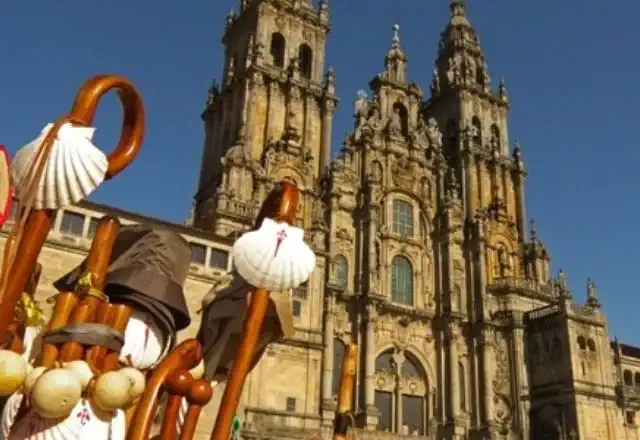
Your last day as a pilgrim! You climb up to San Marcos and reach one of the most exciting places on the Camino, Monte do Gozo, which owes its name to the joy of seeing the cathedral towers for the first time. Savour the final kilometres up to your triumphant arrival at Plaza del Obradoiro. You've completed your Camino and you're in Santiago!
- day 12
End of the trip
After your last night, you check out of your accommodation and your trip comes to an end.
Related Trips
 7 days / 6 nights
 8 days / 7 nights
 6 days / 5 nights
Frequently Asked Questions
-
How do I make a reservation?
To make a reservation, you can follow these steps:
- Through our website: Select the route you want and follow the steps indicated in the form. Provide your personal information and that of your companions, choose the type of accommodation, room distribution, meals, transfers, bike rental, etc.
- By email: If you prefer to make the reservation by email or need a personalized trip, you can send us an email to info@viajecaminodesantiago.com. We will provide you with the necessary information to complete the reservation via email.
It is important to note that if the routes or services available on the website do not meet your specific needs, you can request a personalized quote by sending an email to info@viajescaminodesantiago.com.
-
Can I change or cancel my booking before the start of the trip?
If you have any doubts about cancelling or modifying your reservation, we recommend you to visit our General Booking Conditions.
-
How can I get to Sarria?
Sarria is one of the most common starting points of the Camino de Santiago, and getting there is quite simple, although it will depend on your place of origin.
From Madrid:
- Direct train daily in the early afternoon (approx. 13:00–15:00).
- Bus with Alsa: first to Lugo and then a connection to Sarria.
- Own or shared car.
From other points in Spain or abroad:
- The most practical option is to fly to Santiago de Compostela. From there, you can take a direct bus to Sarria or arrange a private transfer with us to the start of your route.
At the end of your Camino, it is common to return by train or plane from Santiago de Compostela.
👉 More info: More info
-
What services are included in the Camino de Santiago on your own?
The Camino de Santiago at your own pace includes the following services:
- Accommodation for resting.
- An informative dossier with details about the stages.
- The Pilgrim Passport.
- A 24-hour assistance phone number available at all times.
- A travel insurance for your peace of mind.
Additionally, you have the option to customize your experience by adding extra services:
- You can add luggage transport so you do not have to carry it.
- You can choose whether to include breakfast or half board.
- We offer private transfers to take you to the start of the stage from Santiago de Compostela, from its airport, or any other point.
- We can take your vehicle from the starting point to the end of your Camino.
- You have the option to book extra nights at the beginning or end of your trip.
Unlike group trips, we do not include a guide or support vehicle between stages. However, we provide you with a 24-hour assistance phone number to resolve any issues or unforeseen events you may encounter on your journey.
-
Does making the Camino de Santiago from Sarria entitle you to the Compostela?
Yes, as long as you walk the whole route. From Sarria to Santiago it is just over 110 km, above the 100 km that the Pilgrim's Office requires to be walked (200 km by bicycle) to obtain the Compostela. That is why Sarria is the most popular starting point: it is the closest start that meets the requirement. -
What is the Camino Francés in short stages and who is it for?
It is the same Camino Francés from Sarria to Santiago, but split into short, gentle daily stages —10 stages for 111 km, 9 to 15 km a day— instead of the standard pace. Ideal if it's your first time, you prefer to walk without rushing, or you want a lower physical demand.
-
How many kilometres a day do you walk on the Camino Francés in short stages from Sarria?
Between 9 and 15 km a day. It is 111 km from Sarria to Santiago spread over 10 stages, about 11 km per day on average: the shortest are Morgade–Portomarín and Salceda–O Pedrouzo (9 km); the longest, Palas de Rei–Melide (15 km). With these distances you reach the end of each stage early and have the afternoon to rest, enjoy a leisurely meal or explore the village.
-
Are there cash machines on the first stage of the Camino from Sarria?
No. There are no cash machines between Sarria and Portomarín, so withdraw cash in Sarria before you start. On the Camino Francés in short stages the first stage ends in Morgade, so you will not pass a cash machine until the next day, in Portomarín. Along the way you cross the Pequeno river on the medieval Áspera bridge, see the Romanesque church of Barbadelo and finish next to the 100 km marker.
-
Why is Portomarín up on the hill, and what lies under the reservoir?
Because the village was moved stone by stone to higher ground when the Belesar reservoir on the Miño flooded the original site. On a day with good light, you can still make out the remains of old Portomarín on the riverbed. On the Camino Francés in short stages you arrive after only 9 km from Morgade, so you have plenty of time to stroll around, look for those remains and enjoy the local food.
-
Is the detour to Vilar de Donas worth it on the Camino Francés in short stages?
Yes, and in this format you have plenty of time. It is on the Ventas de Narón–Palas de Rei stage, only 11 km long: after the hamlet of Portos you turn off the Camino for about 2.5 km to reach the monastery of Vilar de Donas, one of the most striking churches in the area and the burial place of the Knights of Santiago. Allow almost 5 km extra there and back. Afterwards, only about four kilometres separate you from Palas de Rei.
-
Are there bars between Portomarín and Ventas de Narón?
Fewer than on the previous stages: there are few villages on this stretch of the Camino from Sarria, so leave Portomarín with water and some food. It is an easy 11 km, although with some climbs best taken calmly. The detour to the Castromaior archaeological site, which is well signposted, is worth it, and when you reach Ventas de Narón, have a look at the chapel of A Madalena, with its door carved with the cross and the pilgrim's scallop shell.
-
Why do you spend a night in Lavacolla before reaching Santiago?
Because on the Camino Francés in short stages the arrival is split into two 10 km days: O Pedrouzo–Lavacolla and Lavacolla–Santiago. Lavacolla, very close to the airport, appears in the Codex Calixtinus as the place where pilgrims washed before entering Santiago. Go to bed early: the next day you climb up to San Marcos and Monte do Gozo, where you see the cathedral towers for the first time, and you arrive with the whole day ahead of you.
French Way in short stages
From 443 €

Reviews
Jose Antonio
Salinas, Maria Elena
Manuel Alonso Tejeda
estmanuel
Almudena
eva ruiz
pere
Jose Navarro
Irati Olano Arrieta
Kerman Aranbarri Altuna