


Why the Camino de Santiago is one of the best summer camps for teenagers?
16 January, 2026
The Camino de Santiago is an ideal summer camp for teenagers: it combines physical challenge, community living, safety, and personal growth. It helps them disconnect from screens, gain autonomy, strengthen real bonds, and learn essential values outside the classroom.

Not all summers are the same, nor are adolescents. When the usual camps are no longer enough, the Camino de Santiago emerges as one of the best options among summer camps for teenagers. Halfway between a physical challenge and an inner journey, this itinerant camp offers more than just games and workshops: it provides an educational, safe, and profoundly human experience that supports young people during a crucial stage of their lives.
Many parents share a concern: how to offer their children a meaningful experience without screens or empty routines? If this is your case, and you are looking for different summer camps for teenagers, the Camino de Santiago addresses this concern with a proposal that combines enjoyment, learning, and personal development. It is, moreover, a distinct and original experience, an itinerant camp that offers the opportunity to walk through natural landscapes, disconnect from digital noise, and connect with oneself and with others.
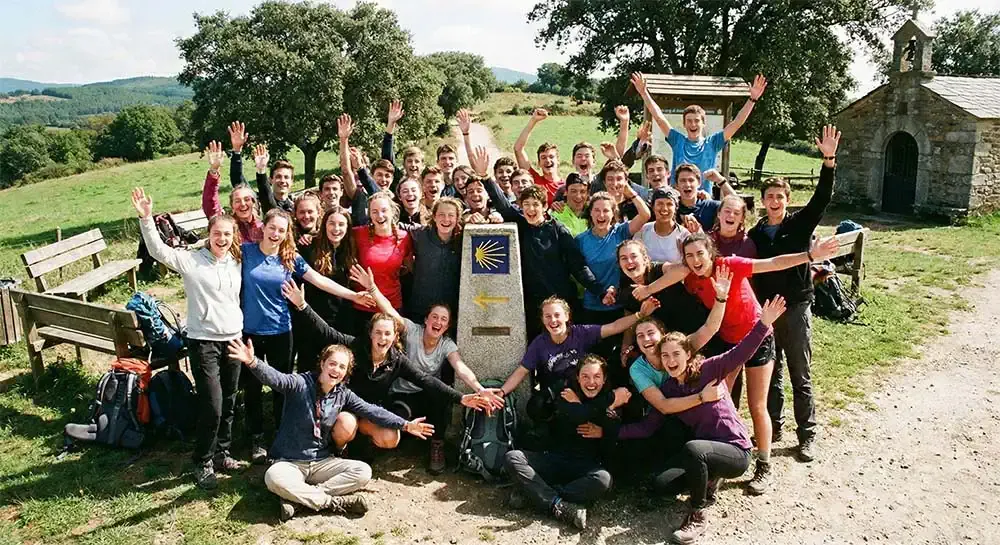
Walking stages of the Camino, living with other companions, and reaching a common goal is a practical way to learn values, develop autonomy, and strengthen real bonds. Throughout the journey, adolescents will face everyday challenges such as fatigue, group decision-making, collaboration, and the need for mutual assistance (waiting for a tired companion, encouraging them, providing support). These elements, far from being obstacles, become catalysts for growth and emotional learning.
Experiential education beyond the classroom
On the Camino de Santiago for teenagers, young people learn without the need for desks or exams. The natural environment and daily challenges invite them to take on responsibilities, care for their equipment, organize their belongings, and respect common spaces. This type of educational summer camp enhances essential skills such as empathy, autonomy, shared decision-making, and the ability to resolve conflicts constructively.
Although the logistics are perfectly planned and supervised, adolescents do face a form of personal uncertainty: the physical challenge of each stage, the sustained effort, and the need to surpass themselves. These experiences foster flexibility, self-confidence, and tolerance for frustration. Fundamental learnings that are rarely taught in the classroom, but are essential for adult life.
The power of living together day by day
There is no artificial coexistence: they walk together, eat together, and sleep in the same shelters. This shared routine generates authentic bonds among participants and promotes social skills that go beyond simple courtesy: active listening, peaceful conflict resolution, cooperation in common tasks, and a sense of belonging. Many adolescents return home with a new way of relating to their peers… and to adults.
These experiences also help reduce social anxiety, which is so common at this stage of life. By sharing spaces, difficulties, and achievements, relationships are created that do not depend on screens or filters, but on real and meaningful experiences.
Safety and structure: fundamental pillars
For the Camino to function as a true summer camp for adolescents, organization is key. Specialized programs have teams of monitors experienced in working with young people, stages adapted to the physical capabilities of the group, pre-selected accommodations, and a logistical plan that ensures safety without compromising freedom.
This careful planning allows adolescents to experience autonomy in a protected environment. Knowing that there are adults available, but who do not invade their space, gives them the necessary peace of mind to explore their own limits and discover their capabilities.
Disconnect to reconnect
In an era where teenagers' free time is easily filled with social media, series, and video games, the Camino de Santiago offers a radical pause. Walking in silence, observing the landscape, listening to others, and engaging in long conversations without digital interruptions establishes a more authentic and real connection with the present. This experience, although simple, has a profound impact on their emotional well-being and their capacity for introspection.
For many young people, this type of disconnection is revealing. They discover that they do not need to be permanently connected to feel accompanied, as they find in the group, in nature, and within themselves, vital resources that will accompany them beyond the summer.
Do you want to delve deeper into this experience?
If you are considering this option for your son or daughter, we have compiled detailed information that may help you. You can start by reading all our content about the Caminos de Santiago for young people and teenagers, where we address the most common questions from families and share real testimonials.
And if you want to know all the practical details, visit our page on summer camps for teenagers based on the Camino de Santiago, where we explain how this educational model works, why it is an alternative to traditional camps, and what makes it a purposeful experience: a real opportunity to grow through walking.