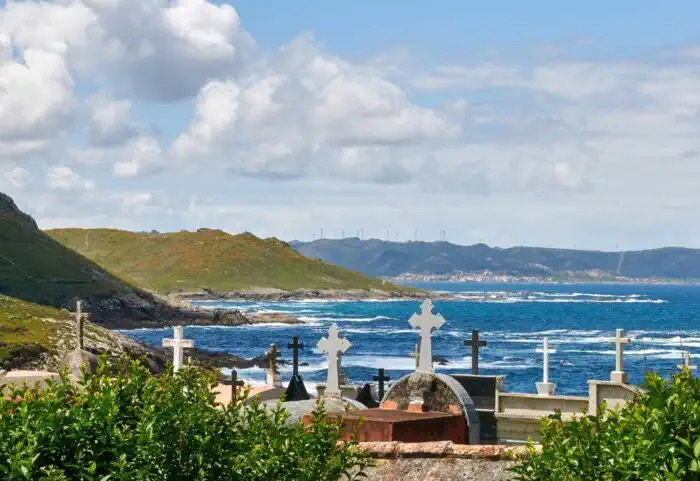
Way of the Lighthouses Malpica – Arou

Way of the Lighthouses Malpica – Arou - Paquete turístico

Camino de los Faros Malpica – Arou (4 stages) is a proposal designed to walk the stretch between Malpica de Bergantiños and Arou with a clear organization from the start. The journey takes place over 6 days and 5 nights and covers 92 km, making it particularly suitable for travelers seeking an intense hiking getaway, well-structured and with enough time to enjoy the route without worrying about the main logistics.

With prices starting from 550 €, this trip includes luggage transfer and travel insurance, two services that provide comfort and peace of mind during the route. Camino de los Faros Malpica – Arou (4 stages) fits very well for those who want to do the first stretch of this route on their own, at a good pace and with an organized base that facilitates the experience from start to finish.

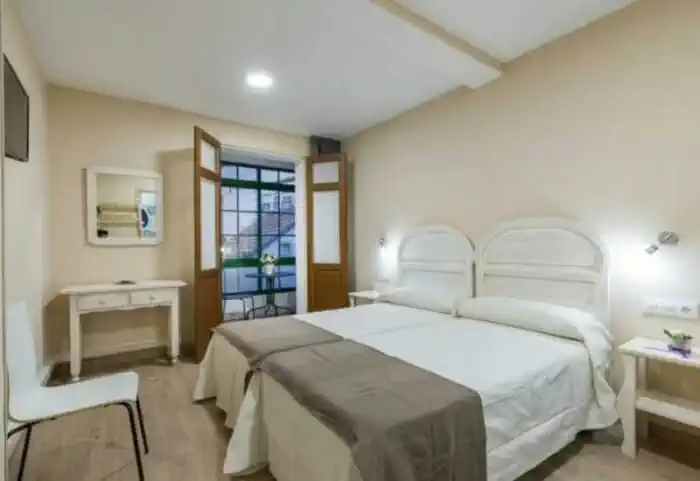
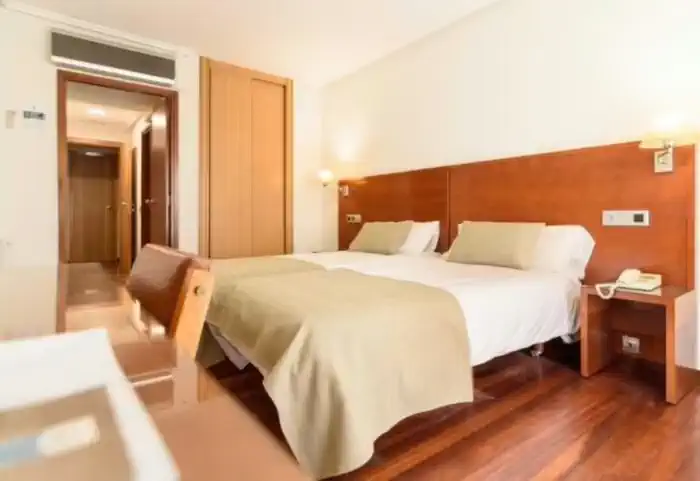
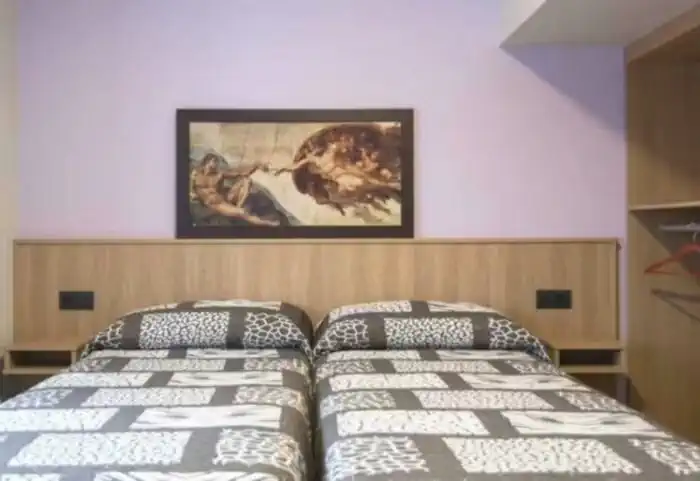
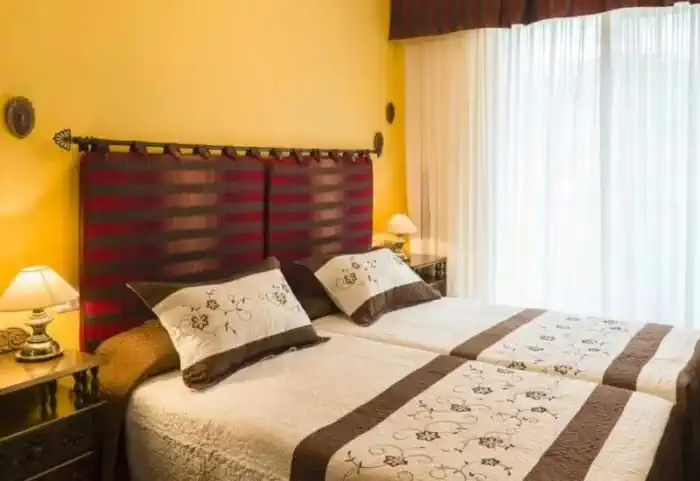
Photos

Accommodations

  • Hostels, guesthouses, and rural houses

Services

Included in all our routes

  • Accommodation

    6 days / 5 nights

  • 6 days / 5 nights accommodation

  • Complete documentation (Dossier and material for the Camino)

  • Luggage transfer during the stages. (1 piece per person max 15 kgs)

  • On-the-road emergency telephone assistance

  • Pilgrim's Credential

  • Travel insurance

Optional

  • Extra night
  • Breakfast
  • MP (Breakfast and dinner)
  • Cancellation Insurance

Map of the Way of the Lighthouses Malpica – Arou
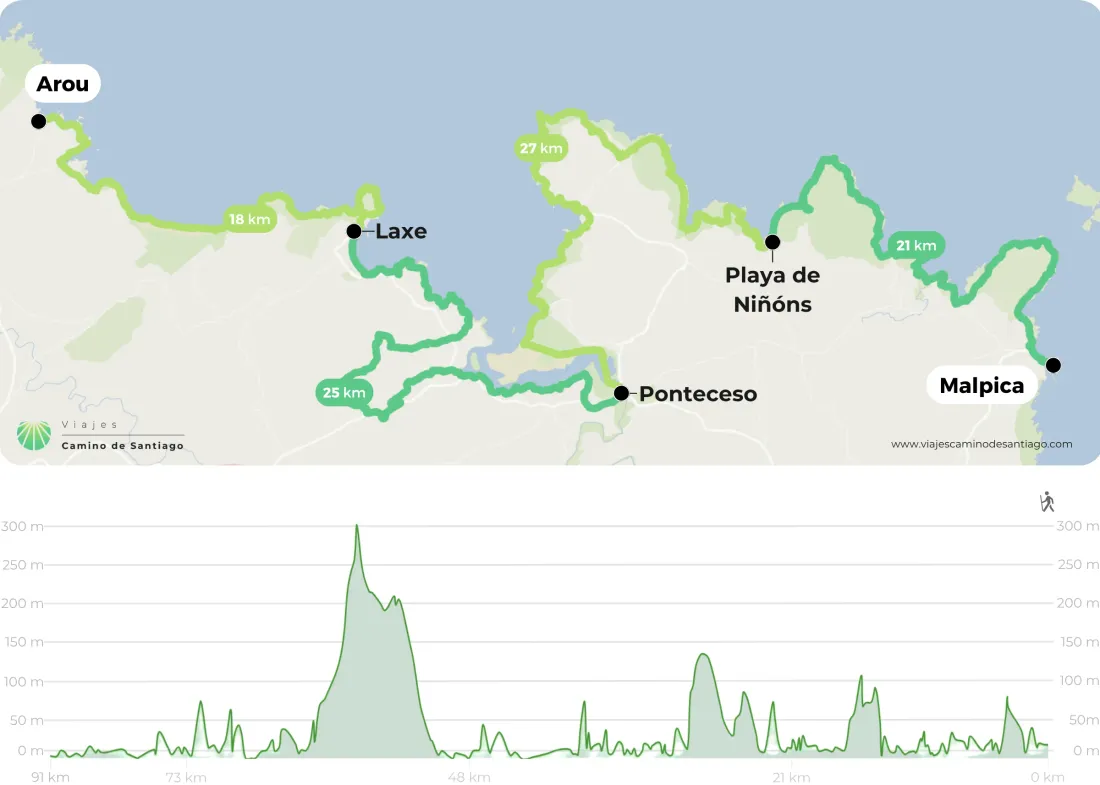
Mapa Camino Faros Malpica Arou Jpg MLSzN

Stages

  • day 1

    Arrival at Malpica de Bergantiños

  • day 2

    Stage 1. Malpica de Bergantiños - Playa de Niñóns (21.3 km)

    We begin this stage at the port of the fishing village of Malpica de Bergantiños, capital of the city council (in Galician, concello) of the same name and of the region of Bergantiños, on the way to Niñóns Beach. A town of great fishing tradition, its port is famous for whale fishing.

    From the harbour beacon we start our adventure. Leaving the Port we can find the first signs that will guide our steps, which will take us through the central streets of the city centre until we reach the Paseo Marítimo and the beaches of Area Maior and Canido. From there we can sense the path that will take us to the Hermitage of San Adrián passing by the Seaia Beach and the fountains of Navenllos and Los Romeros (be careful, the first one causes flu, the second one cures warts!).

    Passing the hermitage we arrive at the Cape of San Hadrian, from where we admire the fabulous Sisargas Islands, with the lighthouse of the Sisarga Grande Island. We continue along fishermen's paths, which we will find many along this Way, as well as along the first cliffs until we reach Beo Beach. We continue and Seiruga Beach awaits us which, as usual, will force us to take off our shoes and roll up our trousers to cross the small stream that flows into it: this is a lively and fun Way.

    We continue towards Barizo, with a new beach, and here begins the hardest part of this stage.

    A short climb takes us to a very short stretch of asphalt that leads to the Puerto de Barizo, and here we will (almost) climb, getting ready to reach the Mount Punta Nariga and the Punta Nariga Lighthouse, the most modern of the route (1998) and designed by the renowned architect César Portela with a lot of work on the "Costa da Morte". Be sure to observe the environment, the rocks have very particular shapes and you can also find petroglyphs, those marks and incisions in the rock work of ancient inhabitants of the area.

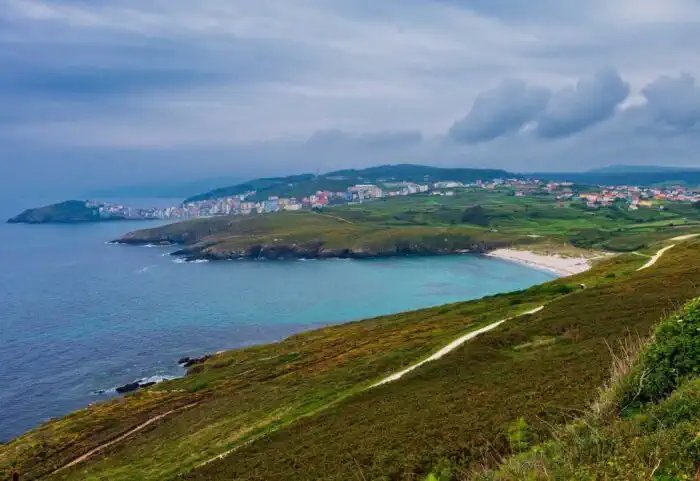
    We continue a little further to reach the end of the stage, Niñóns Beach, but before we get there there are a series of streams of very fresh water that fall into the sea. Once on the beach, once the stage is over, you have to take into account that this is a place that hardly has mobile coverage.

    To be taken into account.

    The Way of the Lighthouses is much more than you can imagine with the first kilometres you will find in this stage, and when you finish it you will realise what this fantastic route is all about. You will find some fountains with drinking water as well as streams. From Malpica, mobile coverage is sometimes conspicuous by its absence, in this case even at the end of the stage in Playa de Niñóns. There are some bar and restaurant services along the way, but they are usually closed in low season.

    Places of interest.

    • Viewpoint "Atalaia" of Malpica (near the route).
    • Casa del Pescador de Malpica (on the route).
    • Hermitage of San Adrián (on the route).
    • Pazo and towers of Mens (outside the route, privately owned, not open to visitors).
    • Petroglyphs of Punta Nariga (on the route).
    • Beaches and lighthouses (on the route).

    Gastronomy.

    • Fish.
    • Seafood.
    • Galician broth.
    • Tripe.
    • Lamb.
  • day 3

    Stage 2. Playa de Niñóns - Ponteceso (27.1 km)

    We leave the beautiful beach of Niñóns through a forest that takes us to the small beach of O Morro, which leads us to Ponteceso. Small coves and beaches such as Niño do Corvo and Santamariña make us advance to a point where we will momentarily leave the coast, as it is a dangerous area of cliffs. We quickly return to the coast and we find the beach of A Barda.

    Now comes the complicated part of the stage. The Costa Tremosa offers us a demanding path that will take us to the rustic and picturesque village of Roncudo, with its traditional popular architecture perfectly adapted to the difficult climate of the area. Dotted with wind energy blades, this high area will suddenly offer us a steep downhill slope towards cliffs rich in barnacles, where brave and brave "percebeiros" risk their lives to put these rich marine jewels on our tablecloth.

    We have arrived at the Roncudo lighthouse.

    From there an asphalted road joins the lighthouse with the village of Corme, where we can find several services. After the beaches of Arnela, Osmo and Ermida, we will arrive at Balarés Beach, at the foot of Monte Branco (don't worry, we won't climb this one), which, after surrounding it, offers us the marvellous beach of Barra Beach. A path and then the Paseo del Malecón will take us to Ponteceso, a small village with services and the end of our stage.

    To consider

    This is one of the longest and most complicated stages, so have a good breakfast before leaving Playa de Niñóns and take it easy, and we will start to find steep downhill slopes, so we recommend knee pads and walking sticks, to reach Ponteceso without incident. Fortunately, we will pass through the town centre of Corme shortly after the halfway point of the stage, so we will have access to several services.

    Places of interest.

    • Tower of Brántuas and Church of Nuestra Señora del Faro (off the route).
    • Pedra da Serpe (out of the route).
    • Museum of Contemporary Art Costa da Morte (on the route).
    • Eduardo Pondal Foundation (outside the route).
    • Beaches and lighthouses (on the route).

    Gastronomy.

    • Barnacles.
    • Sea urchins.
    • Sea and river fish (elvers and trout).
    • Shellfish (cockles).
    • Octopus.
    • Raxo.
    • Beans.
  • day 4

    Stage 3. Ponteceso - Laxe (25.3 km)

    We start the stage leaving the town centre of Ponteceso, from the house of the famous Galician bard Eduardo Pondal and we cross the bridge over the Anllóns River to walk 1 km along the AC-429 road towards Laxe. We quickly turn right and walk through the woods until we reach the shore opposite to the final route of the previous stage, with Barra Beach in front of us. We will find some fountains and the beach of A Urixeira.

    We arrive at the small urban centre of Cabana de Bergantiños, which is, however, the municipal seat. There we will pass by the beach of A Carballa, and we will have some services nearby (bar, restaurant, taxi). We continue through this area of ornithological importance, and we arrive at the Lodeiro Cove, where we will have a small supermarket.

    It is here that we will enter and temporarily leave the coast. We should not be disappointed, as a forest path with a stream and old mills awaits us: the Rego dos Muíños will not leave you indifferent. We continue with a respectable but beautiful ascent, and at its end we find the AC-430 road: to visit the Castro Borneiro we have to turn off 1 km round trip.

    We continue through the village of Vilaseco and arrive at the fabulous Dolmen of Dombate.

    It is worth a 15 minute stop and visit (free entrance). We continue on the plain and arrive at Fontefría, where we will find a public washing place and a fountain. We continue and get ready to climb to the top of Monte Castelo, where we will enjoy the reward for our effort: a wonderful view of the Ría de Corme and Laxe, where we can take a deep breath, rejoice in the scenery and encourage us to continue, because now it is time to descend, which we will do carefully.

    We arrive at the village of Cánduas and shortly after we return to the coast, where we will again have some considerable ascent. The beaches of Rebordelo and San Pedro await us, which, together with Punta do Cabalo, precede the beach and village of Laxe, where we will have all kinds of services and we will end our stage.

    To be taken into account.

    This is not a particularly difficult stage, although we must be aware that there will be some steep climbs and descents ahead of us. The incursion to the interior, leaving the coast, from Ponteceso, will not detract from the merit of this route, indeed, it will enrich it with beautiful fluvial and panoramic landscapes until reaching Laxe, as well as with a historical and ethnographic heritage of great value.

    Places of interest.

    • Castro Borneiro (on the route).
    • Dolmen of Dombate (on the route).
    • Monte Castelo viewpoint (on the route).
    • Laxe Sea Museum (on the route).
    • Beaches and lighthouses (on the route).

    Gastronomy.

    • Fish (haddock, horse mackerel, etc.).
    • Seafood.
    • Octopus.
  • day 5

    Stage 4. Laxe - Arou (18 km)

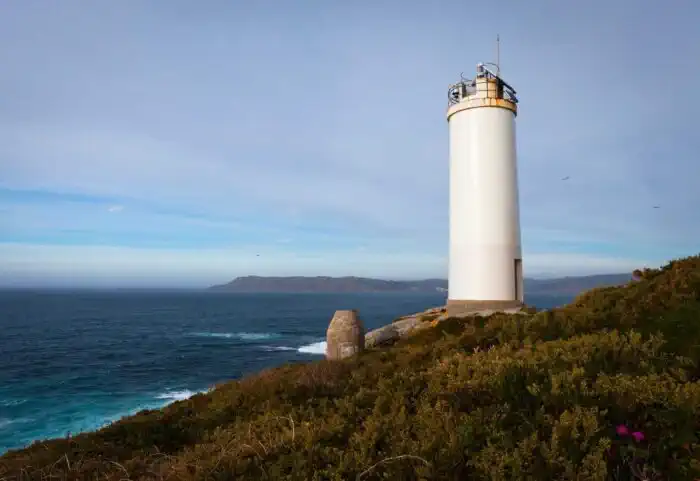
    We leave the Port of Laxe by the Church of Santa María de la Atalaia, in Gothic style, whose name reminds us of the Atalaia of Malpica and suggests a defensive function and surveillance of the city, and we head towards the town of Arou. In a few minutes we will be back along the coast and passing points, capes, "coídos" and "furnas". We arrive at the Lighthouse of Laxe, which is followed by the Stone of Lovers, a very common sight on the Galician coast.

    We continue walking and, if we are lucky to have low tide, we will find a treasure fruit of the bad action of Man, but that Nature took care of mending: Playa de los Cristales, a cove where the sea, with the passage of time, dragged the crystals of bottles of different colors that Man threw into a landfill in the area.

    Thus, the capricious Nature created a beach of perfectly polished crystals that, curiously, it is forbidden to pick up.

    We continue and, after a climb, we reach the Peñón de Soesto, with beautiful views and which precedes the Playa de Soesto. We keep going and we pass Arnado Beach and, shortly after, the majestic Traba Beach. Here we will find a drinking fountain and, at the end, with a short detour, we will find a bar.

    We keep going and arrive at the Coído (or pebble beach) of Sabadelle, just before the fishing village of Camelle, where we will find services and learn the story of an endearing foreign character who was "adopted" by the local population: Man "El Alemán de Camelle", with his little house as a sea hermit, and to whom the Town Council of Camariñas (to which Camelle belongs) honoured him with a museum.

    Sculpture of German Man in Camelle

    This man, In love with the Costa da Morte, he settled in the village, and thanks to the good reception and help from his neighbours, he lived between bathing in the ocean and artistic creations in the style of "Land Art". He died on the Feast of the Holy Innocents in 2002, shortly after the tragic natural disaster of the Prestige oil tanker on November 13, 2002, they say of grief. We continue a little more, and we arrive at Arou, our end of the stage.

    To be taken into account.

    When walking these trails we should never be in a hurry, and in this stage even less so, since from the port of Laxe to the town of Arou, we are presented with a simple, short, charming stage, full of surprises. Today we give you a break so that you can enjoy 200% of this Galician wonder, the Way of the Lighthouses; enjoy it, because there is still the second half, which will still be fascinating, but harder.

    Places of interest.

    • Church of Santa María de la Atalaya (on the route).
    • Playa de los Cristales (on the route).
    • House of Man (on the route).
    • Man Museum (on the route).
    • Beaches and lighthouses (on the route).

    Gastronomy.

    • Fish.
    • Seafood.
  • day 6

    End of the Camino

    After arriving... End of the Camino

Frequently Asked Questions

  • What is on-the-road telephone assistance?

    In your travel documents, you'll find an emergency telephone number where we're accessible while you're on the road. This ensures you'll journey with peace of mind, knowin our team members will assist you with any problems, incidents, or questions you encounter along your Camino de Santiago.

  • What is travel insurance?

    It is the guarantee that you can enjoy your Camino in a safe way. In our trips you already have an insurance included with your trip to be protected during the Camino de Santiago. We will send you the insurance policy along with all the documentation of your trip, so you will have everything you need to enjoy the Camino with peace of mind. Walk without worries!
  • What does the private transfer service consist of?

    We have a taxi service that you can hire whenever you need it. You can hire it, for example, to go from the airport to the start of your Camino, or to go from Santiago to your starting point to pick up your car once you finish the stage.   The price of the transfers will depend on the distance from your point of origin to the destination. If you have any questions about this service do not hesitate to contact us.
  • Where are the accommodations located?

    In your travel documents, you will find the names of the accommodations assigned to you, as well as their contact telephone number and location.   As a general rule, all accommodation are located in the centre of the different towns along the Pilgrims' Route to Santiago de Compostela, without the need to deviate too far from the route. But sometimes, due to lack of availability, it is possible that some accommodation may be a little far from the village or even in neighbouring towns.   For all the accommodations that are at a considerable distance from the route of the Camino, we will provide you with a free taxi service that you can use to get to your accommodation and return to the Camino the next morning.   In any case, these are exceptions that we will inform you at the time of booking.
  • What coverage does the travel insurance have?

    The basic travel insurance included in our packages offers extensive coverage against unforeseen events, ensuring you'll receive guaranteed medical assistance and numerous benefits. You can review the specifics in the General Conditions of Travel Insurance.

  • How do I make a reservation?

    To make a reservation, you can follow these steps:

  • Through our website: Select the route you want and follow the steps indicated in the form. Provide your personal information and that of your companions, choose the type of accommodation, room distribution, meals, transfers, bike rental, etc.
  • By email: If you prefer to make the reservation by email or need a personalized trip, you can send us an email to info@viajecaminodesantiago.com. We will provide you with the necessary information to complete the reservation via email.
  • It is important to note that if the routes or services available on the website do not meet your specific needs, you can request a personalized quote by sending an email to info@viajescaminodesantiago.com.

  • Can I choose the dates I want?

    Yes, you will have total freedom to choose your departure date. However, if you want to do your Camino de Santiago in the months of December, January and February, we recommend that you check availability before making your reservation. At this time of year most accommodation is closed and many services may not be available.
  • What does Camino de Santiago on your own mean?

    In this modality you will do the Camino de Santiago at your own pace and you will only have to worry about choosing the route you like the most, the type of accommodation and your departure date. If you choose this option you will travel alone or with the people that appear in your reservation, and you will have all the services included so that you only have to worry about walking and enjoying the experience.
  • What is luggage transport and how does it work?

    Luggage transport service by default is included in all our trips and it is not necessary to request it. You can enjoy the Camino de Santiago without the burden of carrying your luggage on your back, knowing that your suitcase will be waiting for you at your next accommodation upon your arrival.   Along with your credential, you'll also receive stickers. Cover these stickers with the requested information and stick them in a visible place on your suitcase.   Upon arrival at your accommodation, we suggest asking at the reception where you can leave your luggage. You'll need to leave your luggage at the designated spot early in the morning for our carrier to pick it up. This ensures that when you arrive at your next accommodation, your luggage will already be waiting for you.
  • What services are included in the Camino de Santiago on your own?

    The Camino de Santiago at your own pace includes the following services:

    • Accommodation for resting.
    • Luggage transport so you do not have to carry it.
    • An informative dossier with details about the stages.
    • The Pilgrim Passport.
    • A 24-hour assistance phone number available at all times.
    • A travel insurance for your peace of mind.

    Additionally, you have the option to customize your experience by adding extra services:

    • You can choose whether to include breakfast or half board.
    • We offer private transfers to take you to the start of the stage from Santiago de Compostela, from its airport, or any other point.
    • We can take your vehicle from the starting point to the end of your Camino.
    • You have the option to book extra nights at the beginning or end of your trip.

    Unlike group trips, we do not include a guide or support vehicle between stages. However, we provide you with a 24-hour assistance phone number to resolve any issues or unforeseen events you may encounter on your journey.

Way of the Lighthouses Malpica – Arou

Reviews from our users
contact
contact
Request a quote
Organised Trips
Rafael Sánchez López - Kaufmännischer Leiter - Agentur Viajes Camino de Santiago